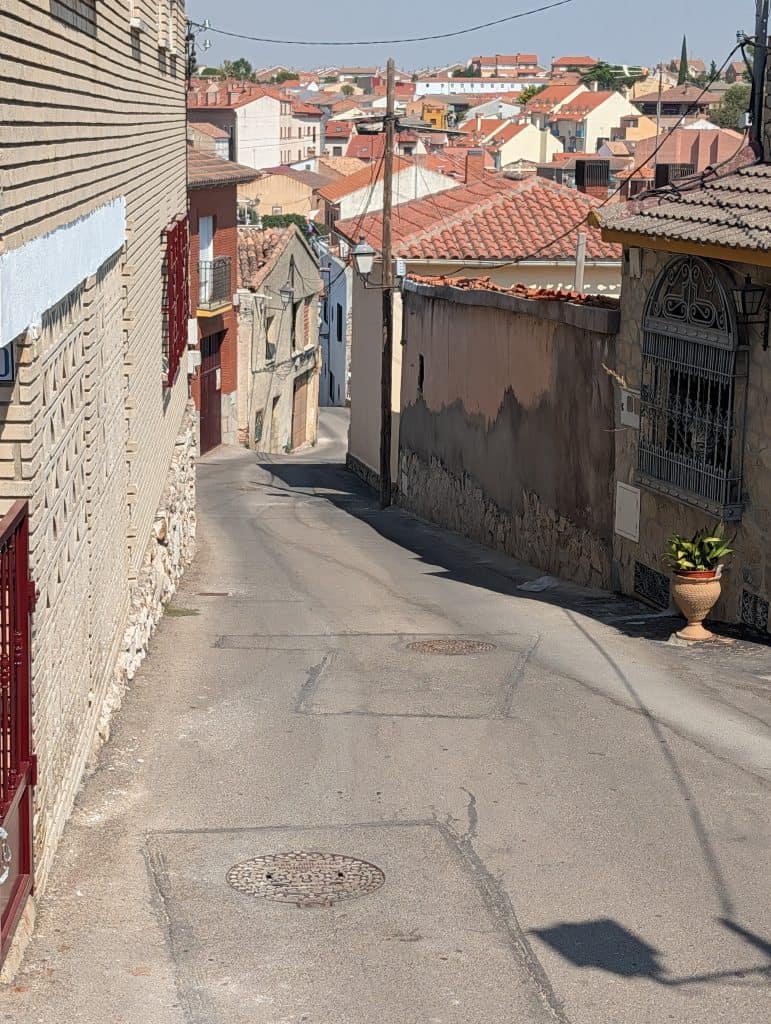
Every shutter on the street was down by early afternoon, and there was nothing curated about it, no picturesque hush staged for whoever might be passing through. Doors locked, blinds drawn, not a café chair set out anywhere, the whole place gone still under a heat with real weight to it, bearing down until you gave up and went inside. Nothing about that street gave any hint that in a few hours this same village would host one of the more anticipated astronomical events Spain has seen in over a century.
This is Los Santos de la Humosa, a hilltop village of a little over 2,500 people east of Alcalá de Henares.
A Wait of a Hundred and Twenty-One Years
The last time anyone standing on the Iberian Peninsula watched the sun go fully dark was August 30, 1905. Not a partial eclipse, not a near-miss with cloud cover: a true total eclipse, sun gone, stars out at midday, the whole event. That eclipse swept west to east across the northern half of the country, through Burgos, Palencia, and Soria, into Aragón and Catalonia, out over the Balearic Islands, totality lasting close to four minutes in places. It drew astronomers from across Europe, left behind detailed observations of the sun’s corona, and inspired a painting, Eclipse, by the Málaga-born artist Enrique Simonet, still the image most Spaniards picture when they think of what it looked like.
A second eclipse crossed Spain on April 17, 1912. Some official sources, including the country’s own Instituto Geográfico Nacional, treat that one as the more recent marker for the last time totality touched the Iberian Peninsula, putting the gap at 114 years rather than 121. It was technically a hybrid eclipse, though, total for only a few seconds along an extremely narrow strip of the country, nothing like 1905’s full, nearly four-minute totality. Either number is defensible. I’m using 1905, and 121 years, since it’s the fairer comparison to what actually happened today.
Nobody alive today was there for either one. On August 12, 2026, the wait ended. The path itself began the day over remote Siberia, crossed eastern Greenland and the western edge of Iceland, and only reached mainland Europe once it touched Spain, the first time that had happened since 1999. From there the path of totality cut across the northern half of the country in a band roughly 290 kilometers wide, sweeping from Galicia in the west through Castile, La Rioja, the Community of Madrid, Aragón, and Catalonia before it reached the Balearic Islands and slid out over the Mediterranean.
Madrid, the country’s capital and its biggest city, sat just outside the northern edge of the band, missing true totality by the narrowest of margins. What it got instead was a 99-percent-plus partial eclipse, dramatic in its own right, though anyone in the capital hoping for totality itself needed to leave the city to find it. Alcalá de Henares, where this whole day started, did better: it actually sat inside the path, one of eleven municipalities in the region running an organized viewing program of its own. Staying home would have gotten us totality. What it wouldn’t have gotten us was the elevation, or the clear run of horizon to the west that this particular hillside was built for.
A hundred and twenty-one years is a long time to wait for something, long enough that nobody who saw the last one is around to compare notes. Having now stood in a dirt lot at the edge of a village most of Spain has never heard of and watched it happen, I understand that number differently than I did reading about it beforehand. It’s one thing to know a fact. It’s another to have felt the ground go dark under it.
A Hill Village for This Exact Moment
Los Santos de la Humosa is not a place most travelers to Madrid have on a list. It sits in a stretch of countryside called the Alcarria de Alcalá, a natural sub-region wedged between the Henares and Tajuña rivers. It has one striking, verifiable distinction: at just over 900 meters above sea level, it’s the highest municipality in the Corredor del Henares, the string of towns strung along the Henares valley between Madrid and Guadalajara.
That elevation, and the open horizon it buys, is the whole reason to be here for an eclipse that happens right at sunset. The place feels almost purpose-built for exactly this event, and the village isn’t shy about saying so itself. Its own town hall states it plainly on the municipal website: this isn’t the wider, more forgiving zone of partial visibility most of the region gets. Los Santos de la Humosa sits inside the actual path of totality, and its height and open sightline west give it a real edge for catching a sun that’s already dropping toward the horizon by the time the show starts.
On August 12, the partial phase crept in around 7:30 that evening, the moon starting its slow crawl across the sun. Totality didn’t land until 8:32, a full hour later. And by 9:17, less than an hour after that, the sun set on its own, with or without the moon’s help. A town built on a rise, with nothing blocking the view west, was exactly what that kind of eclipse rewarded.
Getting There Without a Car
We took the bus. Los Santos de la Humosa has exactly one public transport connection to the outside world: Línea 275, run by Castromil under a concession from the region’s own transport authority, and it’s a strange little route. It only runs in one direction, a full loop out of Alcalá de Henares through Anchuelo, Santorcaz, and Pozo de Guadalajara before it reaches Los Santos de la Humosa and circles back. There’s no reverse service. If you miss the bus going one way, you don’t catch a different one coming back the other way; you wait for the loop to come around again.
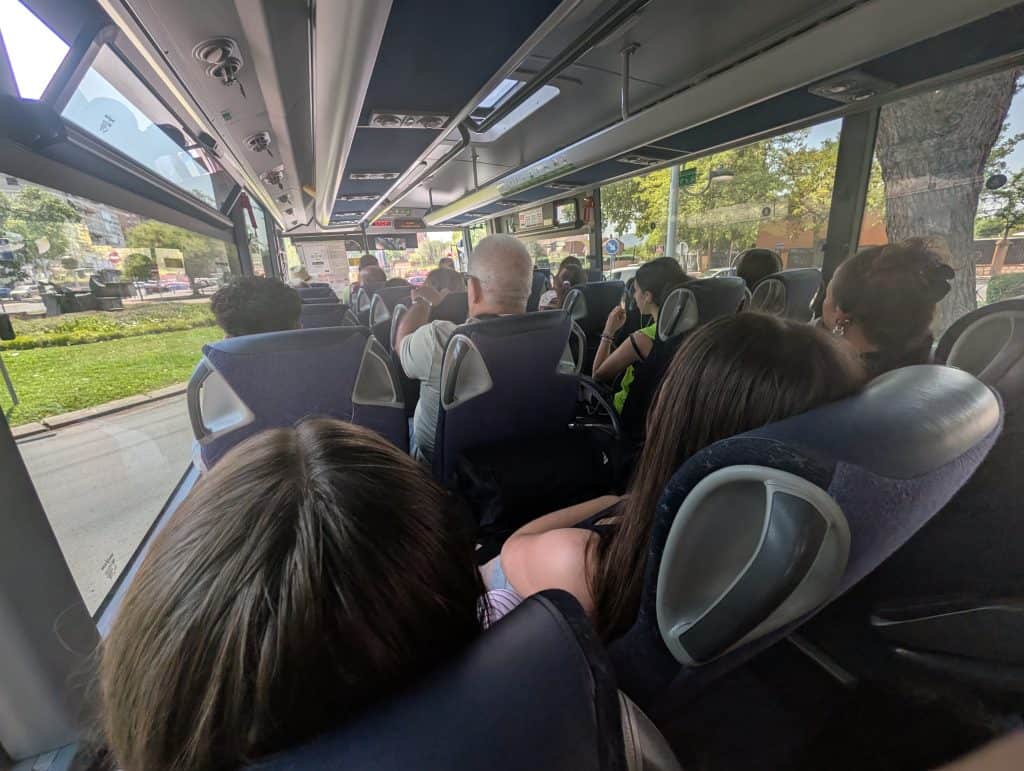
The bus that pulled up was already crowded, no seats left. We stood the whole way to Anchuelo. It wasn’t the young families I’d expected, no toddlers with cardboard glasses, no fathers with tripods slung over a shoulder. Mostly retirees and people in their thirties and forties, quiet. Several women worked fans against the heat with a motion that looked inherited rather than learned. Nobody seemed to be expecting what the evening held. If it weren’t for the date, nothing about the bus itself would have given away that anything unusual was about to happen. Spanish carried the whole ride, no English in it anywhere. The countryside rolled by in low hills dotted with short trees, farmland stretching out between them, all of it shimmering faintly in the heat. Inside, the air conditioning was fighting a losing battle against the crowd and the heat outside. A seat opened up near Anchuelo, and we took it without much thought, the kind of small relief that only registers as one once you’re sitting down.
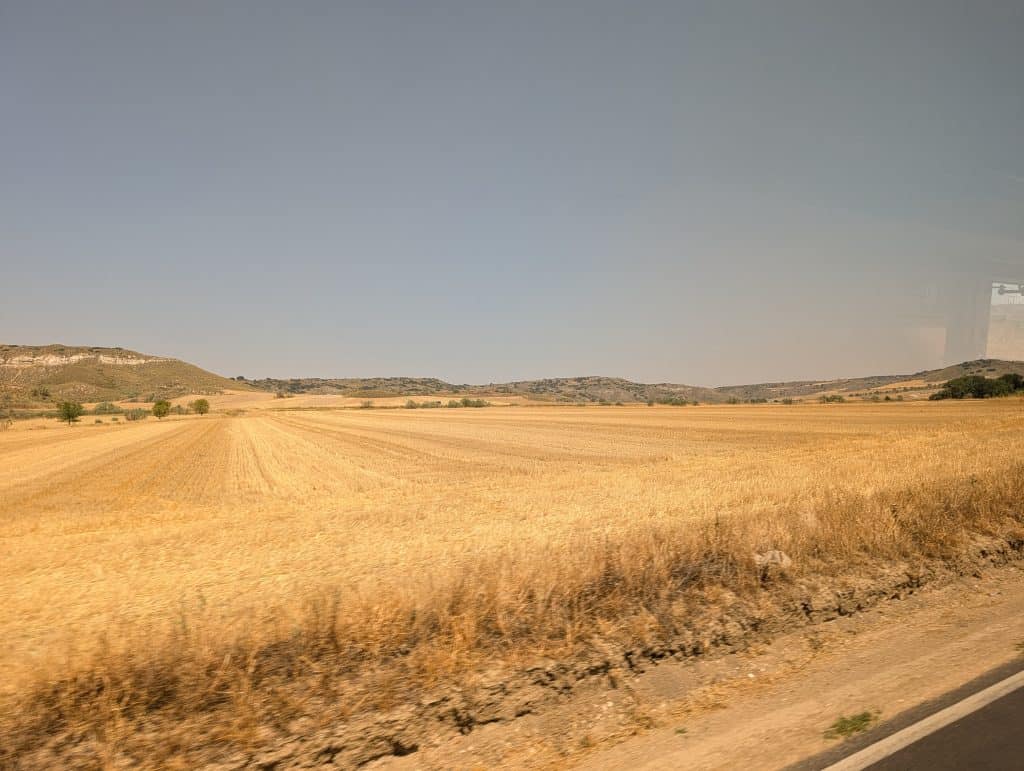
The road ran one lane each direction, hemmed in on both sides by the same rough little hills known throughout the stretch of country between Madrid and Guadalajara. A nineteenth-century Spanish geographic dictionary once described this kind of terrain as áspero, meaning rugged, harsh enough in places to draw admiration from travelers passing through.
It’s the same country Camilo José Cela walked in 1946, backpack and canteen, ten days across seventeen villages and six rivers, and turned into Viaje a la Alcarria, one of the more loved travel books in the Spanish language. He wrote the whole thing in the third person, always “el viajero,” the traveler, never “I,” a small formal trick that lets him watch himself the way he watches everyone else along the road. It’s a spare, unglamorous book, written in the hard years after the Spanish Civil War, full of hunger and poor villages and the particular generosity of people who don’t have much to give. Outside the window, that same hungry, generous country kept going, hill after hill for long stretches, until a village interrupted the pattern and then let it close back up behind the bus.
Santorcaz went by wearing the same easy, unhurried look Anchuelo already had: flowers dressing the balconies, people tucked into whatever shade they could find against the heat, shutters down and doors shut on businesses already deep into their siesta. Whatever actually set the two apart wasn’t visible at that speed, from a seat on a moving bus. Then the same rough hills again, the road climbing more noticeably now, until Pozo de Guadalajara broke the pattern a second time with a good deal less charm, flatter and more workaday, the kind of place built around something industrial rather than around a plaza. The fare for the whole ride came to three euros a person, paid straight to the driver.
A Lucky Find
The only plan was lunch, as soon as we got into town, but the same closed-up quiet we’d noticed on the walk in showed no sign of lifting. Nothing seemed to be open, no chairs set out, no sign anyone was expecting customers, and by then the heat alone had started narrowing what we were even willing to look for. Finding a table anywhere started to feel like the day’s first real win. What we found, eventually, was El Pontifical, a restaurant and small hotel built partly into a seventeenth-century wine cellar the village’s own monks once used to store their wine and the church’s tithe, though we ended up seated upstairs, in a different part of the building entirely, still noticeably, gratefully cooler than the street outside. We ordered the Menú Degustación, forty-five euros a person.
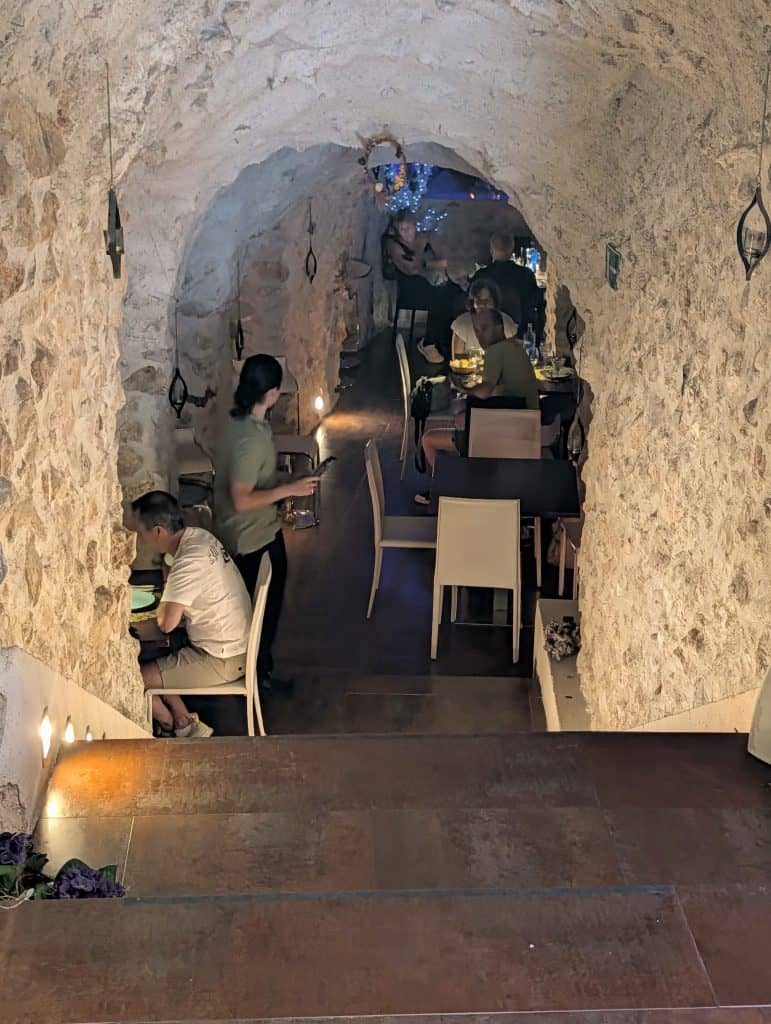
Five courses came out, no choices offered, the kind of fixed sequence a proper Menú Degustación is supposed to be, small portions of each so the whole thing built rather than filled.
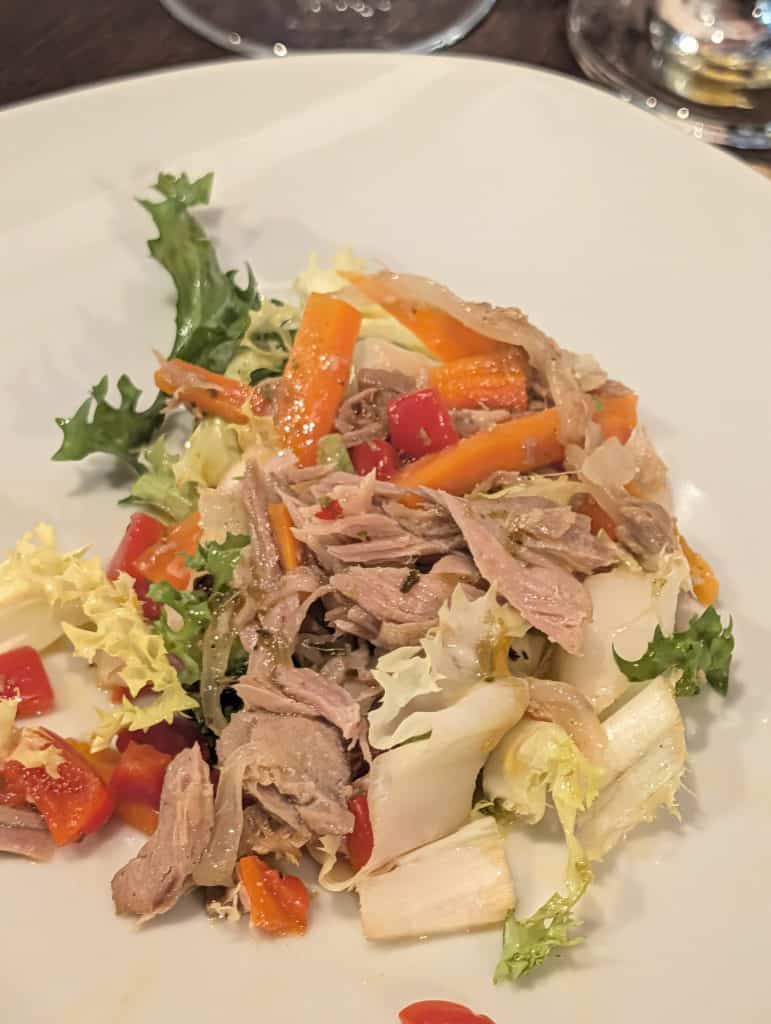
First came a salad built around ventresca of tuna, served on a bed of escabeche and set alongside roasted piquillo peppers. Escabeche itself is centuries old, a bath of vinegar, wine, oil, and bay leaf originally meant to keep fish edible before refrigeration existed, kept around today simply because it tastes good. Ventresca is the belly cut, the fattiest section of the fish, sitting just below the head, marbled through with fat the way a good cut of Ibérico pork is marbled, and it’s exactly that marbling that gave the dish its richness, the escabeche‘s vinegar cutting through just enough to keep each bite interesting rather than heavy.
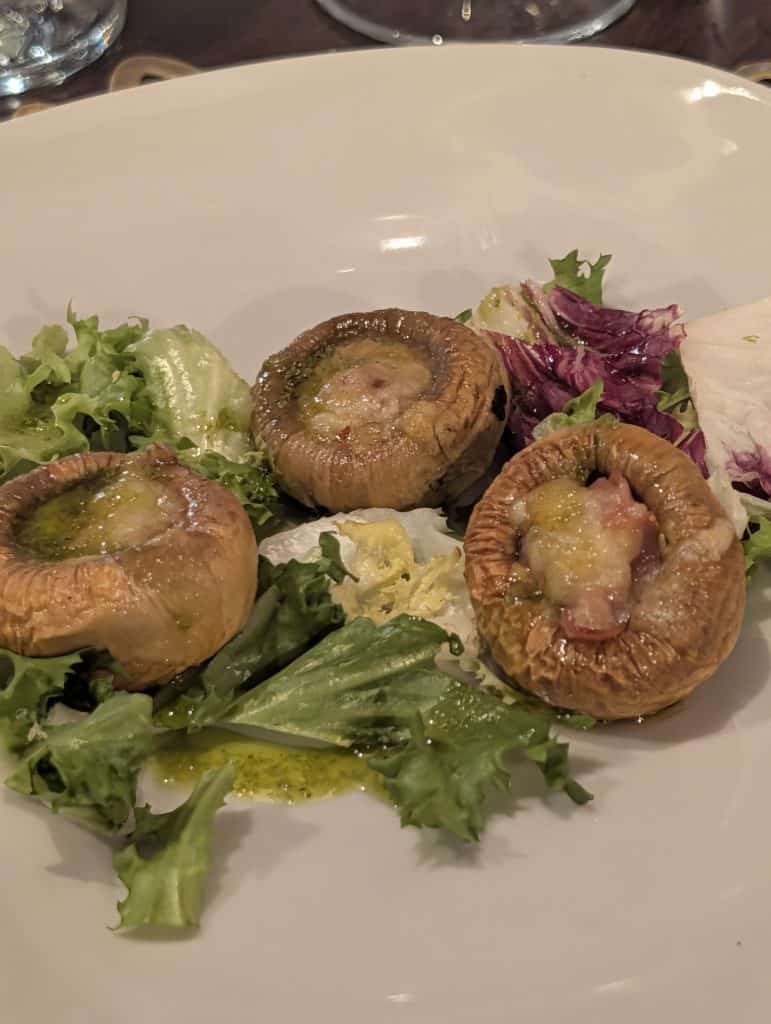
Then mushrooms, gratinéed, with jamón ibérico laid over the top, and this was my favorite of the five, though the whole meal was strong enough to make picking a favorite feel almost unfair. Jamón ibérico comes from a rare pig breed found essentially nowhere outside Spain and Portugal, raised on the oak-studded pastureland of Extremadura and Andalucía called dehesa. Most people know it by its nickname, Pata Negra, black hoof, for the dark, uniformly colored feet nearly every variety of the breed shares, whatever color the rest of the animal happens to be. It carries a genetic quirk most pigs don’t share, the ability to marble fat directly into the muscle rather than keeping it separate. The best grade spends its final months in the montanera, roaming free and fattening exclusively on acorns, which is exactly what makes the fat itself so prized, rich in the same monounsaturated fat that gives olive oil its quality, before curing for years in a bodega. None of that history was on the plate, but the taste explained it anyway, deep and nutty and nothing like the thin, salty ham most people picture at the word “ham.”
A third course broke from the set menu entirely: a fillet of salmon over salad, unannounced, competent, forgettable in the specific way a good but unremarkable dish always is sitting next to two that came before it.
Then solomillo of beef, tenderloin, cooked exactly as it should be, with a sauce of wild mushrooms and truffle that managed something legitimately hard: potent enough to hold its own against a cut that good, without ever drowning it out.
Dessert was supposed to be tiramisu, according to the menu, but what actually arrived was a cheesecake under a red berry sauce, light where the rest of the meal had been rich, the fruit cutting cleanly through everything that came before it, served with a café con leche to close things out.
A Village Named for Smoke, and for Saints
The village’s own name splits into two disputed halves, Humosa for smoke or mist, Los Santos for a pair of saints tangled up in Alcalá’s own founding story, each with its own tradition, neither fully settled, and a deeper history underneath both reaching back to Roman milestones and medieval frontier wars. That’s a story worth its own telling. Here, it’s enough to say the village earned its two names the hard way, long before anyone thought an eclipse might one day be reason enough to visit.
What the Village Still Holds
The village doesn’t have a long list of sights, and that’s part of its appeal: both worth seeing sit within a few minutes’ walk of each other, at the top of the old town.
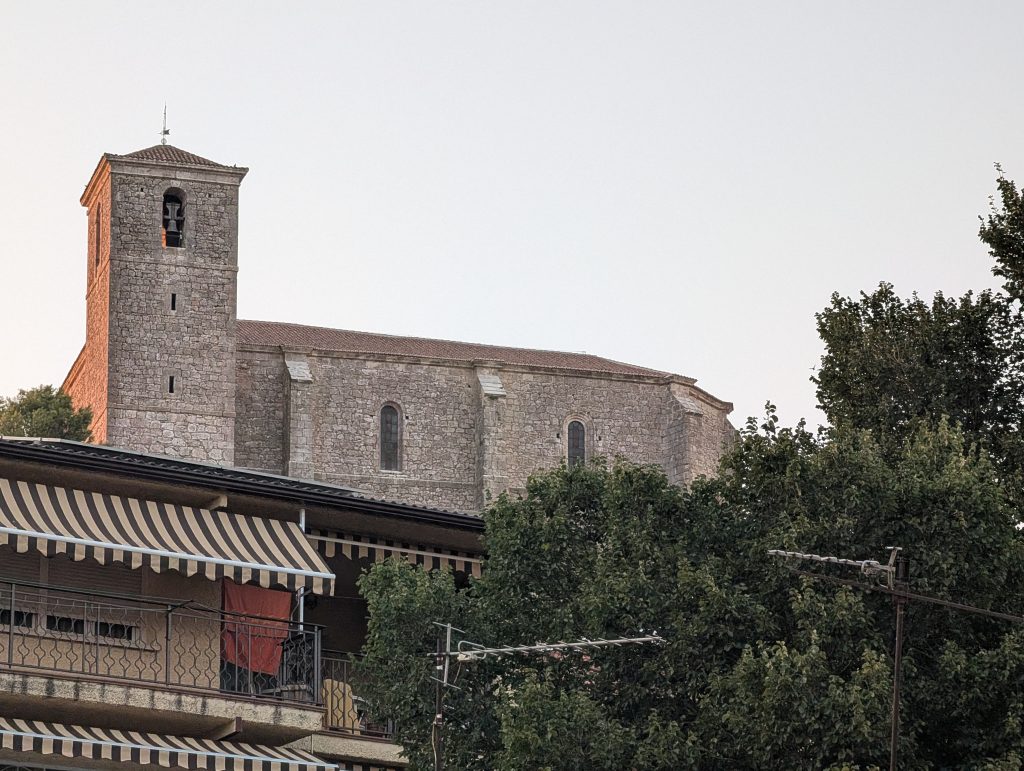
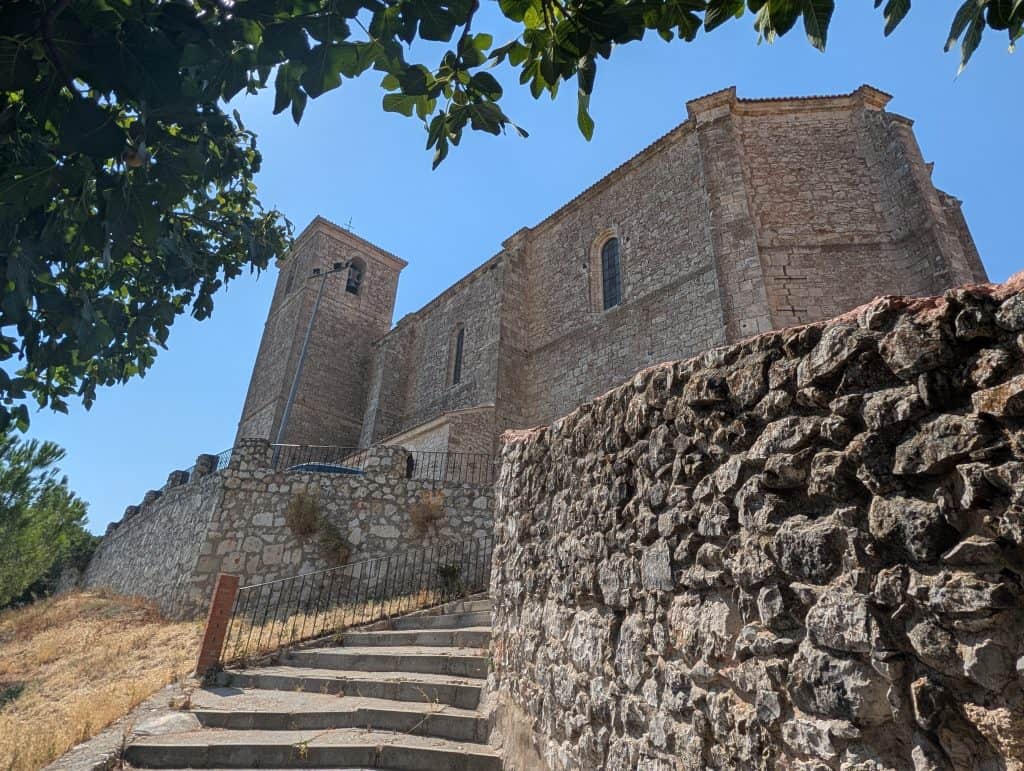
The Iglesia de San Pedro Apóstol, the parish church, is the oldest building standing in the village and sits at its highest point, with a clear view over the surrounding countryside. Construction began in 1562 under a master stonemason who also worked on the University of Alcalá’s façade, one of several threads tying this quiet village to that far more famous university a few kilometers away, threads worth following properly elsewhere.
The church was locked. No mass in progress, no caretaker around, no way inside, just a heavy door that didn’t move, though I still spent several useless minutes circling the building in full sun, checking for some side entrance I already knew wouldn’t be there. My wife and her son had the good sense to wait it out on the church steps, tucked into the one strip of shade the building actually offered, watching me do it anyway. A sign outside filled in a little of what the door wouldn’t, though most of it will keep for another telling. What the closed door didn’t take away was the view from around the building’s base, west out over the rooftops and down into the valley, wide and clean, good enough on its own that we started talking right there about watching the eclipse from this exact spot instead of the town’s official viewing site later that evening.
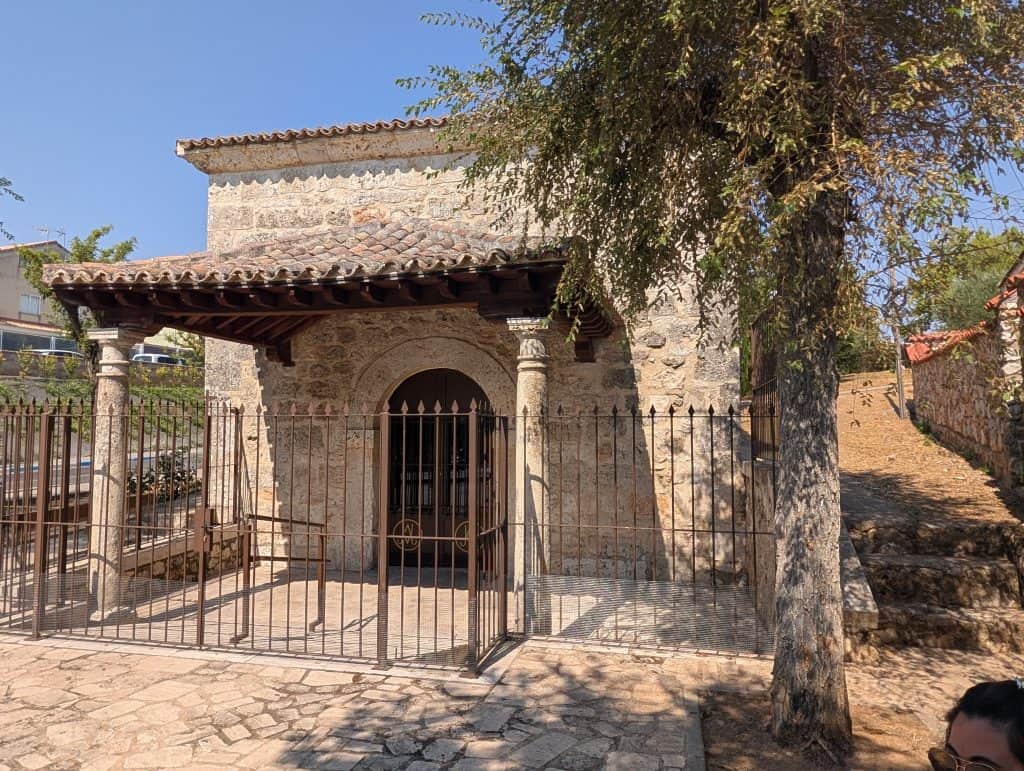
An eleven-minute walk from there sits the Ermita de la Virgen de la Soledad, a small sixteenth-century hermitage with a history of its own, older and stranger than it looks from the road, worth the same fuller telling as the church up the hill. It sits at the edge of the village on the road toward Pozo de Guadalajara, small enough to take in within a few minutes: a square chapel, sober and plain.
Getting there meant walking through the worst of the early afternoon sun, no real shade along the way, closer to fifteen minutes than the eleven our phones promised. The hermitage was locked too, same as the church, nothing to do but circle the building once and take in what there was from outside.
Somewhere West of Official
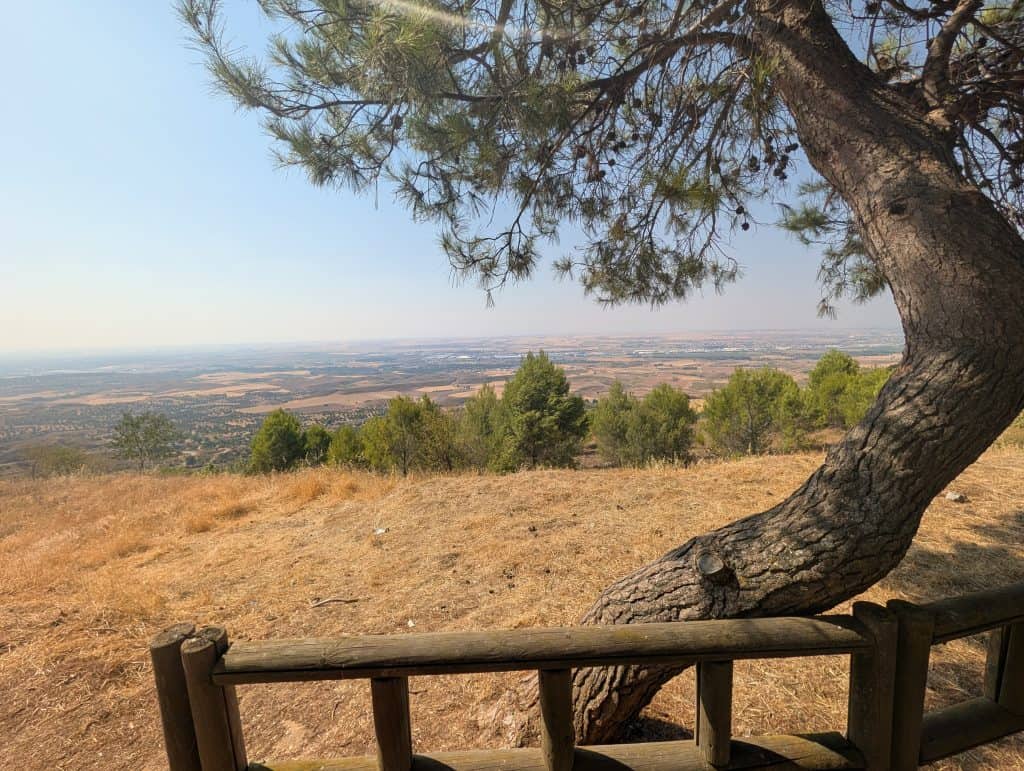
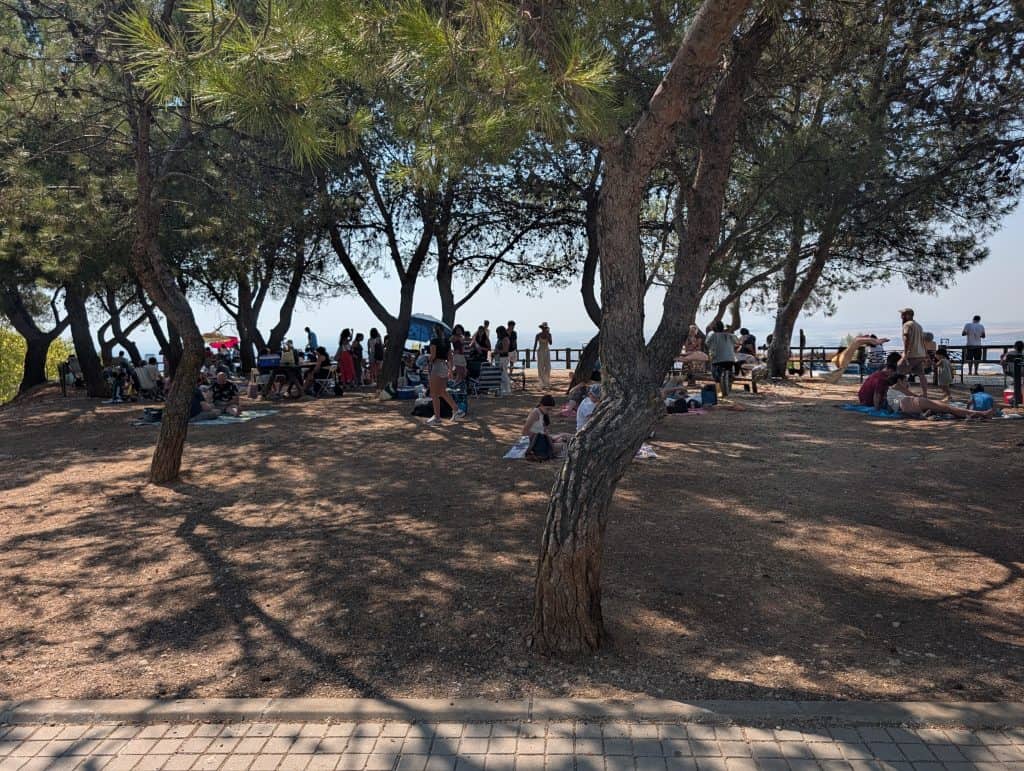
West is the direction that matters today, and the town has more than one mirador, as these built viewpoints are called locally, facing exactly that way. From the Ermita de la Virgen de la Soledad, we walked on to what looked like the town’s main gathering spot for the evening, a shaded park under pines with a children’s play area at one end, open countryside falling away toward a horizon lost in haze. Whether this was actually the registered official site never got confirmed. The crowd already there, two and a half hours before anything was due to start, was intimidating enough to talk us out of investigating further: small groups staked out on blankets, patient, holding their spots in direct sun, the kind of dedication that makes you quietly reconsider your own commitment to a good view. The grass at the edge of the clearing didn’t help either, littered with a genuinely alarming amount of animal droppings, which made sitting down anywhere a real gamble. We decided, generously, that it had to be from herbivores, since whatever left it had the decency not to smell, even in that heat.
We didn’t stay. Between a crowd already claiming every scrap of shade and an afternoon sun with no interest in negotiating, what followed was less a decision than a tactical withdrawal, back down toward El Pontifical, the same restaurant from lunch and about the only thing in town that was actually open. My wife put it best afterward: it wasn’t really a restaurant at that point, it was salvation from heat that had genuinely limited what else we could do that day. We went back for something cold to drink.
Somewhere in that stretch, the plan quietly changed: skip the crowd, skip hunting down the actual official site somewhere else in town, and watch totality from the church instead, up at the top of the hill. The waitress at El Pontifical backed the idea without hesitation, the mirador around the church, she said, beat anything the ayuntamiento was recommending, official status or not. Whatever crowd the parish’s own mirador drew, it had to be smaller than this one.
The town, through all of it, stayed almost entirely unbothered. Shutters down, doors locked, the same closed-for-siesta quiet that had greeted us from the bus window in Santorcaz hours earlier, except here there was no excuse of being a smaller village along someone else’s route. This was the village actually hosting the event, a registered capacity of two thousand people expected on a hillside a few hundred meters from its own front doors, and not one shop seemed to think that was worth staying open for.
Then It Went Dark
A partial eclipse is a curiosity: the sun with a bite taken out of it, safe to glance at only through certified filters, interesting but nowhere near the real thing. Totality is a different event entirely, and it only happens inside that narrow band of the moon’s shadow. It doesn’t last long. The Comunidad de Madrid’s own estimate for this stretch of the region runs 30 to 90 seconds, depending on the exact spot. Short as it is, the sky often darkens enough in that window to see stars and planets, and the temperature drops. It’s also the one moment it’s safe to look directly at the sun with the naked eye, since the disk itself is fully covered and only the pale corona is visible around its edge. The moment totality ends, that stops being true instantly, which is why every official recommendation, from the Instituto Geográfico Nacional to the village’s own town hall, insists on certified eclipse glasses meeting the ISO 12312-2:2015 standard for every other moment of the event.
The village’s official viewing spot, a west-facing overlook the regional government has registered as an observation point, caps out at two thousand people, and getting a spot required registering in advance through an app built for exactly this kind of crowd control. We did that a few days ahead of time, tickets for three, once it became clear demand for the free eclipse glasses alone was already expected to outstrip supply. In the end, we never used it.
We never found out how many people the official site ultimately drew, or for that matter, whether we ever actually laid eyes on it. The church’s own mirador wasn’t empty either, not by any measure. Every open space and viewpoint in town, from what we could tell, had turned into its own small unofficial gathering, and ours was no exception, though it stayed manageable. I’m bad at judging crowds, notoriously so, but I’d guess two hundred to two hundred fifty people, spread over enough ground that moving through it never felt tight. My wife and her son found a spot against a support wall near the church itself. I walked further down the street to a lower, makeshift parking lot with an unobstructed view west, clear of the wires and cables that cut across the higher vantage point.
The town’s own claim about the view from its miradores held up here too: nothing blocked it, no rooftops, nothing but the valley falling away toward Alcalá. Further out, through the haze, a few distinct towers rose on the horizon, high enough and sharp-edged enough to be Madrid and nothing else. The village’s own signage backs it up: on a clear day, it claims, you can see all the way to the towers of Madrid’s Castellana from here, the city skyline some forty kilometers off. We’d apparently picked a clear enough one.
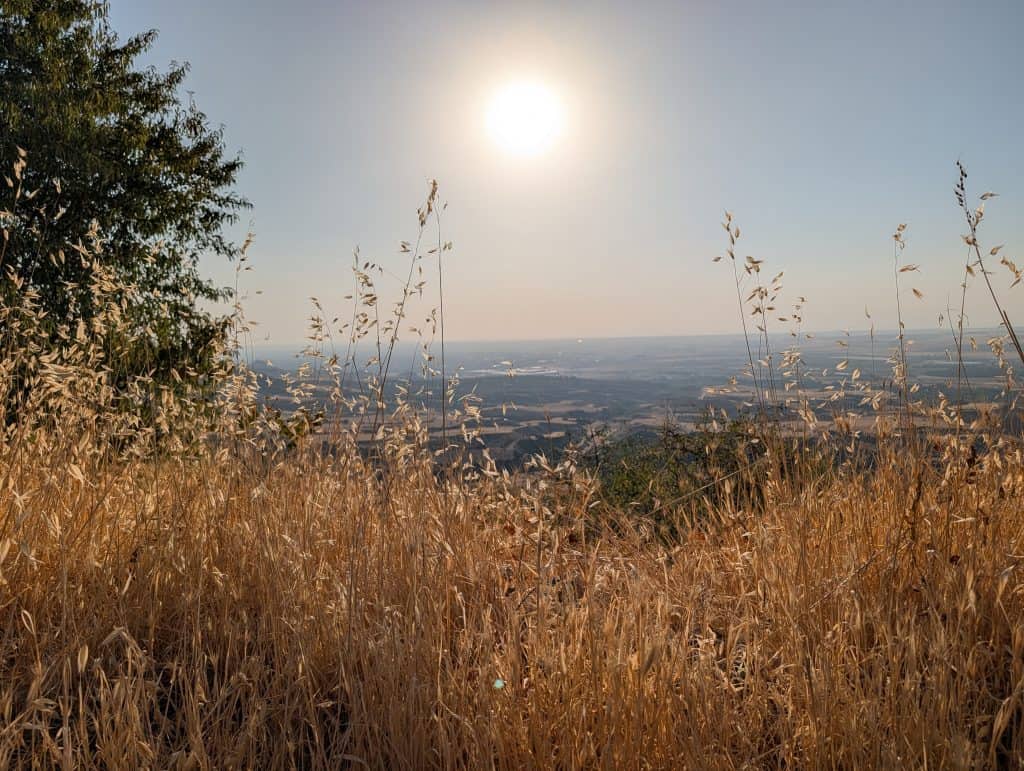
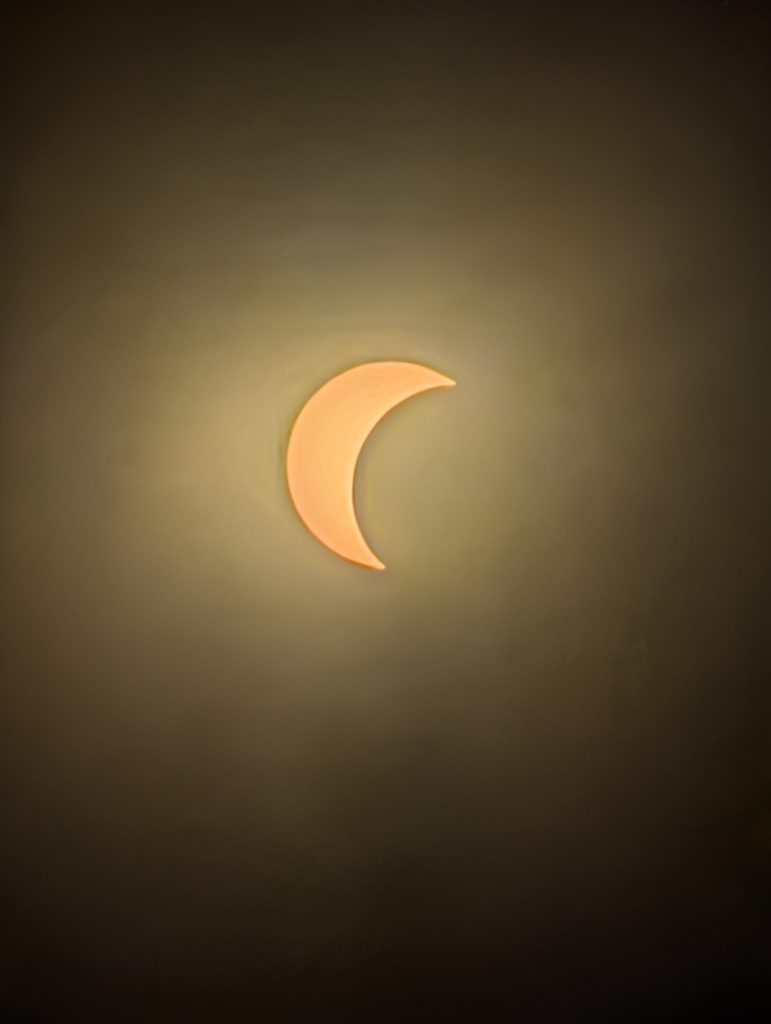
A little past 7:30 in the evening, glasses on, I made out a small notch in the lower right edge of the sun’s disk. It had started. I already knew totality wouldn’t come for almost another hour, closer to 8:30, so there was no urgency to it, just a slow erosion happening far overhead while everything at ground level carried on as if nothing were different. Sitting in the dirt at the edge of my chosen spot, I alternated between two pairs of glasses, ordinary sunglasses for the valley spread out below, the certified ones for checking on the sun’s progress.
What struck me most, watching that first hour unfold, was how little the light itself seemed to change. Even once the moon had taken half the disk, then two-thirds, the valley still looked exactly as bright as it had before any of this started. I thought back to a partial eclipse we once watched in Maryland, years ago: fun enough in the moment, a little magic in the air, but nothing that stayed with me afterward as a real event, more a curiosity than anything worth rearranging a day for. Sitting there watching this one crawl along at the same unhurried pace, I caught myself wondering if today would end up filed away the same way. As only a thin sliver of sun remained, the light thinned too, though not enough to break the spell of an ordinary afternoon: the kind of dimming you’d blame on haze rolling in, not on anything happening ninety-three million miles away.
Then, all at once, it happened. A last thread of sunlight flared into a single bright point along the disk’s edge, the pale ring of the corona already glowing faintly around the rest of it. One point of light against a faint ring, close enough to actual jewelry that astronomers call it the diamond ring effect.
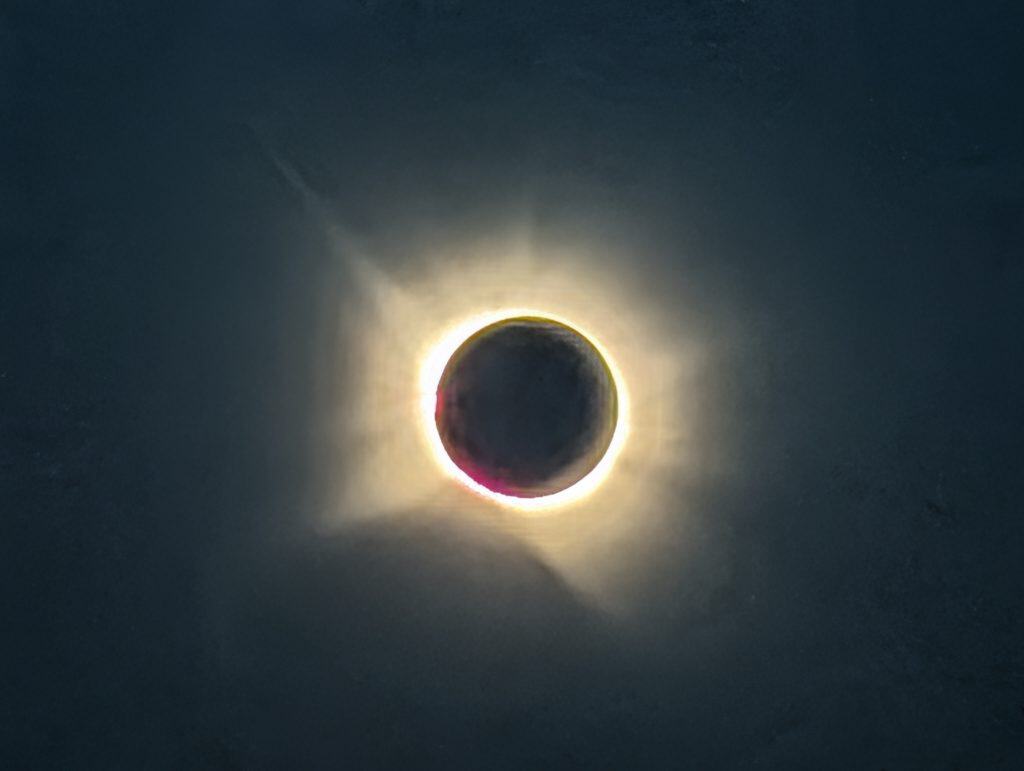
Then the ring closed and totality landed like an explosion in reverse: not light rushing outward but its opposite, something collapsing inward into dark. Before anyone clapped, before anyone had time to think about it, the whole hillside gasped at once, shouts of pure surprise breaking out from strangers who had nothing in common except standing in the same spot at the same moment. Then the clapping came. There was something genuinely moving in that, all these people who didn’t know each other having the identical, involuntary reaction to something that had nothing to do with any of our ordinary lives.
The temperature dropped hard and fast, the first real relief all day from a heat that had shaped nearly everything since morning, and the world went dim the way it does right before sleep, except this felt like it might not wake back up. No stars showed themselves, no planets either. Evening was already too far along by the time totality started, the sky settling into a deep dusk rather than true darkness.
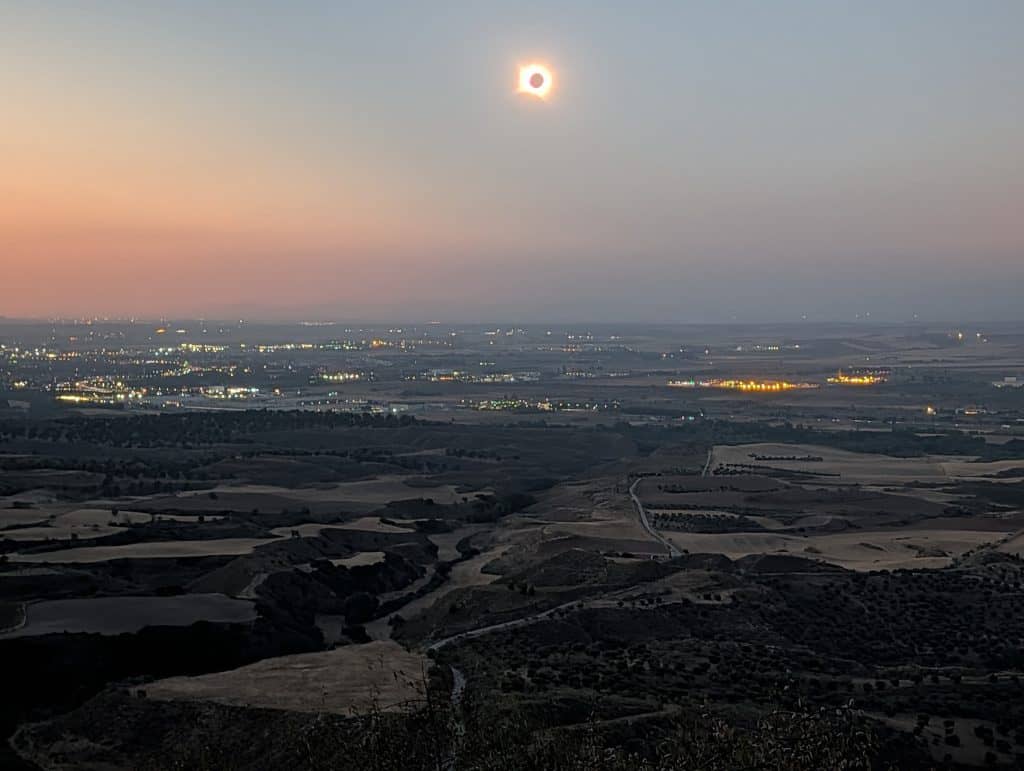
Visually, what struck me most was the corona itself: the sun’s storms, constant but ordinarily far too bright to see without serious equipment, suddenly right there, plainly visible, waves of light reaching out from behind the black disk of the moon. For a second, fully aware of the mechanics of orbits and shadows, some older part of me still wondered whether Sköll, the wolf of Norse legend, the one said to chase the sun across the sky, had finally caught her. My wife told me afterward that totality had brought tears to her eyes, which meant something coming from a woman who rarely lets what she’s feeling show on the outside.
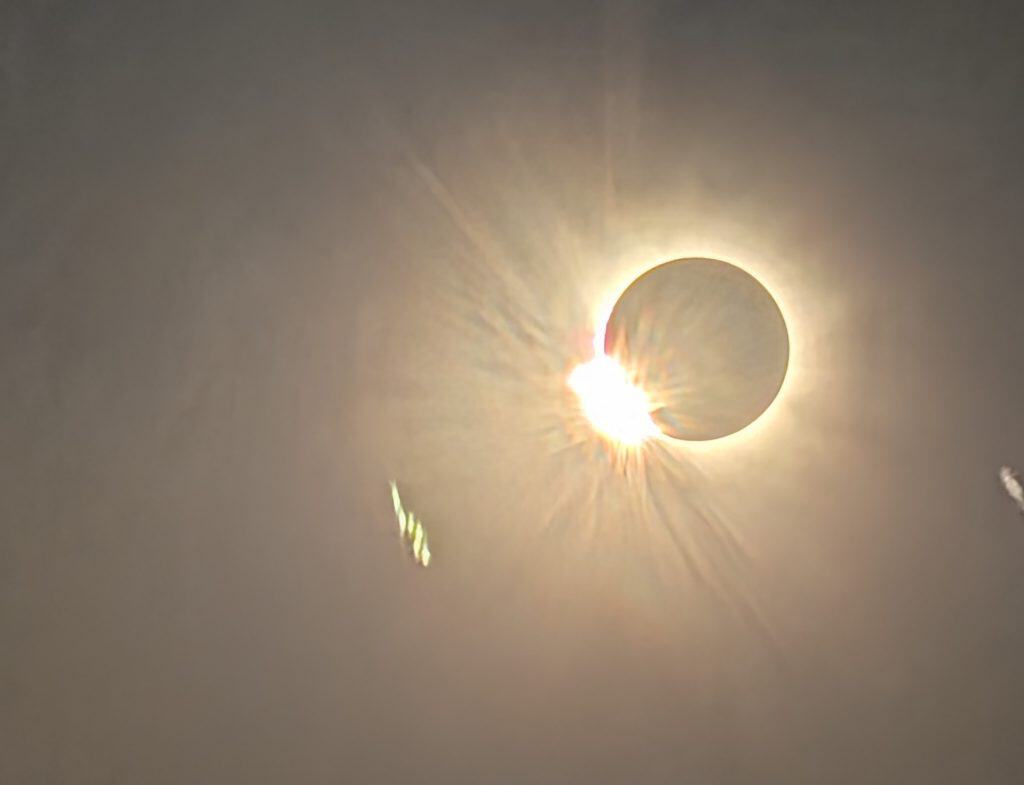
Then totality passed, and what hit me wasn’t disappointment so much as an almost instant nostalgia, already missing the elated state we’d been in only seconds before. Whatever had been hanging in the air a moment before, that unmistakable feeling of magic, of something enormous happening, cut off the instant the light returned. The ordinary world came back just as fast, the way it always does, the whole thing already fading like a dream erased by wakefulness.
Spain, it turns out, is in the middle of something astronomers are calling the Trío de Eclipses, three consecutive solar eclipses touching the same stretch of the same country within three years. It isn’t literally unheard of elsewhere; Illinois saw two total eclipses seven years apart, in 2017 and 2024, and Australia will see five of them between 2023 and 2038. But Spain’s own astronomers still call this run extraordinarily infrequent. Two totals and an annular eclipse, all inside three years, in the same country: that combination doesn’t come around often. This one comes first. Next, on August 2, 2027, a total eclipse crosses the south of the country, tracking through Cádiz, Málaga, and the Strait of Gibraltar with a longer totality than today’s, already being called the eclipse of the century by some. Then, on January 26, 2028, an annular eclipse crosses the peninsula southwest to northeast, from Huelva through Córdoba, Toledo, and Valencia to the Balearic Islands, the sun once again low near the horizon. This one produces not darkness but a ring of fire, the moon just slightly too small to cover the sun completely. After that, anyone still wanting a true total eclipse from Spanish soil will have to wait until 2053.
Reading about all three ahead of today, I was fairly sure this first one would be the only one I’d commit to, a local curiosity worth a day trip and nothing more. Having actually seen it, I understand now why people chase eclipses across the world, wherever and whenever they happen, the way we never once thought to chase that half-remembered one in Maryland. I think we’ll go again.
Along with what must have been thousands of other people looking up at the same sky, it was time to think about logistics again: walking five or six minutes down from the church, from the high point of the mirador, back into the part of town where the bus would take us home.
Getting Back
A direct, reinforced bus service, added specifically for the day and separate from the regular route’s odd one-way loop, was running the whole evening, several extra departures scattered between six and eleven, the whole operation coordinated in real time from a traffic control center in Madrid built to handle exactly this kind of single-day surge. On paper, we had margin to spare.
By the time we reached the stop, the town’s single road out was already solid with cars, an unbroken line of them leaving Los Santos de la Humosa all at once. I checked my phone out of habit: ninety-five degrees, the sun still well above the horizon, sunset still to come. And somehow it felt like relief, an almost comic contrast with the blistering heat we’d been fighting since midday. Our bus ran more than thirty minutes late. When it finally showed up, it was packed: university students, probably from Alcalá, and a scattering of European tourists still talking through what they’d just seen. My wife got lucky and found a seat. Her son and I spent the whole ride perched awkwardly on the bus’s exit stairs. The ride back, usually a twenty-minute trip, took over an hour.
We’ll never really know whether watching from the church instead of the official site was the right call. I never actually confirmed where the official site sat relative to the nearest bus stop. What I do know is that the church left us only a five- or six-minute walk to a stop at the edge of town, and not having to fight that traffic from behind a wheel of my own made the whole decision feel like the right one, whether or not that was actually true.
If there’s one thing worth trading the bus’s convenience for, it’s the flexibility a car would have given us to stay later. The Perseid meteor shower peaked that same night, conditions about as good as they get, a new moon leaving the sky properly dark for it. The day itself turned out to be a strange kind of triple bill nobody had fully clocked in advance: a six-planet alignment before dawn that none of us woke up for, the eclipse itself, and then, somewhere past midnight, meteors streaking over a village we were already on a bus away from.
Not one person on that hillside actually believed a wolf was about to swallow the sun. Probably. We know better, all of it accounted for by centuries of astronomy sophisticated enough that our medieval and ancient ancestors would have called it sorcery in its own right. And yet for those two minutes, standing in the dirt with certified glasses hanging around my neck, surrounded by strangers gasping in the same instant at the same cosmic event, the knowing didn’t matter. Somewhere nearby, out of sight, a woman whose composure rarely cracks felt hers crack anyway. Something older than the knowing took the wheel for a moment, and then, just as suddenly, let go of it again.