The Aparcamiento Pico del Obispo looked exactly like I remembered it. Six months earlier, on a scouting trip in January, we had left the rental car in that same open-air lot before wandering into the casco histórico, the old town, to imagine a life we hadn’t built yet. Now that life was starting, and I found my way back to the plaza without once looking at my phone. Past the Archbishop’s Palace, along the edge of the square where the Archaeological Museum sits, onto Calle Mayor, Main Street, beneath its old stone colonnades, and into Plaza Cervantes. M. and A. stood guarding eight suitcases, a guitar, a case of cat supplies, and our cat, Leila, deeply unimpressed, in the shade. M. is my wife. A., thirteen, is her son, and this move is as much his as it is ours. Somewhere between the parking lot and that patch of shade, it occurred to me that I had spent months picturing this week as something close to an adventure. What I actually got, for the first seven days, was logistics: eSIM cards, bank forms, a mattress delivery window, a missing phone. Immigration, it turns out, is not vacation with better paperwork. It is paperwork with better views.
Our flight out of the US was delayed almost two hours by storms battering the Northeast, so a 6:10pm departure became an 8pm one, and by the time we landed at Madrid-Barajas it was 9:30 in the morning local time, an hour and a half later than planned and a full night’s sleep behind schedule. Customs and baggage claim, the part of international travel I’ve learned to dread, took thirty-five minutes start to finish, the fastest I’ve ever moved through an airport. At the Alamo counter, the agent who signed us up wished us a warm bienvenida the moment she learned we weren’t just visiting, and handed us the keys to a Volvo SUV, the biggest car on the lot, because eight suitcases, three humans, and a cat needed the room.
We stopped for equipment for Leila before we’d bought so much as a toothbrush for ourselves, because some priorities don’t need discussing. Then, still running on airplane sleep, we found a café in Barajas for café con leche and tostada con tomate, bread rubbed with grated ripe tomato, the taste that has come to mean Spain to me more than almost anything else. Twenty-five minutes later we were in Alcalá de Henares.
The keys to our actual apartment weren’t ready yet, so we drove as close to the casco histórico as its largely pedestrian streets would allow, unloaded suitcases and cat and pet supplies onto a corner, and I drove off alone to park while M. and A. waited in the shade. That’s the walk I started this piece with. We spent our first three nights at Casa de Escritores on Plaza Cervantes, booked through Booking.com, dragging fifty-pound suitcases over cobblestones to a third-floor room. A short nap, an early dinner of tapas at Indalo on Calle Mayor, and we were asleep before we’d really arrived.
Keys, and a Man Named Vicente
The next morning, we finally sorted out Spanish numbers at Orange, mine and A.’s, since M. had gotten hers back on our scouting trip in January. That afternoon, we drove to the apartment for the first time in person. We’d only ever seen it on a video call from the US.
Angelica, our real estate agent, met us there, along with Vicente, our landlord, and Alberto, a worker finishing last-minute repairs, most urgently the air conditioning. Spain was in the middle of one of its hottest summers on record, a third heat wave arriving before July had even ended, with a major wildfire recently contained west of Madrid from the week before we landed. Air conditioning was not a luxury item this particular week.
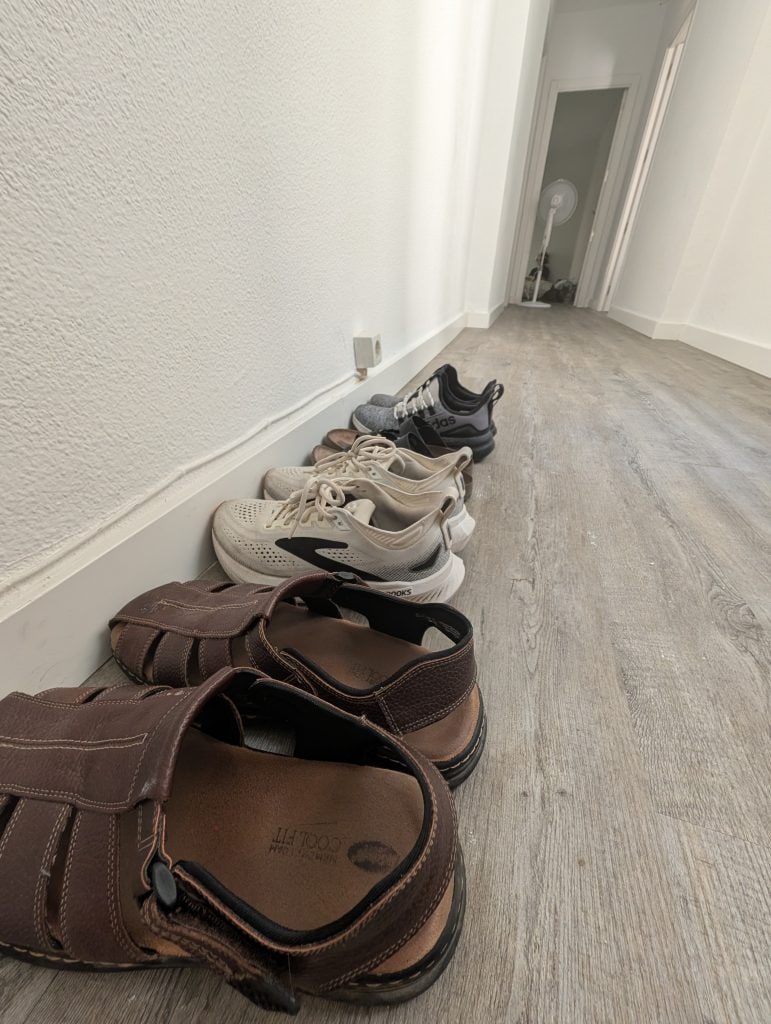
Vicente walked us through the apartment room by room, apologizing that he had to move quickly, he and his wife were about to leave on their own August vacation, the same one that seemed to be emptying out half the country. He promised a longer visit once he was back in Alcalá later in August. After that, his wife would head to Brazil, and once she returned in September, the two of them wanted to have us over for paella. It was the kind of warmth that catches you off guard in a country you’ve just arrived in, a landlord treating a lease handover like the start of a friendship rather than a transaction. I keep thinking about that promised paella. I’m already looking forward to September because of it, whether either of us has said so out loud or not.
From there we drove fifty minutes to the IKEA in Alcorcón, the largest in the Madrid region, remarkably identical to any IKEA I’ve ever walked through in the US, same labyrinthine path, same restaurant, same Swedish meatballs. We took measurements and decided to prioritize the two bedrooms and the office first, letting the living room wait until we’d actually lived in the space long enough to know what it wanted. We left without buying a thing. Somewhere in the maze, A.’s phone went missing. We retraced our steps, asked employees for help, and gave up, on the phone and on the shopping both. It’s just one of those things that happens when you’re moving a household and a teenager across an ocean. We didn’t let it slow us down.
A rest, a thin-crust pizza with unusually creative toppings at Sabora Pizza off Calle Mayor, and another early night.
Beds, Bureaucracy, and a Bank That Finally Said Yes
The next morning we tried to accomplish two things at once at the same office on the same street: register A. for school through the Servicio de Apoyo a la Escolarización, and register myself for Spanish classes at the neighboring Escuela Oficial de Idiomas. Only to learn both offices were closed entirely, not just short-staffed, shut from July 15 through September 1. Of the two, A.’s school situation was the one that actually kept me up at night, so that’s the one worth telling in full.
We’d applied months earlier through the Comunidad de Madrid’s points-based admissions system, the baremo, for a spot at Colegio Alborada, a bilingual concertado school, something like a charter school in the US, publicly funded but independently run. Families are scored against fixed criteria, address, siblings already enrolled, income, and ranked by that score. Most concertados, this one included, are also Catholic institutions, a legacy of the Church’s dominant role in Spanish education for over a century, especially under Franco. When democracy arrived in 1978 and Spain declared itself religiously neutral, the government chose not to dismantle that existing network of Church-run schools but folded it into the public system instead, subsidizing it in the name of educational pluralism.
None of that was what drew us to Alborada. Alborada had a real reputation for integrating foreign students well, which mattered more to us than anything else on the list. A. landed ninth on the waiting list. In early August, with school starting in September, ninth on a list that hadn’t moved in months was not the number I wanted to be looking at. With the office shut until September, there was nothing left to do but shelve it and wait, which was its own particular kind of nerve-wracking. Not everything on the list was stuck, though. The bank account, at least, was still entirely up to us.
Opening a Spanish bank account turned out to be a real milestone, the step that actually unlocks the next layer of practical setup: a phone contract, a utilities contract, home internet, all of it assumes you already have one. We’d chosen Banco Santander specifically, since it was likely the one major bank that would actually open an account for non-residents. It still made us work for it. A thirty-minute wait ended with a suggestion that we book an appointment instead, and a promised callback that never came. We tried again a few days later, without an appointment, and this time it worked, though it worked because of an accident of citizenship rather than persistence: opening the account on my French passport, as an EU citizen, cleared a path that an American passport alone wouldn’t have as easily.
Between the school waitlist and the bank, there was Roberto. Still without beds after IKEA came up empty, we tried Templo del Colchón, a mattress store a ten-minute walk from Casa de Escritores. We were his only customers, and he moved between Spanish and English without missing a beat, English he’d learned from songs and movies rather than a classroom. We ordered a medium-firm foam mattress for M. and me and a soft one for A., a canapé abatible for each, the kind of base that lifts the whole mattress up to reveal storage underneath. The whole order came to about 2,500 euros with delivery and setup, the bases arriving from a factory in Toledo, the mattresses themselves from Sevilla. A handwritten note on the shop door announced everything sold there was made in Spain. Roberto didn’t try to sell us anything we didn’t need, and I left the store wanting to recommend it to strangers, which is more than I can say for most shopping trips anywhere.
We went back to IKEA a second time, this trip finally productive, though mostly for the unglamorous foundations of a kitchen: plates, pots, silverware, plus a couple of thin mattresses to sleep on until the real ones arrived. Nothing else for the bedrooms or the office we’d planned out two days earlier. Still no sign of A.’s phone. It never turned up, and A. ended up calling his father back in the US, whose account the phone was on, to break the news.
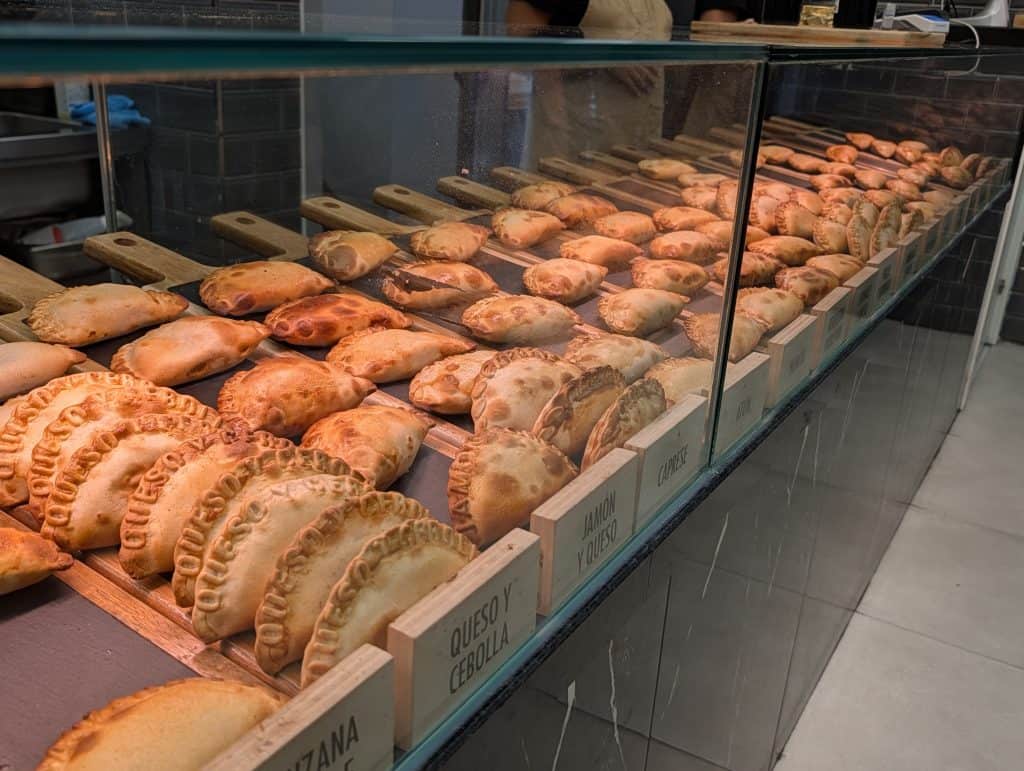
That night, before bed, we walked into Sabores Express, an Argentine empanada chain with a spot on Plaza Cervantes, no seating, takeout only. We picked two each and shared all of them the way we always do: pollo picante, pollo carbonara, a strange and delicious Nutella-and-brownie one, six or seven flavors between us. It was the first time I’d had Argentine empanadas in Spain, though it echoed a trip we took to Argentina itself two years ago almost exactly, the same soft, hot dough, a small déjà vu that had crossed an ocean and two years to find us.
A Sunday Slow Enough to Notice
Sunday morning, church bells rang from every direction of the city, calling people to Mass. I let myself lie still and just listen for a while before getting up. I’m not a Christian, and I wasn’t raised one either, yet the sound reached somewhere old in me anyway, something laid down in infancy, long before I had any say in what would stay with me and what wouldn’t. For a moment, lying there, I felt more certain of being in Europe than I had all week, more certain than any building or any street name had managed to make me feel. Bells don’t argue. They just ring, and something in you answers whether you asked it to or not.
We took our time getting up, and took our time walking, too, all the way to Bartolo Coffee Store on Calle Nebrija, no particular hurry to get there. Over café con leche and a croissant filled with turkey, Gouda, and some sharp, bright herb I couldn’t quite name, I found myself eating slower than I meant to. That herb, whatever it was, hit with a kind of clarity I don’t often get from food, luminous, distinct, and yet somehow it never fought the bread, the turkey, or the cheese, it just made all three a little more themselves. One bright note doing more work than an entire plate usually manages. I’ve eaten more meals than I could count in my previous life, plenty of them good, most of them forgettable within the hour. This was neither. A single ingredient, handled with enough care, apparently does more for you than volume ever did. I put the rest of the croissant down for a moment, in no hurry to finish it, the first time all week I hadn’t been rushing toward something else.
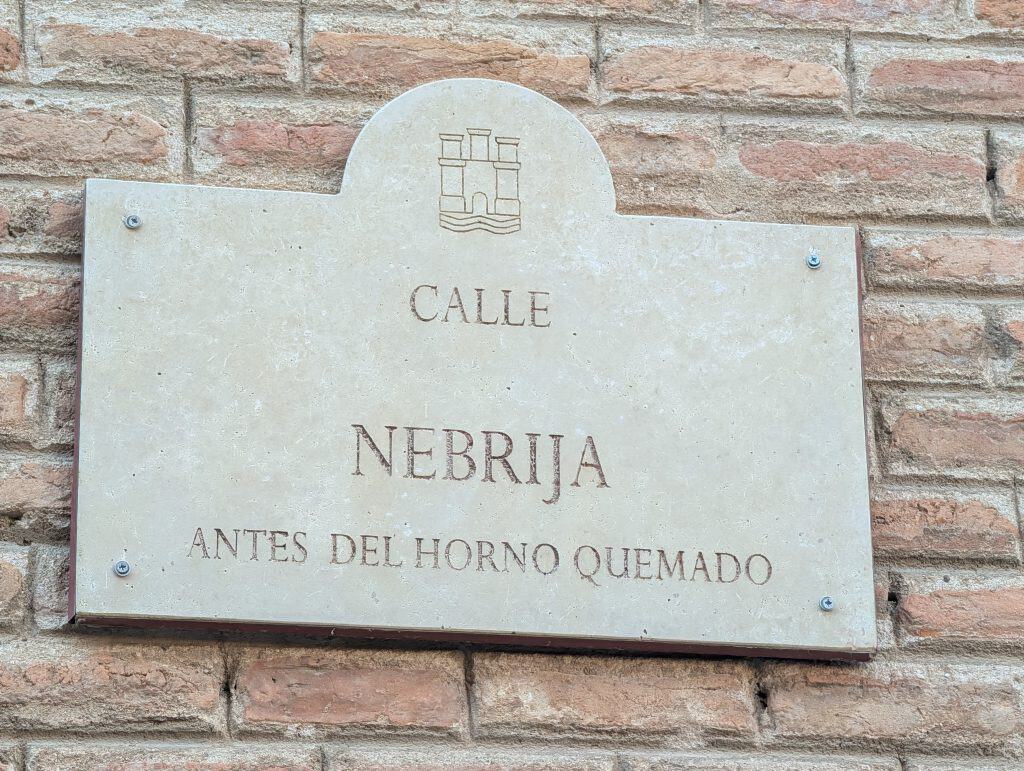
My eyes kept drifting back to the street sign outside, longer than I needed to look at it. Calle Nebrija. The street honors Antonio de Nebrija, the Spanish humanist grammarian who would later become central to a story I’m saving for another post, the making of the Complutensian Polyglot Bible at the University of Alcalá, but that morning I didn’t need the history to matter yet. It was enough to recognize the name at all, to feel like I was starting to read the city instead of just walking through it. A street sign had become a small, private landmark.
We didn’t hurry home either. When we did get back, we discovered Medusa Cómics on the way. A comic and game store that felt exactly like the ones I used to visit in the US, people gathered around tables playing, shelves of manga, D&D books, dice, and board games. We came out with Settlers of Catan for 47 euros.
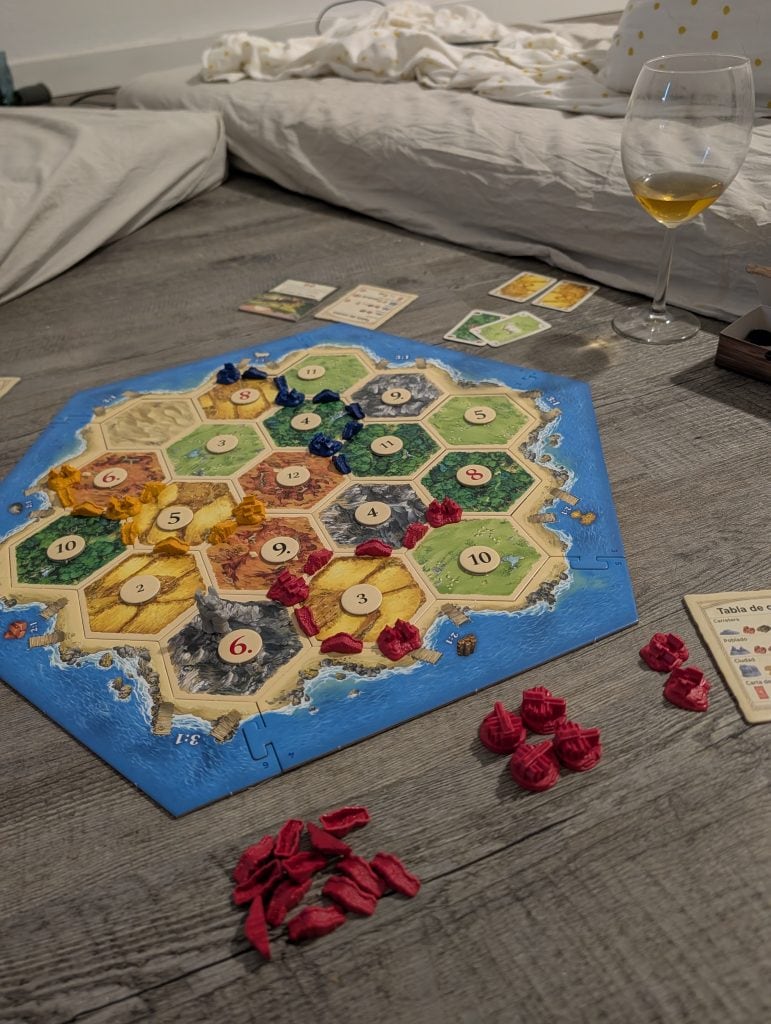
By the time siesta hour arrived, the whole city had gone quiet around us, closed for the afternoon the way it had every day since we’d arrived, but felt especially total on a Sunday. We dragged our three thin IKEA mattresses, the only things resembling furniture in the entire apartment, into a triangle on the floor, one of us on each, the Catan board set up in the empty space between us. Nowhere else we needed to be, and no one we needed to be there for.
My first instinct, an old one, trained by a life spent chasing convenience and constant availability, was to see the siesta as time stolen from a day that was already too short. Hours where the whole country simply declines to be productive, closed shutters standing in for closed opportunity. I’m only now starting to unlearn that instinct, and to understand the siesta for what it actually is. It’s not a gap in the day. It’s a room the day makes for you, on purpose, at the exact hour the sun would otherwise make anything else impossible. Spanish culture didn’t stumble into this rhythm, it built it, the same way it built sobremesa, another one of the small mechanisms Spanish life offers for living fully rather than promptly. The same idea I wrote about when I first explained why the ampersand in this blog’s name matters to me. An afternoon spent rolling dice with my family, with nowhere to be, might be the most Spanish thing that happened to us all week.
Evening pulled us back into motion. We worked from Santagloria Coffee and Bakery on Calle Libreros until closing, walked home past the university that will get its own post before too long, and cooked pasta in an apartment that was, slowly, starting to feel like ours.
Two People Who Turned Transactions Into Relationships
Monday brought the day I now think of as the Orange marathon: two and a half hours in one store, merging M.’s phone line and mine under a single family account tied to my French identity card, putting A.’s line on hold since there was no longer a device to put it in, ordering home fiber internet, and setting up Orange’s own electricity service for the apartment, four separate bureaucratic transactions handled by one extraordinarily patient agent named Miguel.
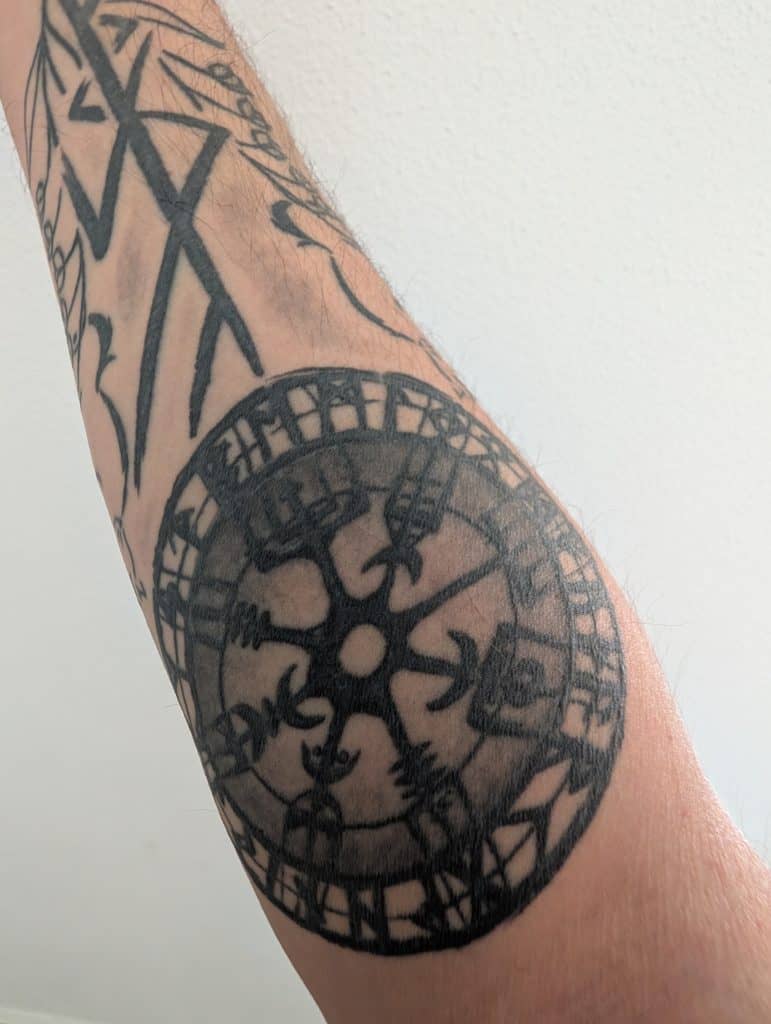
Miguel had a vegvisir, a 19th-century Icelandic symbol for wayfinding, tattooed down one arm, part of a full sleeve. I have one too, on my forearm, part of a tattoo I got in honor of Freyja, the Norse goddess of love, magic, and war. The old function of the symbol, according to the folklore around it, was to help a sailor find his way back to harbor no matter how far he’d strayed or how rough the water. I’ve always taken it more broadly than that: a promise that wherever life takes me, physically, psychologically, or spiritually, whether I go looking for it or it simply finds me, I can still find my way back. Miguel’s face lit up when he saw mine, and he spent several unhurried minutes explaining every element of his own design while other customers waited their turn behind us, another agent free to help them in the meantime. I left with the name of his tattoo artist and the quiet certainty I’ll use it eventually. In a country that keeps turning transactions into relationships, this was the clearest version of that yet.
On the way home, we stopped, as we do most days now, at the little corner convenience store a block from our apartment, the kind of place that sells a bit of everything, food, household basics, whatever you forgot at the bigger stores. The owner, a middle-aged Chinese woman who speaks more warmth than Spanish, has greeted us the same way three visits running: “mucho calor,” very hot, the first two times, when the heat sat at 100 and then 104 degrees, and “menos calor,” less hot, the third, when it finally eased. It’s such a small thing. It’s also exactly how she’s decided to build a relationship with two strangers who wandered into her shop a week ago, one weather observation at a time, and I love that I’m becoming part of her daily rhythm as much as she’s quietly becoming part of ours.
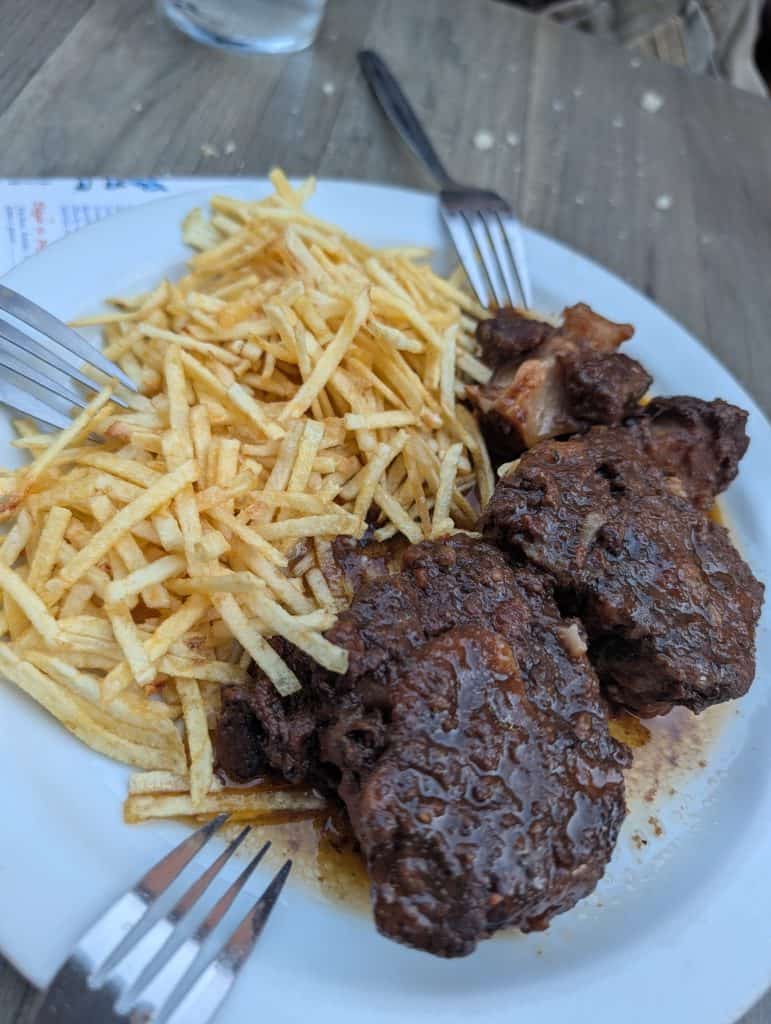
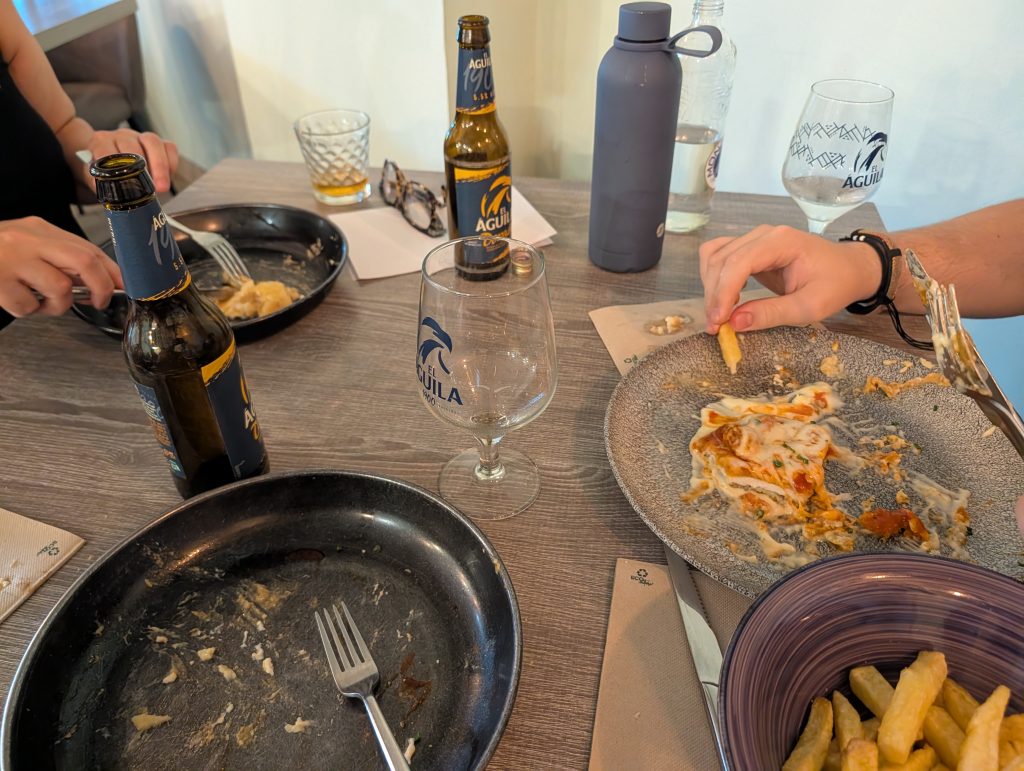
That night, we ate at Cervecería El Hidalgo, near Plaza San Diego, in the shadow of the University of Alcalá, the five-century-old institution the whole city grew up around. We ordered copas of beer and a ración of cured meats, chorizo, jamón, salchichas, and a rabo de toro I’m still thinking about. Our waitress worked more than a dozen outdoor tables entirely alone, never once losing her rhythm, and I left her four euros, a genuine outlier by local standards, where rounding up a euro or two already counts as generous and ten percent would be considered lavish. Some things are worth breaking the local rules for. We walked home realizing we were eating at 9:30 at night exactly the way Spaniards do, and it didn’t feel strange at all. It just felt like the schedule now.
By the end of the week, the apartment had internet, a day earlier than the technician had originally promised, a bank account, a family phone plan, two beds arriving on two different timelines from two different Spanish cities, and still no sign of A.’s phone. None of it was the adventure I’d pictured on the flight over. It didn’t need to be. A vegvisir was never about the destination. It’s a promise that you can wander as far as you need to and still find your way home. By the end of the week, we had.