
The charger lasted about ninety seconds. Long enough to feel like progress, short enough to feel personally insulting. Plug in, wait, watch the little blue light blink with what I can only describe as false confidence, vacuum for two minutes, die. Repeat a few times until we admitted the machine was never going to get better and drove it to Hipercor like a sick pet.
Except we don’t have a car, and Alcalá runs on buses, so “drove” is generous. What actually happened is only the smaller pieces fit into our grocery cart, the cord, canister, and attachments rattling around together like loose parts, while the vacuum’s own body and handle wouldn’t fit no matter how we angled it. I ended up carrying that part myself, gripped in both hands the whole way to the bus stop and then through the store, like some kind of medieval weapon. Nobody so much as glanced at us. Which, now that I think about it, might be its own small commentary on what counts as a normal Tuesday around here.
Hipercor is the hypermarket wing of El Corte Inglés, Spain’s largest department store chain and something of a national institution, the place everyone’s grandmother has a loyalty card for. It’s Spain’s answer to what happens when a department store and a supermarket have a baby, and the baby is enormous. Groceries, mattresses, television sets, motor oil, and yes, vacuum cleaners, all under one roof so large you could plausibly get lost looking for the exit.
We took the A1 bus in from the Casco Histórico, Alcalá’s old town, receipt in hand, budgeting twenty minutes for the whole affair.
We were off by more than forty.
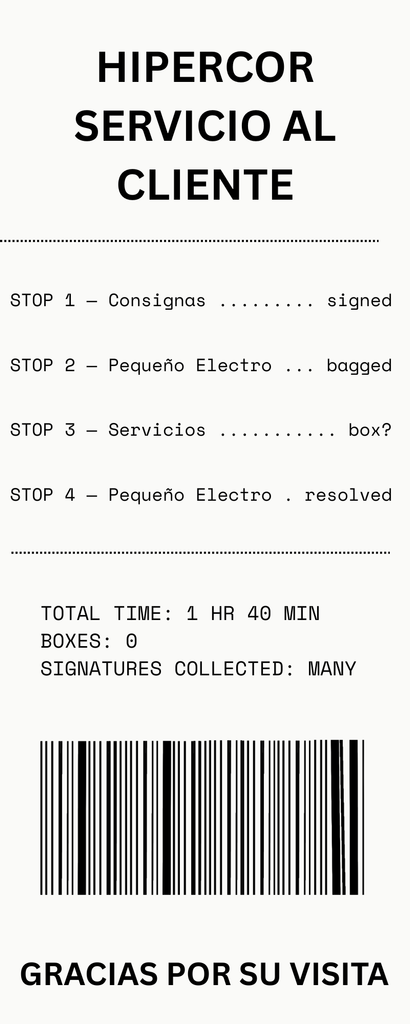
Stop one was right at the entrance, before we’d even properly gotten inside. A counter that looked like customer service. It was not. It was consignas, the desk for people picking up online orders, which is not us and has never been us. The woman working it didn’t miss a beat. She produced a slip with more blank signature lines than the situation seemed to require, signed one herself automatically, and directed us to the entrance to present it to the guard.
The guard signed it too, just as automatically, without even really looking at us, as if this happened forty times a day. For all I know, it does.
Small appliances turned out to be clear on the other side of the building, past groceries, past mattresses, past a wall of television sets, exactly the kind of walk the earlier line about getting lost looking for the exit had in mind.
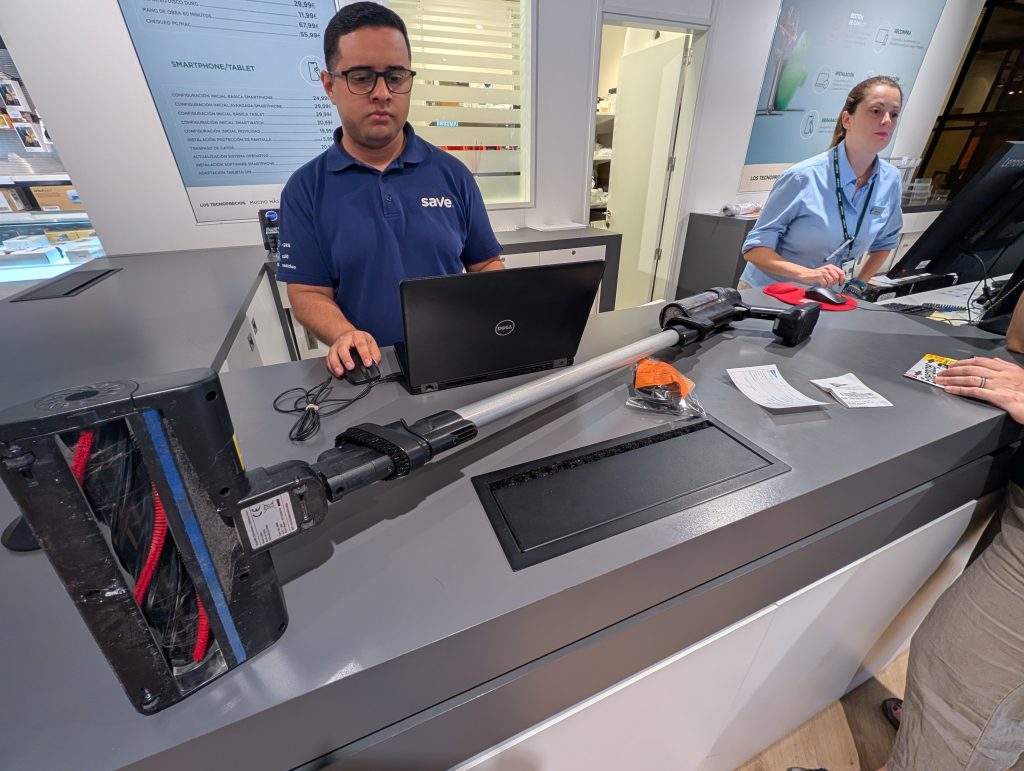
Stop two: small appliances, fans and toasters and the like. A friendly clerk took one look at our sad vacuum and got straight to business. Off came the charging cord, into a plastic bag it went, sealed shut like evidence at a crime scene. Given the nature of the alleged defect, she explained, this one needed to go to Servicios, third floor, to have the whole thing formally judged.
Stop three. Servicios is Spanish for the place where your expectations go to be politely managed. It’s also, more literally, where broken appliances get fixed. But since we’d bought the vacuum recently enough to still be inside the warranty window, we weren’t there for a repair. We were, it turned out, eligible for a straight replacement. Case closed, problem solved, new vacuum, everyone goes home happy. Except for one small detail.
Did we still have the box?
We had not. Having owned a fair number of vacuum cleaners between us over the years, neither of us had ever once been asked this. Apparently you’re just supposed to keep the box, for some undefined stretch of the warranty period, on the off chance the thing inside it ever needs to go back. Ours had gone out with the recycling days ago, blissfully unaware it might one day be missed.
The woman at the counter was lovely about it, genuinely, but she also treated the missing box as the real problem now, bigger than the vacuum, bigger than the dead battery. She frowned, disappeared into a back room, presumably to consult a higher authority on the matter of cardboard, and came back looking thoroughly stumped. Then came the phone call, to a manager stationed somewhere else in the building entirely. The verdict: nothing could be done here. Back downstairs we’d have to go, to the same small appliances clerk from stop two, to handle the exchange there instead. She said it the way you say something you’re not sure will work, more hope than instruction.
Stop four: small appliances, three flights back down, and the same long walk back across the floor in reverse. Both of us were fully committed to the bit by now. The same clerk from stop two took one look at us, box problem and all, and just smiled. She apologized for the runaround, lightly, as if the whole business with the missing box and the phone call had been some minor inconvenience she personally regretted, and then got on with it like there was no problem at all.
Here’s the part I didn’t see coming, and the part I only pieced together afterward, talking it over with my wife. Whatever had actually happened between Servicios and that phone call to the mysterious manager, the clerk downstairs already knew what to do the moment we walked back up to her counter. She didn’t have a spare vacuum lying around. What she had was a brand new one, still boxed, its battery and charger zipped into their factory bags like tiny electronic burritos. She opened it, pulled out the working parts, and handed them to us to put in our own vacuum. Then she took our dead ones and put them where the working parts had been, sealed the box back up, and set it aside. That unit, defective battery and all, would go back to the manufacturer in its original packaging, paperwork intact. Ours would walk out the door with no box at all. As far as anyone’s records were concerned, it simply no longer needed one. No form for that. No stamp. Somewhere between the third floor and the ground floor, in a phone call we never heard either side of, somebody had already decided this was the right thing to do. We never found out who.
The one moment of friction, and it was a small one, came when we asked if she could actually test the new battery before we left. She gave us a look, the kind that suggested this was a bit much, and I understood it: she’d just performed minor surgery on a floor unit without blinking, but plugging a charger into an outlet already sitting right there at her station, apparently, was the part that tried her patience. She did it anyway, without making us ask twice, and it worked.
Over an hour, four stops, six flights of stairs, the length of the building crossed and recrossed more times than I bothered counting, a slip covered in signatures nobody will ever look at again, and a vacuum cleaner that now runs on a stranger’s battery. Spain has a real gift for making the simplest errand feel like a small bureaucratic opera. Then, somewhere in the third act, when the process has tied itself in so many knots that nobody on the ground can actually make it work anymore, someone just quietly hands you what you needed anyway.
No fuss. No further forms. Problem solved, off the books, by somebody we never got to thank.