
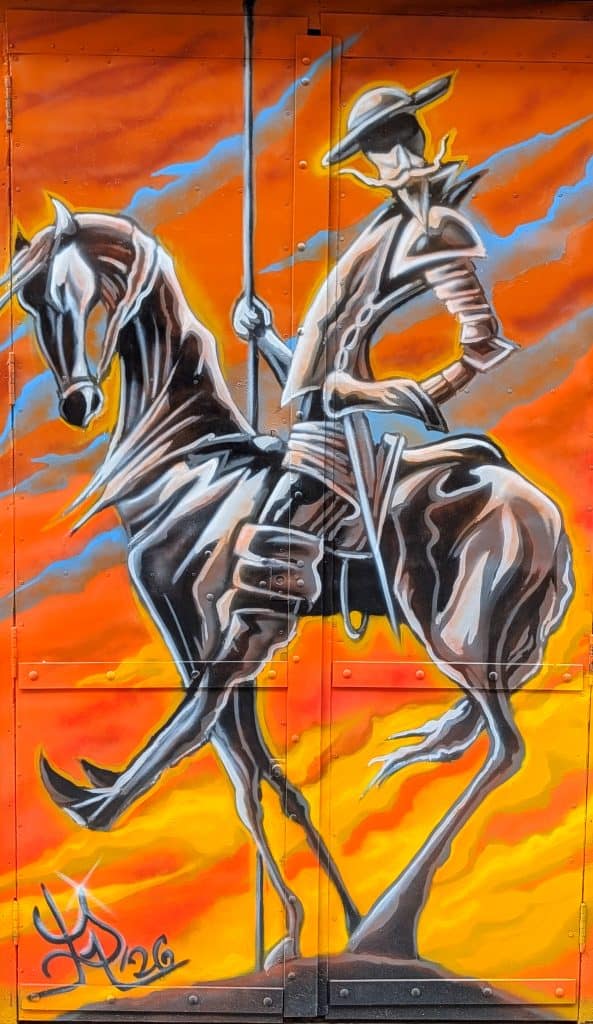
A Knight Without a Cause
We all need purpose. The hard part is figuring out what that purpose actually is.
Mine came, of all places, from a fictional character. Don Quixote, Cervantes’ aging knight who looks around at the world he lives in, decides it no longer fits him, and simply rides away to create his own story. He’s deluded, yes. Possibly mad. But there’s something in that impulse, to abandon the comfortable and familiar and go looking for something more alive, that I’ve never been able to shake.
So here I am. A Frenchman who spent thirty years in America, packing up his life in Silver Spring, Maryland and moving to Alcalá de Henares, Spain. The birthplace of Cervantes. The city where Don Quixote was conceived.
If that’s not a sign, I don’t know what is.
Thirty Years, One Continent, One Realization
I didn’t see this coming. Six years ago, if you’d told me I’d be leaving the United States, I would have laughed. I’d built a life in the Washington DC area: thirty years of it. Work, friendships, a sense of belonging. America had been good to me in more ways than I can count.
But life has a way of shifting the ground beneath you. When it did, I found myself looking honestly at something I’d quietly ignored for years: the distance between who I am and the culture I was living in. I was born in France, and though I don’t think of myself as narrowly French, there is something in me that connects deeply to a broader sense of European values. An old world sensibility, perhaps. A different relationship to history, to time, to what a good life actually looks like.
Going back to France was never really on the table. I’ve never been drawn to retracing steps. I wanted something genuinely new: a different language to wrestle with, a different history to walk through, a different way of being in the world to try on. I belong, I think, more to the human species broadly than to any particular patch of soil. And yet here’s the contradiction I’ve made peace with: I’m also deeply hungry to put down real roots somewhere. To know a place intimately. To become, over time, a genuine part of it.
Whether Spain turns out to be that place, I honestly don’t know yet. But it’s where I’m headed. And right now, that feels like enough.
The Slow Burn of a Life Too Fast
There’s a particular kind of exhaustion that creeps up on you slowly. You don’t notice it at first because everything around you is moving so fast that stopping to take stock feels like falling behind.
For a long time, the pace of American life suited me. The energy, the ambition, the sense that anything was possible if you worked hard enough, as a young man, these things were genuinely exciting. They pulled me forward. I was glad to be pulled.
But somewhere along the way, the calculus changed. The rising costs, the relentless hustle, the sense that no effort is ever quite enough, what once felt like fuel started feeling like a weight. I began to wonder whether I was living my life or just getting through it.
What I imagine in Alcalá, and I hold this loosely, knowing that no place is a cure for anything, is something simpler and harder to name. Streets where people actually stop and talk to each other. Cafés where an afternoon can be spent without guilt. A community that builds itself around human connection rather than productivity. The quiet reassurance of knowing that your most basic needs, your health, your dignity, are not contingent on your output.
A life, in other words, that moves at a human pace. Not slower exactly. Fuller. There’s a line I keep coming back to as I prepare for this move: I want to live fully rather than promptly. To stop burning myself out in pursuit of a goal that keeps moving just out of reach.
Maybe Alcalá will give me that. Maybe I’ll arrive and discover I’ve romanticized the whole thing.
But the only way to find out is to go.
Why Spain — and Why History Still Matters
If you ask me to name the moment medieval Spanish history stopped being an academic interest and became something more personal, I’d struggle to answer. It happened gradually, the way the most important things usually do.
What drew me in was a world that shouldn’t have existed. In 10th century Córdoba, under the Umayyad Caliphate, something genuinely remarkable took shape: a city where Muslim scholars, Jewish philosophers, and Christian thinkers not only coexisted but collaborated. They translated ancient Greek texts, built libraries, wrote poetry, and advanced medicine and astronomy while most of Europe was fumbling in the dark. Córdoba was, by some accounts, the largest and most sophisticated city in western Europe at the time. The Spanish call it convivencia, coexistence, and historians debate endlessly how harmonious it truly was. But something real happened there. And its echoes are everywhere in Spain today.
You hear it in flamenco. You taste it in the food. You see it in the architecture: the horseshoe arches, the geometric tilework, the patios built for shade and conversation. Even the Spanish language carries it, threaded through with Arabic words that most speakers never think about. Ojalá, God willing. Aceite, oil. Almohada, pillow. A civilization absorbed into the texture of daily life.
This is what moves me about Spain in a way that France or Italy, for all their beauty, never quite did. It is a place where history didn’t just happen. It accumulated, layer upon layer, and stayed.
And then there is the language itself. At the most practical level, Spanish opens doors: to people, to experiences, to opportunities that stay closed otherwise. But that’s the least interesting thing about it. Languages don’t just communicate the world. They reveal it differently. They hand you new ways of seeing.
There is a Spanish word, sobremesa, that means, literally, “upon the table.” It also refers to the time after a meal when no one gets up. When the plates are cleared and the conversation deepens and the afternoon simply continues. There is no real English equivalent because the concept doesn’t quite exist in the same way in English-speaking culture. The moment you truly absorb sobremesa, not just as a word but as a practice, as a value, something shifts in you. You start to see that an unhurried hour after lunch is not wasted time. It is, perhaps, the point.
That is what learning a language does at its best. It doesn’t just add vocabulary. It expands what you’re capable of noticing. I want to become genuinely trilingual not as an achievement but as an ongoing act of becoming more fully human.
Spain, of all the places I could have chosen, seems like the right classroom.
The City That Called Me Home Before I’d Ever Been There
Coming back to Europe was never really in question. The question was always where.
I grew up in a small village in southwestern France: a handful of stone houses gathered around a plaza, and at its center, a 12th century church that had been standing since the Crusades. It was not a place that appeared in guidebooks. Nothing dramatic had happened there, at least nothing the wider world had noticed. But that church, and the centuries it represented, were simply part of the landscape of my childhood. The past was not something you visited. It was something you lived inside.
Thirty years in America gave me many things. But that particular feeling, of being held by history, of walking streets that remember more than you do, was not one of them. I hadn’t fully understood how much I needed it until I started to feel its absence like a dull ache.
My wife and I had settled on Madrid as our destination for practical reasons. It made sense professionally and personally, and it remains one of Europe’s great cities. But living in the middle of it, the scale, the noise, the relentless energy of a capital, wasn’t quite what we were after. We wanted proximity to all of that without being consumed by it.
It was my wife who first suggested Alcalá de Henares. I had never been. I knew the name, knew it was the birthplace of Cervantes, but had no real picture of it. So we visited.
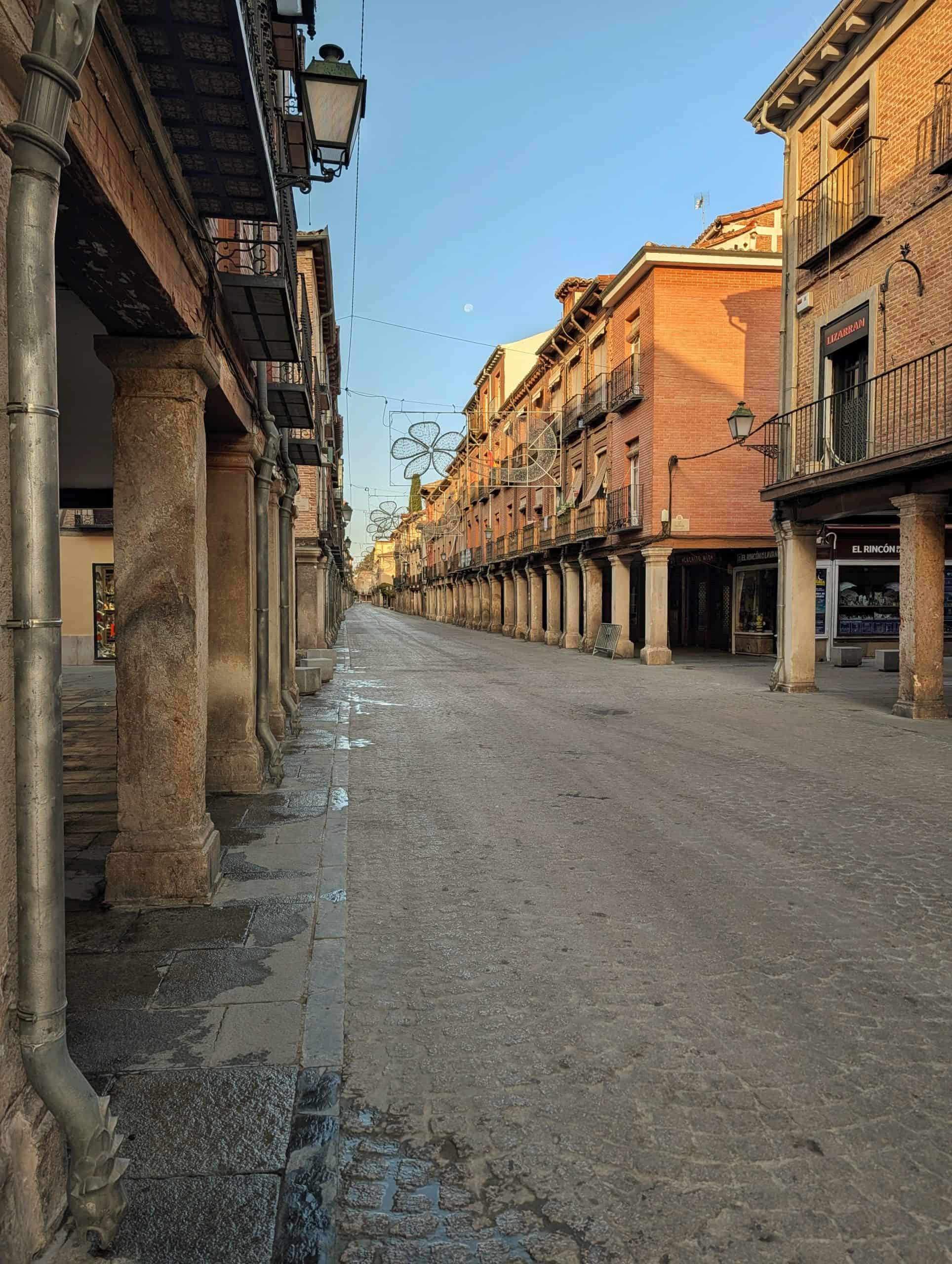
I understood immediately.
Alcalá is a city built around a university founded in 1499 by Cardinal Cisneros, one of the most powerful figures in Spanish history. Its historic center is a UNESCO World Heritage Site. Its streets are lined with Renaissance architecture, arcaded walkways, and stone facades that have been standing since the time of King Ferdinand and Queen Isabella. The Catedral Magistral, a cathedral whose clergy, uniquely in the world, are required to hold academic degrees, sits at the heart of the city. The house where Cervantes was born still stands, now a museum, on a street that has barely changed in five hundred years. Roman ruins lie beneath the modern city, remnants of Complutum, the settlement that preceded Alcalá by more than a millennium.
And yet for all of that, it doesn’t feel like a museum. It feels like a town where people actually live: where students fill the cafés, where neighbors greet each other in the plaza, where history is simply backdrop to ordinary daily life. That combination, living history rather than preserved history, is exactly what I had been missing without knowing how to name it.
The Don Quixote parallel, which I mentioned at the beginning of this post, felt complete the moment I walked those streets. If I was going to set out on my own small adventure, to build a new chapter from scratch, there was a certain rightness to beginning it in the city where Cervantes first imagined his knight errant. Some coincidences are too good to ignore.
Leaving Is Never Simple
I want to be honest about something.
This post has been, for the most part, a story of forward motion: reasons and passions and the pull toward something new. And all of that is real. I am genuinely excited about what comes next. There is a part of me that believes this move will re-energize something that had grown tired. The newness of it all: the daily small adventures, the language, the streets, the gradual process of building a life from scratch. All of it pointing toward feeling more alive than I have in years.
But leaving thirty years behind is not a clean thing, even when it’s the right decision.
There is the place itself: Silver Spring, the DC world, the routines and rhythms that have become so familiar they’re almost invisible. The coffee shop, the drive, the particular quality of a Sunday morning in a neighborhood you know by heart. Comfort, for all its limitations, is not nothing. A more conservative instinct would say: you have built something here, you know how this works, why not simply coast? It’s a reasonable voice. I’ve heard it. I’ve chosen not to listen to it. But I’ve heard it.
And then there are the people. Friends and family physically left behind: the heart and soul of any lived experience, what makes a place a place, what makes a place home. No amount of excitement about a new chapter makes that part easy. The hope, of course, is that genuine connection survives distance, that the transatlantic gap proves smaller than it looks on a map. I believe it will. But believing it and feeling it are two different things, and right now, standing on this side of the move, I feel both.
The bittersweet is part of the story. I’d rather tell it honestly than pretend the leaving is simple.
Welcome to Alcalá & Away
So who is this blog for?
It’s for you, the adventurous heart. Not necessarily the person who jumps out of planes or ticks countries off a list, but the one who walks into an unfamiliar city and wants to understand it rather than simply photograph it. The one who believes that a place is not a museum set up for your entertainment, but a living thing, full of people and history and lessons, if you’re willing to slow down enough to receive them.
It’s for the person who values connection: to people, to place, to the deeper currents of history that run beneath the surface of everyday life. Who approaches a new culture not as a consumer but as a student. Who understands that the world, and the people in each corner of it, are teachers, if we come to them with respect and genuine curiosity.
If you value living slower but fuller, if a long lunch conversation matters more to you than an efficient itinerary, if you’d rather understand one place deeply than skim across ten, then you’re exactly who I had in mind when I decided to do this.
Alcalá de Henares is where this story begins and where it will always return. It is my new center: the place I am building a life, putting down roots, and learning to belong. But a center exists to go out from as well as to come back to. From Alcalá, the roads lead everywhere: across the Comunidad de Madrid, deeper into Spain, and eventually beyond. Every post in these pages, whether about a street in Alcalá or a city two hours away, starts and ends here.
That is what Alcalá & Away means. The ampersand, the & symbol, is the hinge: this place, and wherever it takes us next.
There is no efficient itinerary for what I’m trying to do here. There is only the place, and the time you give it, and what happens when you pay attention.
One Last Thing
There is a song by Jacques Brel, a Belgian singer who wrote in French, that captures perhaps better than anything I know what it means to burn for something just out of reach. The song is called La Quête. You may know its English version as “The Impossible Dream.” It was written for a musical about Don Quixote.
Of course it was.
The song is built around a single, stubborn image: a man who sets out to chase a dream everyone has told him is impossible, to go where no one else is willing to go, all in pursuit of a star he has no real hope of reaching. He doesn’t chase it because he expects to succeed. He chases it because the chasing is the only way he knows how to be fully alive. That distinction has stayed with me since I was young, long before I had any plan to live in the United States or had ever set foot in Alcalá.
I don’t actually know if Spain will give me what I’m hoping for. I don’t know if the slower pace survives the romance of arrival wearing off, or if thirty years of friendship can hold across an ocean. The man in Brel’s song never reaches his star either. That was never the point. The point was setting out anyway, eyes open, knowing exactly what it might cost.
I arrived in Alcalá on July 29th. I won’t tell you everything about these first days just yet. That deserves its own post. But I will say this: some places meet you halfway. Some places feel, from the very first walk through their streets, like they have been waiting for you to figure out that you belonged there.
Alcalá was that kind of place. And whether or not I ever fully reach whatever it is I came here looking for, I no longer think that was ever really the question.
Great blog Alain, I can’t wait to read more. 🤗. I will be sending it to a few friends.
Thank you Tory! Have a great time on your own journeys!