We already knew it would be closed. Research done well before the trip had made that much clear. And yet some irrational part of me had still hoped we’d get there and find it open anyway, the way you keep refreshing a canceled flight’s status hoping the app got it wrong. Knowing didn’t make standing at the fence feel any less disappointing.
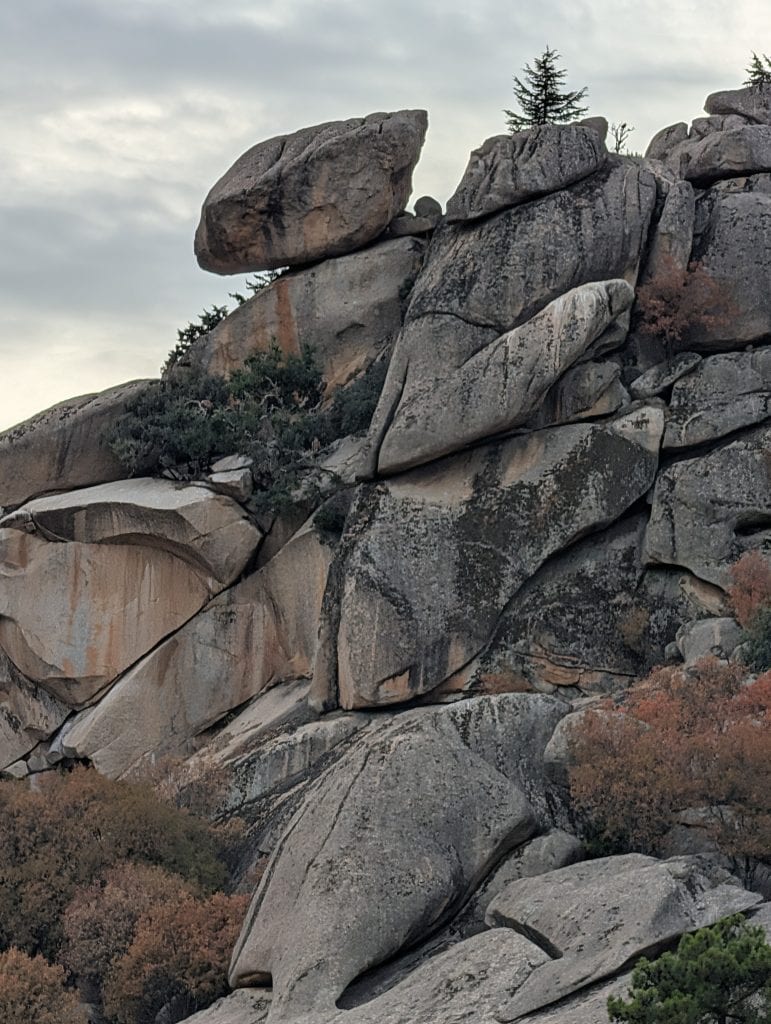
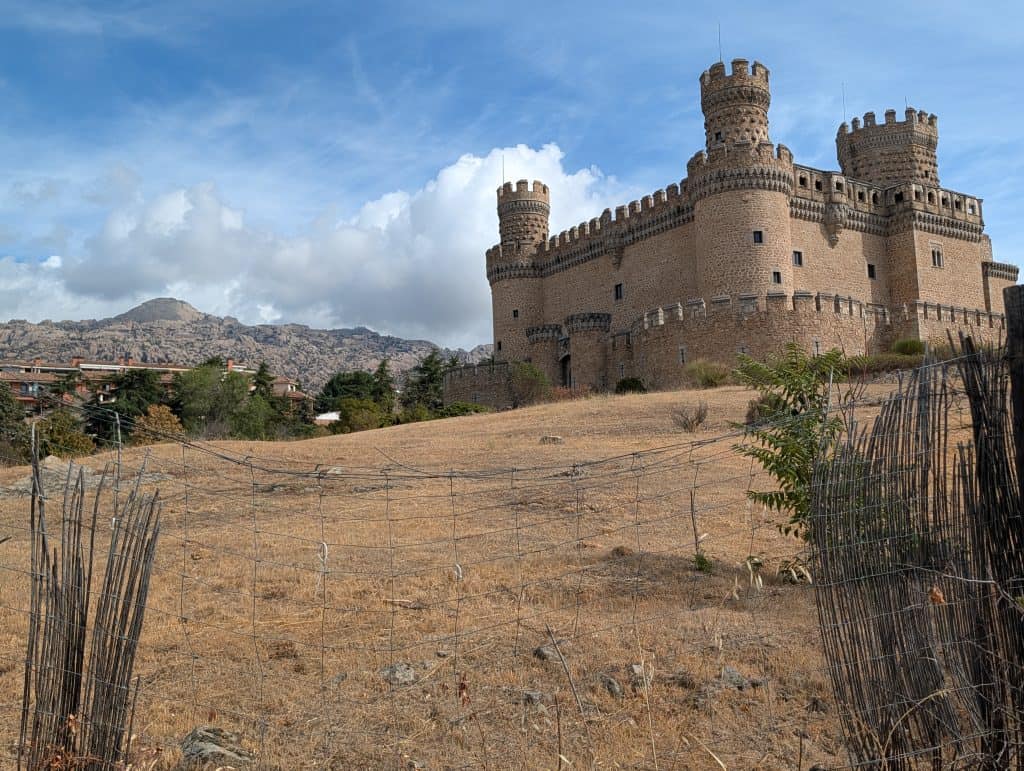
At the main entrance, the fence gave us nothing at all: trees on the other side grew thick enough to block the castle from view entirely. Not ready to give up on at least a glimpse, we walked on down the street looking for a better vantage point, and eventually found one through what looked like a service gate further along. That’s where we finally saw it: round towers and a Gothic courtyard, and I got what photos I could. La Pedriza rose up behind it in slabs of pale granite. The castle is one of the best-preserved in Spain, and it sits closed for reasons that have nothing to do with the fifteenth century and everything to do with the twenty-first.
We’d come up from Madrid for a single day, the three of us, my wife and her thirteen-year-old son along for a town most day-trippers use only as a trailhead into the mountains behind it. The heat that August ruled out any real hiking anyway; La Pedriza’s granite would have to wait for a cooler trip. That was fine by us. Most people drive through Manzanares el Real without stopping; we’d come specifically for what they were driving past.
Two Castles, Locked for Different Reasons
Manzanares el Real has had two castles, and the one everyone photographs isn’t the one that came first. The Castillo de los Mendoza is the storybook fortress with round corner towers that shows up on every postcard of the Sierra de Guadarrama, and it’s the one we’d just been peering at through a service gate. Construction began in 1475 under Diego Hurtado de Mendoza, first Duke of the Infantado, a title that would make his family one of Spain’s most powerful noble houses for the next five centuries.
In 1520 the crown raised the title further still, to Grandee status, the single highest rank in Spanish nobility, outranked by nothing except the king’s own children. His son, Íñigo López de Mendoza, finished the castle with the architect Juan Guas, the same hispano-flemish master who built the Palacio del Infantado in nearby Guadalajara.
Its Gothic isabelino style, the decorative idiom of Isabella I’s reign, favored pointed arches and heraldic ornament, the kind of architecture built to be looked at as much as defended. It worked: the castle is still one of the region’s most recognizable buildings, important enough to have hosted the actual signing of the Comunidad de Madrid’s founding statute in 1983.
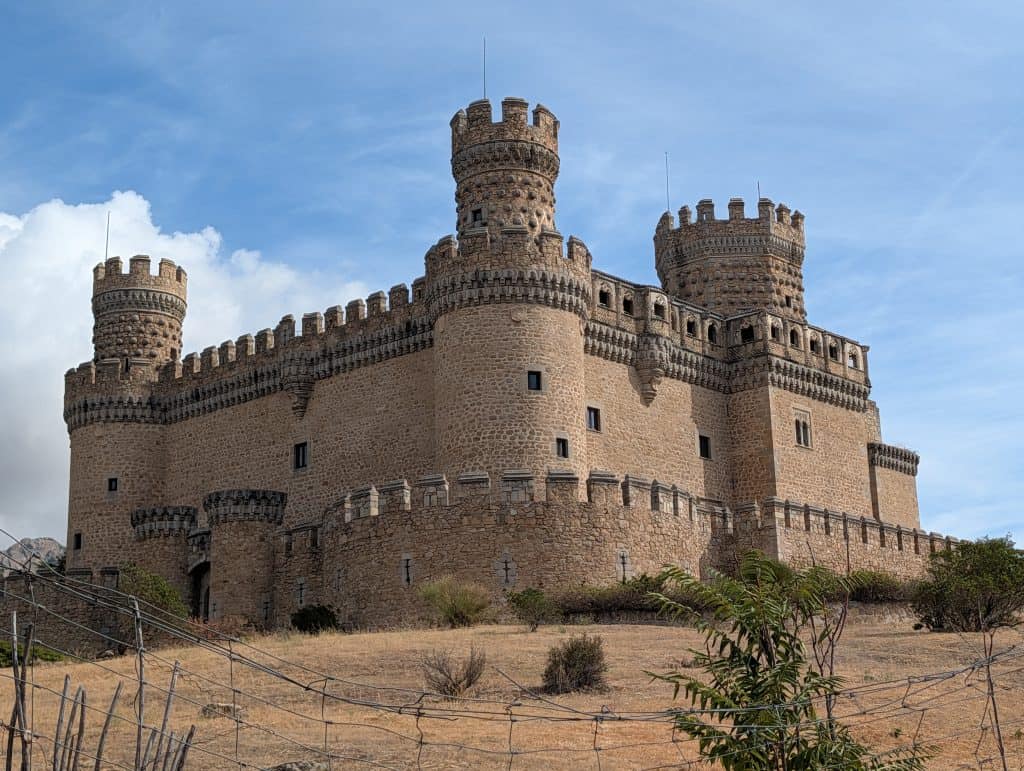
None of that history was visible to us. The Casa Ducal del Infantado reclaimed management of the castle from the regional government in January 2025, after more than sixty years of the Comunidad de Madrid running it as a public attraction, and only then discovered that the family didn’t hold the activity license required to operate the site privately. Spanish law classifies the land itself as rural rather than developable, a status it calls rústico, and that classification blocks any commercial license outright. Lifting it requires the town to formally amend its own zoning rules, a process that by the time we visited had dragged on for a year and a half, with a provisional license still somewhere in the pipeline. Everyone loses in the meantime: the family that owns the building, the town whose restaurants and shops depend on castle traffic, travelers like us. We stood outside a locked gate with nothing to do but read the plaque.
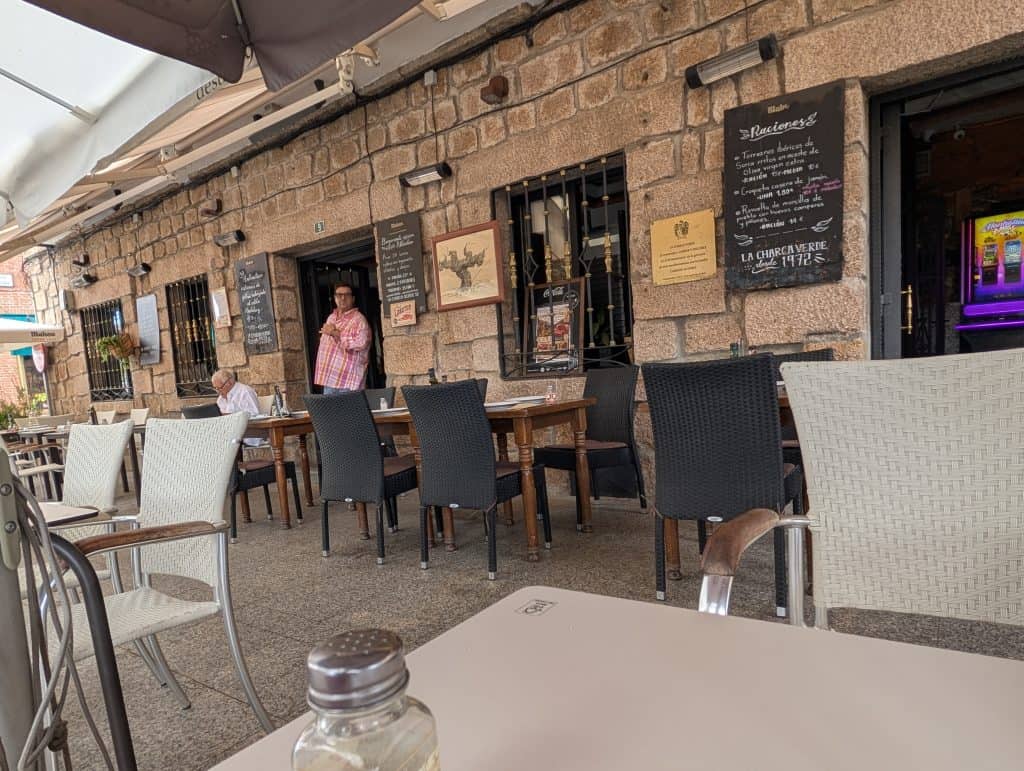
We left the castle behind and walked it off, ten minutes down Calle Real through the middle of town, sweating by the second block. The town was busy in its own unhurried way despite the heat. A cluster of old men sat together somewhere along the street, leaning on their canes and working through the morning at their own pace. A small flea market had set up near the church, a handful of stalls selling mostly clothes and women’s accessories. Past a small fountain, the terrace at La Charca Verde was full of people nursing coffees, and the small businesses around the square were open and doing a quiet trade, locals running errands and greeting each other like people who’d known each other their whole lives. Whatever this town is for the tourists driving through toward La Pedriza, it clearly still belongs to the people who actually live there.
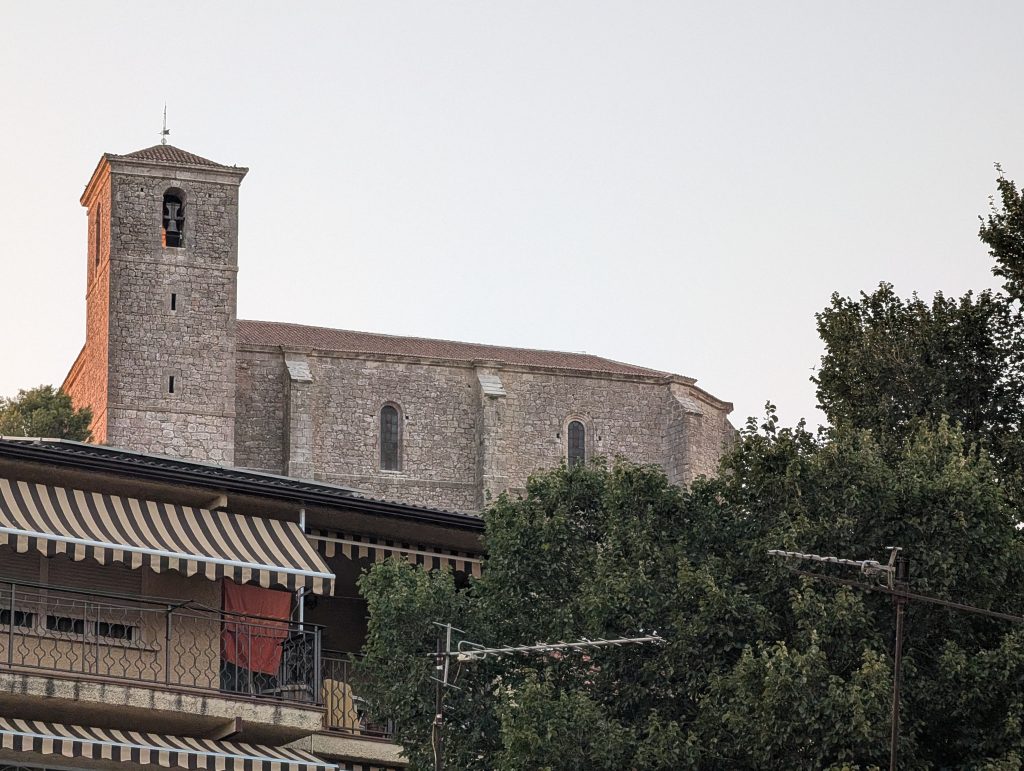
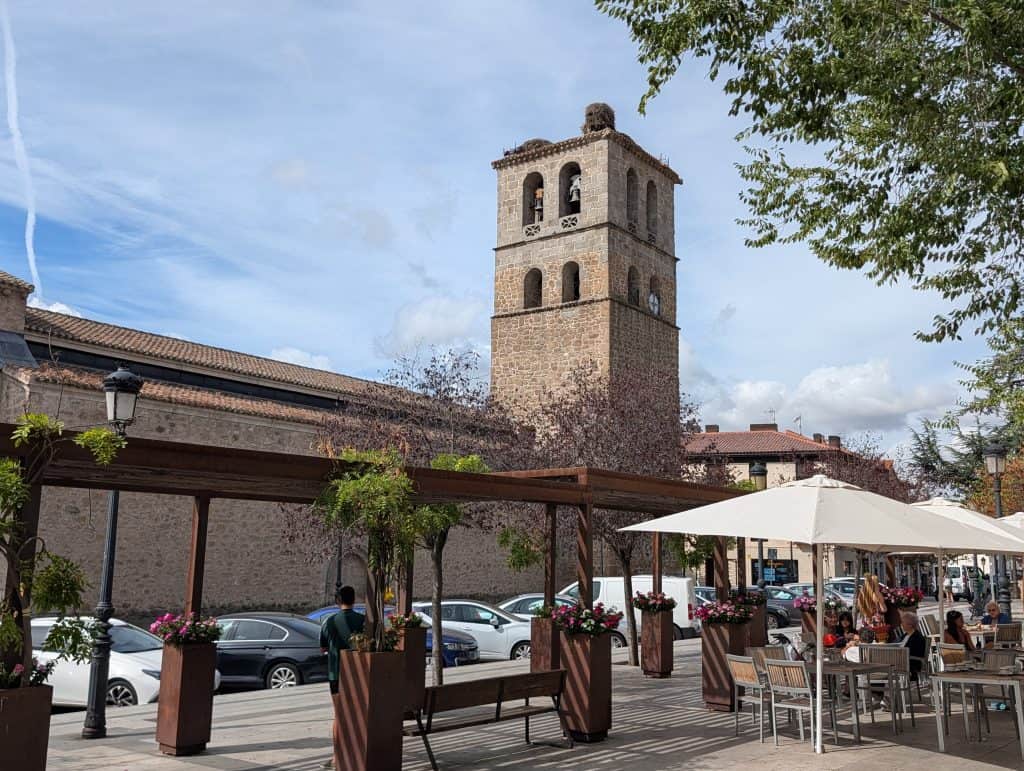
The street eventually took us past the church itself, its tower catching the late-morning sun. We crossed the old stone bridge we’d circle back to properly a little later, and the street opened onto a fenced garden of bare walls that didn’t look like much from where we stood.
This was the Castillo Viejo, literally “the old castle,” and it’s really the reason the newer castle exists in the first place. The sign posted right at the ruins calls its origin an open mystery: maybe King Alfonso XI built it, maybe an earlier lord of the Real de Manzanares, nobody really knows. That’s not quite true anymore. The sign just hasn’t caught up with the town’s own archaeologists yet. The town’s own archaeologists wrapped up a four-year excavation not long before our visit and wrote it up in a peer-reviewed journal, one that’s actually sorted out most of what the sign still shrugs at.
What stands there began as an unfortified palace, already old enough by 1346 to need King Alfonso XI’s own carpenters sent in for repairs. Its walls once carried a Segovian style of stucco relief, carved circles and eleven-pointed stars of the kind you’d otherwise find on grand houses in Segovia itself. That decoration has since turned up sealed behind later stonework.
Sometime in the mid-fifteenth century, that palace got fortified into something that actually looked like a castle: round corner towers, a squared keep, walls built to a design borrowed from a school of Castilian castle-building centered on Valladolid.
The person most likely behind that change wasn’t the duke who’d later finish the new castle. It was his grandfather, an earlier Íñigo López de Mendoza who carried the same name two generations before him: first Marqués de Santillana, and a celebrated poet in his own right. Tradition holds he wrote some of his Serranillas, short pastoral poems about chance encounters with country girls, right here. A coin turned up inside the keep, dated to around 1471 to 1474, right around the time the building stopped being used.
The new castle broke ground in 1475, and the old one wasn’t so much torn down as simply let go: decommissioned, stripped of whatever carved stone was worth hauling off, and left to the weather. It spent the next few centuries as farmland, then picked up a cemetery against its south wall in the nineteenth century. What’s left today is four standing walls inside a fenced garden, hardly a castle by the time you’re looking at it. I didn’t bother taking a picture; there wasn’t much to point a camera at. But the ground underneath is still being read by archaeologists one careful layer at a time, which might be the actual point: everything interesting about this place happened out of sight, and stayed that way until someone finally went looking.
The Church That Cost the Village Its Parish
Between the two castles stands the Iglesia de Nuestra Señora de las Nieves, and it exists because of an act of quiet expropriation. Toward the end of the fifteenth century, the same Íñigo López de Mendoza who’d finished the new castle, by then styled the second Duke of the Infantado, folded the town’s older parish into the castle grounds. That parish was dedicated to the Virgen de la Nava. It was absorption of the kind a private estate practices on whatever sits inconveniently in its path. In exchange, the Duke had a new church built for the village, raised alongside the castle itself and sharing two of its architects: Juan Guas, who’d also designed the castle’s south gallery, and Lorenzo Vázquez de Segovia, architect to Pedro González de Mendoza, the so-called Gran Cardenal, a Mendoza churchman powerful enough in his own lifetime to be nicknamed Spain’s third king.
Guas vaulted the chancel, the space around the altar, in plaster shaped to imitate carved limestone. It blends into an early, restrained strain of Italian Renaissance style added later, in a 1511 expansion to the south. Even the bell tower carries the same isabelino ornament, small stone spheres called bolas mendocinas, as the castle down the road, an unplanned echo between the two Mendoza buildings.
We found the door locked and didn’t go inside. The garden was locked too, its own gate shut when we tried it, so I never actually stood among what’s kept there: several discoid funerary stelae from the thirteenth and fourteenth centuries, carved with Greek crosses and worn soft by five or six hundred years of weather, probably relocated here from an even earlier church that once stood beside the castle itself. I only know that much from the panel propped outside the fence. Older than the church itself, older than either castle, they’re probably the closest the town center gets to feeling genuinely ancient rather than merely historic, though I’ll admit I’m taking the panel’s word for that rather than my own.
The church’s own history hasn’t stayed nearly that gentle, though. Its worst day came on May 14, 1769, during the town’s Fiestas de la Peña Sacra, when a fire tore through the building. It gutted the tower’s spire, the coffered wooden ceiling, and the baptismal chapel, permanently changing how the church looks today.
It wasn’t the last disaster either: the building took heavy damage again in 1936, during the Spanish Civil War. What’s standing now is really the result of a long, uneven recovery, restorations in 1946, 1970, and 1995, and finally a careful, dedicated rebuild between 2010 and 2012 that spent 1.6 million euros trying to undo what the earlier, cruder repairs had gotten wrong.
A Bridge Built for Sheep
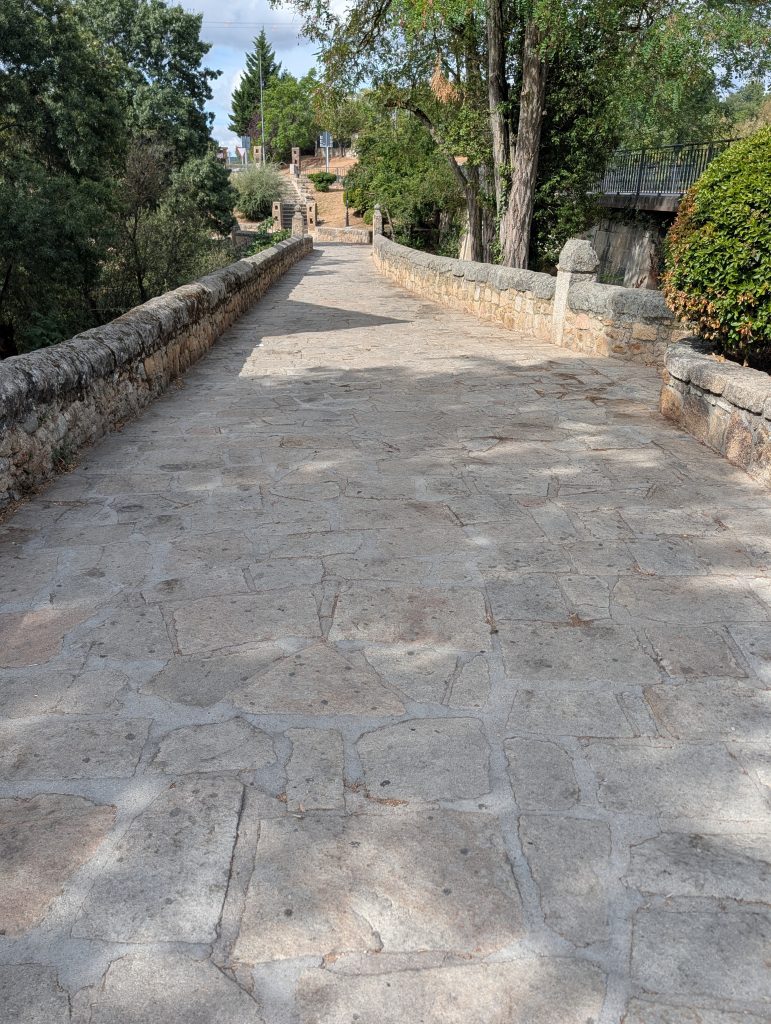
From there we walked down to the Puente Viejo, grateful for a moment near water in that heat. It’s a single stone arch over the río Manzanares that has spent most of its life as an economic instrument rather than a scenic one. This was the required crossing point for the Cañada Real Segoviana, one of the great droving routes that carried migratory flocks between La Rioja and Extremadura twice a year. King Alfonso X formalized it as a protected right of way back in the thirteenth century, specifically to protect the shepherds, merchants, and livestock using it. They paid a toll, the pontazgo, to cross, and that toll was a genuine source of income for the lords of the Real de Manzanares for centuries.
Flooding destroyed the original wooden bridge more than once. Builders rebuilt it in granite in the sixteenth century, and it still took a beating after that: the worst flood, in 1680, wiped out every other bridge and mill along the river. The rebuilt bridge rests directly on the natural rock of the banks, and one of its parapet posts still carries an inscribed date, 1792, from its last reconstruction.
Look upstream from the bridge and you can still make out the remains of a paper mill that opened here in 1837, the first continuous papermaking factory built in Spain. It fed the mid-nineteenth-century boom in newspapers and, more improbably, supplied paper for the Boletín Oficial del Estado, Spain’s own government gazette. A toll bridge built for sheep, quietly feeding paper to the state’s own record of itself a few centuries later, felt like exactly the kind of unbillboarded fact this town seems to specialize in.
I left my wife and her son in the shade, gladly excused from the project, while I tried to get one clean shot of the bridge, one bank, then the other, then back again, never quite landing it. A newer road bridge runs alongside the old one, close enough to crowd it, and the undergrowth along the banks has grown in thick enough to make a clean photograph nearly impossible. Even the information panel has stopped fighting the weather: the text has faded down to a guess in places, and nobody’s bothered replacing it.
It’s a small landmark, and an underserved one. Standing there failing to get a decent picture of it, I kept thinking about how a place like this actually disappears. Not through any single disaster, just neglect: one unmaintained sign, one crowded riverbank, repeated across enough towns and enough years that an entire generation stops remembering there was ever anything here worth looking at.
Lunch That Refused to Be Rushed
By midday we’d earned a stop, and Restaurante Parra gave us one that ran longer than planned. It’s a Castilian institution, open on the same corner since 1973, and we sat outside under the kind of afternoon light this town seems to specialize in. The fixed daily menu, the menú del día, came to sixteen ninety a head, bread and a drink included. First came a bowl of gazpacho andaluz that did more for the heat than the shade did, followed by a German-style roasted pork knuckle, codillo al horno, estilo alemán, rich enough to make me briefly forget how hot it still was outside. Rice pudding, arroz con leche, and tiramisu closed things out, shared between the three of us.
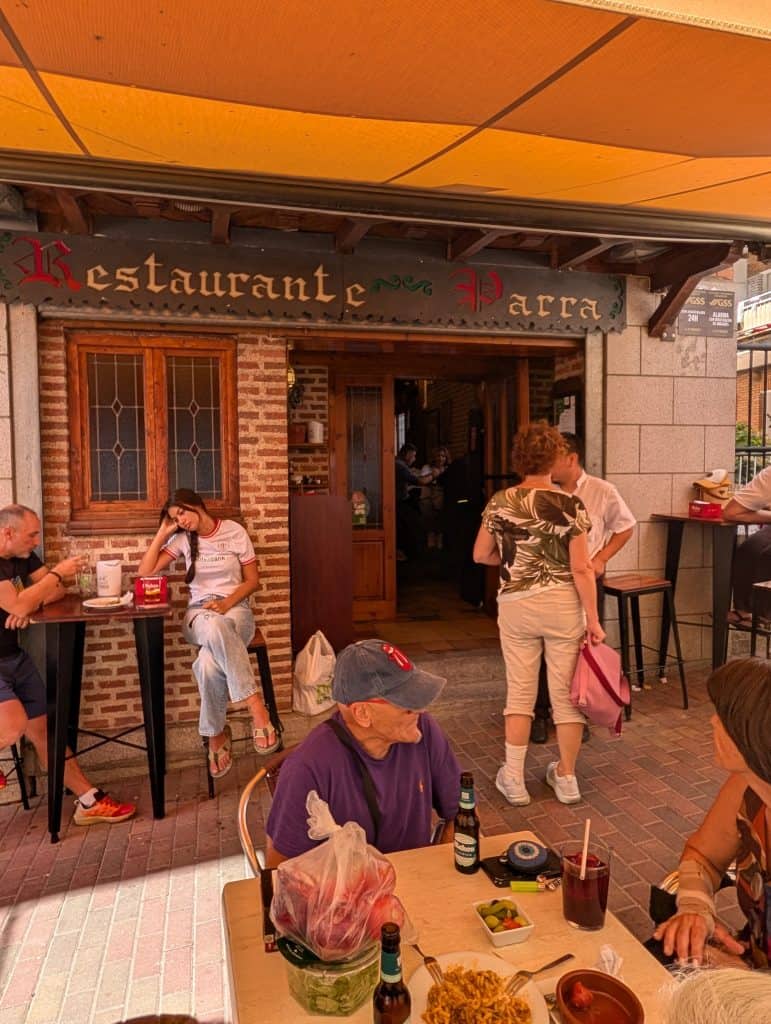
We were at that table for the better part of two hours, and nobody rushed us. I’ve already written at length about what a lunch like this taught me about sobremesa. This was the actual table I was thinking of when I wrote it.
Cold Water at the Foot of the Mountains
By early afternoon the heat had become the day’s real antagonist, more than any locked gate. Manzanares el Real sits high enough at the base of the Sierra de Guadarrama that it runs noticeably cooler than Madrid or Alcalá, but noticeably cooler in August still means hot. My wife’s ankle has been bothering her on and off since late July. She’s a good sport about it, always ready for a walk, but that afternoon it was clearly cutting into her enthusiasm, and it wasn’t going to tolerate much more. Her son’s patience for another closed monument and my own tolerance for standing in direct sun were running just as low.
We’d hoped to reach the Charca Verde, a natural swimming hole tucked inside La Pedriza itself, the sprawling field of granite boulders and outcrops that gives this whole stretch of the Guadarrama its dramatic silhouette. We got there too late: the nearest parking area had already closed for the day, and reaching the pool on foot from the main lot would have meant several more kilometers nobody had the legs for.
We settled instead for the town’s own municipal pool, and it turned out to be exactly what the day needed: a big grassy plot dotted with trees, a clean public pool, almost nobody else there on a weekday, and a genuinely low entrance price for three people to spend the whole afternoon. Her son finally got to be in water instead of just near it, which did more for his mood than any castle would have.
What the Rock Remembers
We saved the best of the day for last, almost by accident. The Ermita de Nuestra Señora de la Peña Sacra sits directly on top of an enormous granite outcrop at the edge of La Pedriza, the rock itself doing more visual work than the modest chapel built on it. It’s the only one left standing of seven hermitages the town once raised in honor of its saints. The current chapel went up at the end of the fifteenth century in local granite, though the town’s own account calls the site’s origins ancestral, older than the building itself: nearby evidence of an earlier settlement suggests the spot may have stayed sacred straight through whatever change carried it from one use to the next.
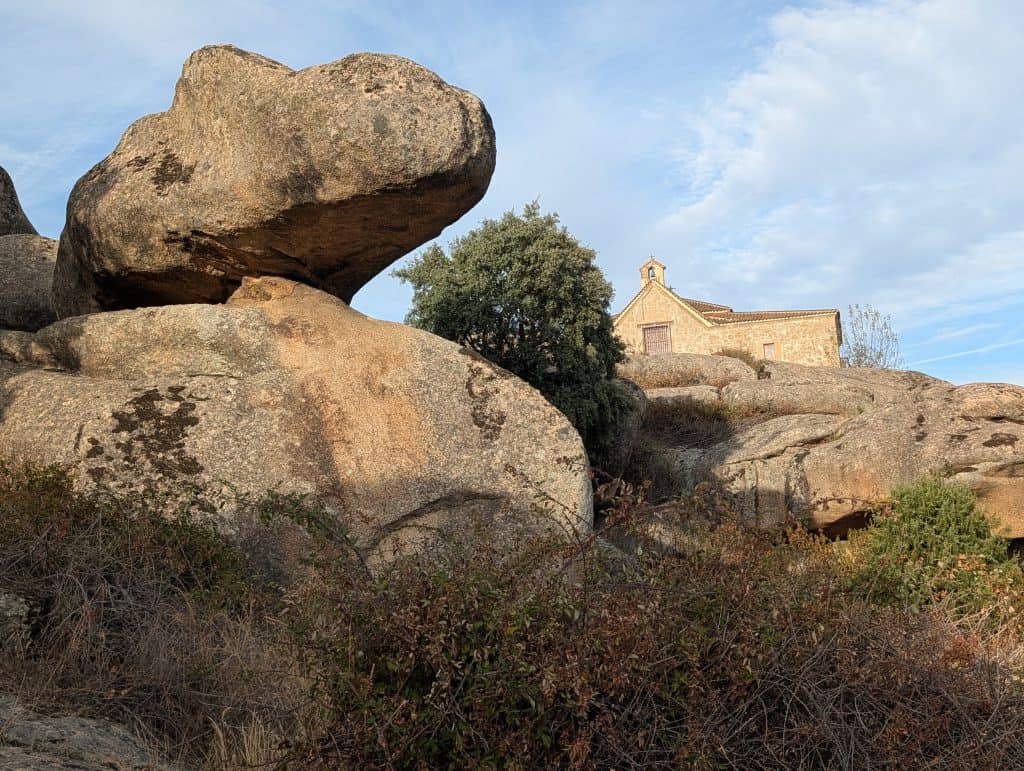
Its own yearly festival, still held today, turned out to be the very one that was underway back in 1769 when fire tore through the church we’d stood outside earlier that day. Even the Pentecost pilgrimage that keeps the tradition alive now ends with a meal at a nearby rock formation, the Canto Redondo, a custom that same account hedges as echoing some unspecified prehistoric rite.
That hedge has its own paper trail. The historian Bernaldo de Quirós wrote almost the same “maybe” back in 1923, and nobody serious has managed to firm it up since.
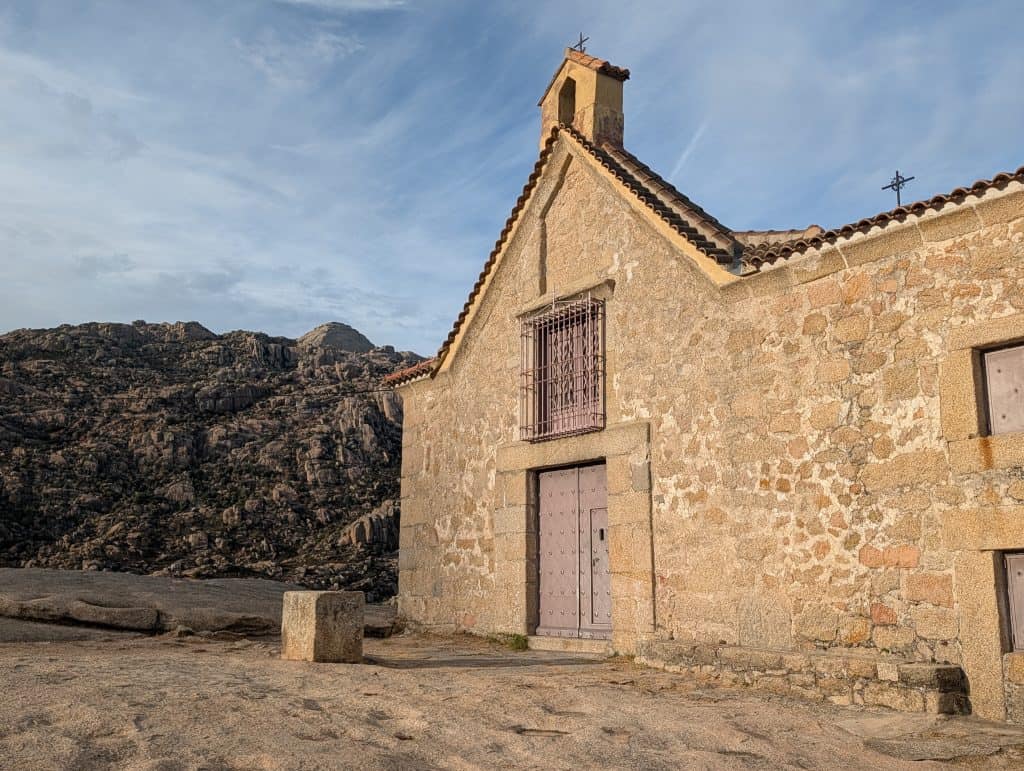
What the actual scholarship argues isn’t that some pagan rite survived intact. It’s that the site itself never really stopped being treated as sacred: the same water-catching basins, the same alignment with where the sun sets behind the hills, carried forward under a different name and a different god. What’s certain is that people have kept returning to this particular rock for reasons that changed entirely without the rock itself changing at all.
There was no one else there when we arrived. I sat facing the ermita with the sun still well above the horizon, in something close to a meditative state. I didn’t know yet what the research would later turn up, but I could already feel that the place was carrying something, the kind of accumulated energy I think certain sites hold onto long after the reasons for it change. It turned out I wasn’t wrong to feel that. I just didn’t yet know why.
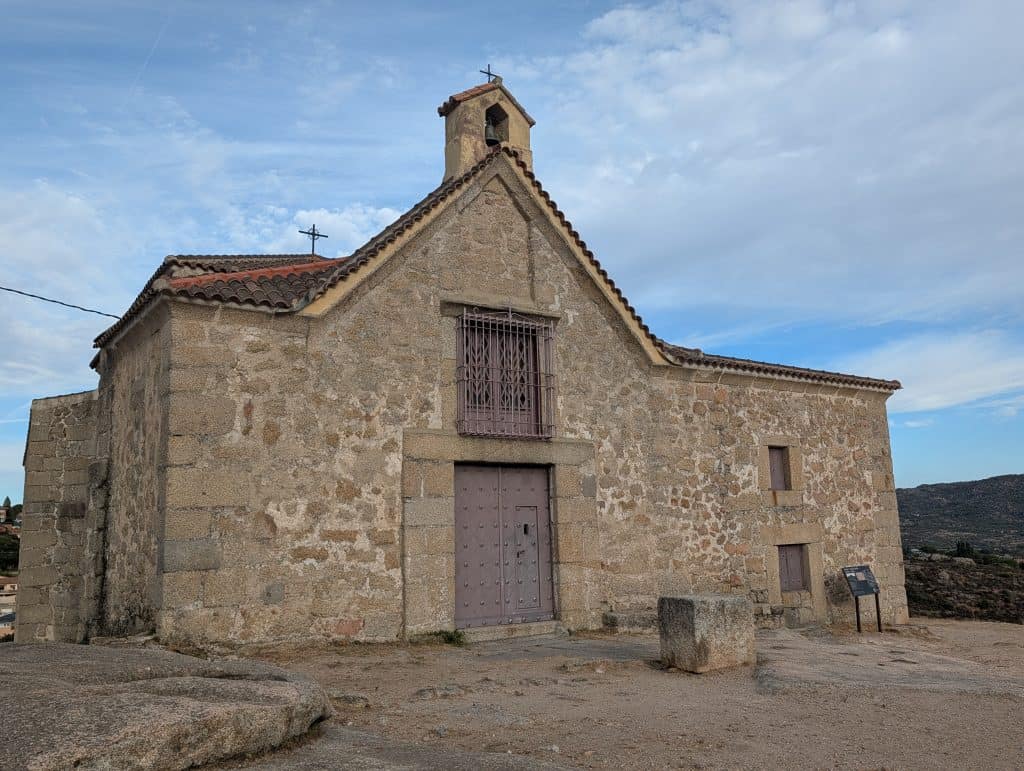
The door was locked too, same as the church and the castle grounds had been all day, but it had a small window built into the wood, glass fogged with age. I pressed the phone against it and got one photograph of what was waiting inside: a Virgin and Child in gold vestments, lit warmly against the dark. Every other locked door that day had given us nothing back. This one gave up a keyhole.
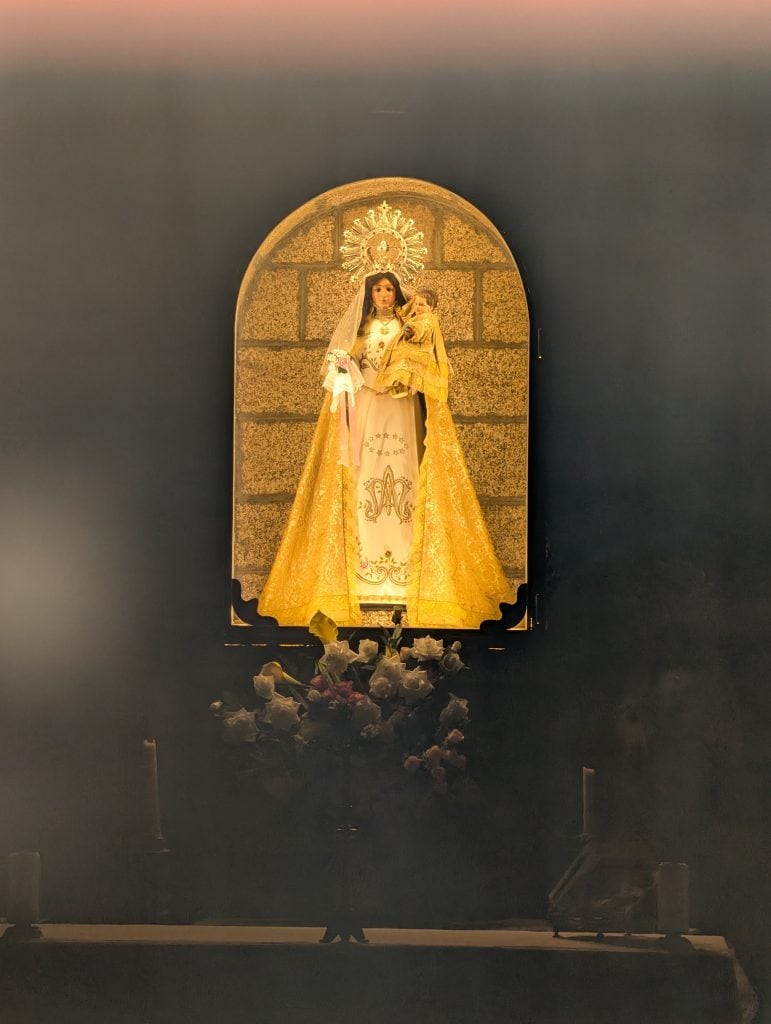
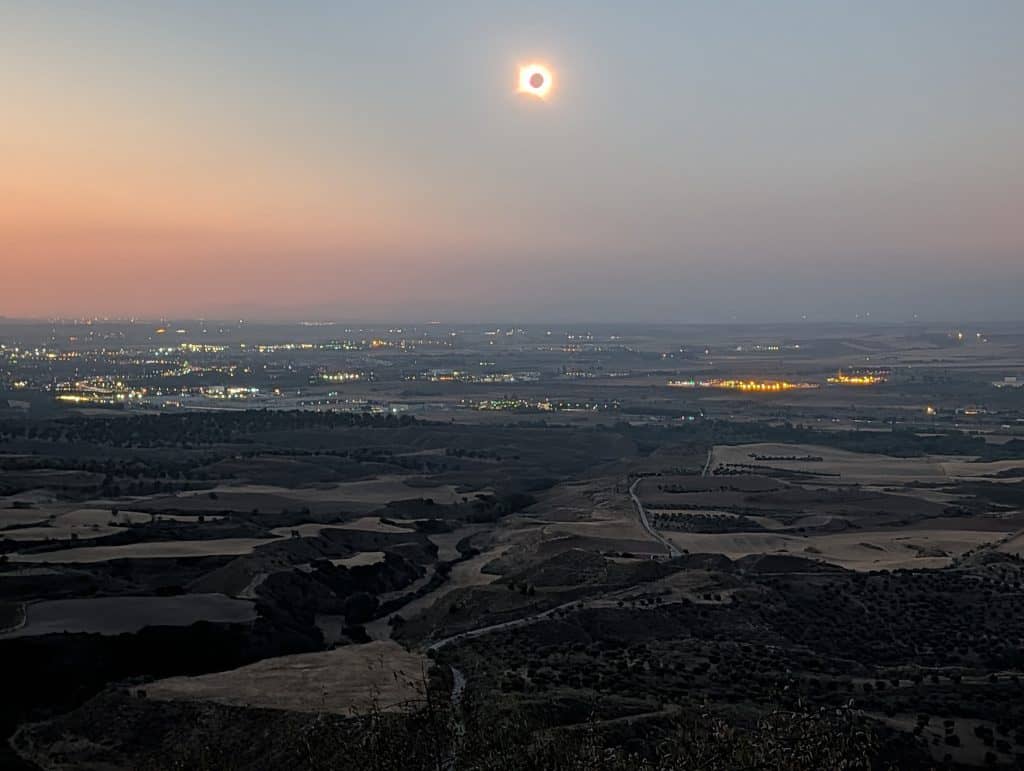
Her son lasted about thirty minutes before deciding a granite outcrop, however striking, couldn’t compete with whatever was waiting on his phone. I didn’t win the argument to stay longer. We left before I got the sunset I’d wanted to wait for, and caught a different one instead from a gas station forecourt outside Torrejón de Ardoz, streaked and genuinely beautiful even there, which felt like both a consolation and a small joke at my own expense.
Getting There, and What to Actually Expect
Manzanares el Real sits roughly fifty kilometers north of Madrid, comfortably reachable by car in under an hour, though there’s no direct train and the bus connections from central Madrid run longer than they look on a map. A rental car is the easiest way to do this trip properly, especially if La Pedriza’s trails are part of the plan. Assume the Castillo de los Mendoza will be closed. That could change by the time you read this, but as of this writing it’s been shut since January 2025, and nobody local seems confident predicting when that ends. Budget a full day rather than a half one: between the two castles, the church, the bridge, and the ermita, this is a town that rewards walking it slowly, not checking off a list.
We never made it into La Pedriza itself, the granite we’d been glimpsing from a distance all day, or to the Charca Verde we arrived at too late to use. Both are still owed to us, and we already know what they’re waiting for: a cooler month, real hiking shoes, and a morning that hasn’t already been spent on two castles, a church, and a bridge. That trip is coming. This one was never meant to cover everything.