Walk through the door and the first thing that actually stops you isn’t the façade you just spent ten minutes photographing from outside. It’s the courtyard opening up in front of you all at once: three tiers of stone arcades rising overhead, grand enough to hold a cathedral’s worth of ambition, all of it wrapped around a single, modest well at the center, small enough to sit beside. The city goes quiet here. What reaches you instead is birdsong, filling in the space where traffic and footsteps should be. Patio de Santo Tomás de Villanueva doesn’t need anyone to tell you it’s one of the most majestic courtyards in Spanish architecture. Standing at the center of it, small under three tiers of stone and strangely at ease beside one quiet well, does that on its own.
The University of Alcalá isn’t a museum built to look important. It’s the administrative and ceremonial heart of a still-working university, founded in 1499 by Francisco Jiménez de Cisneros, then Archbishop of Toledo and later a cardinal, in a medieval town still reeling from the 1492 expulsion of its Jewish community. A guided tour walks you past his own empty tomb, into the same ceremonial hall where Spain still awards its highest literary honor, and through a campus that took over a century longer to finish than it took him to imagine it.
Here’s what you actually need to know before you go.
Getting There
Alcalá de Henares sits under an hour from Madrid by train, and the university complex is a short, flat walk from the station: about 950 meters (roughly 0.6 miles) along the recommended route below, 12 to 13 minutes at an easy pace, the whole way level with no hills. The station itself sits in the newer, more workaday part of town.
There’s genuinely no wrong way to make that walk. Every route between the station and Plaza de San Diego is some variation on the same theme, the newer end of town giving way to the historic one, and every single one of them is a pleasant walk in its own right. What follows is simply a recommendation, a route that cuts into the north side of the casco histórico as early as possible, consistently the most picturesque way in. Treat it as a starting point, not a rule. If a side street catches your eye along the way, follow it. You won’t be disappointed.
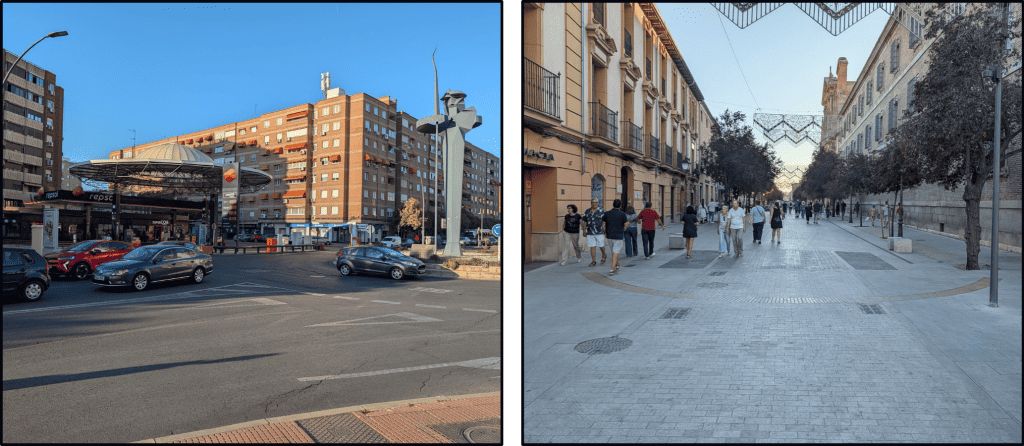
From the station, the walk runs along Paseo de la Estación, then Calle Eras de San Isidro, Calle República Argentina, and Vía Complutense, before cutting through the narrow Callejón de las Santas Formas onto Calle Libreros, the last stretch running straight through the heart of the casco histórico before opening directly onto Plaza de San Diego, the university’s own front door.
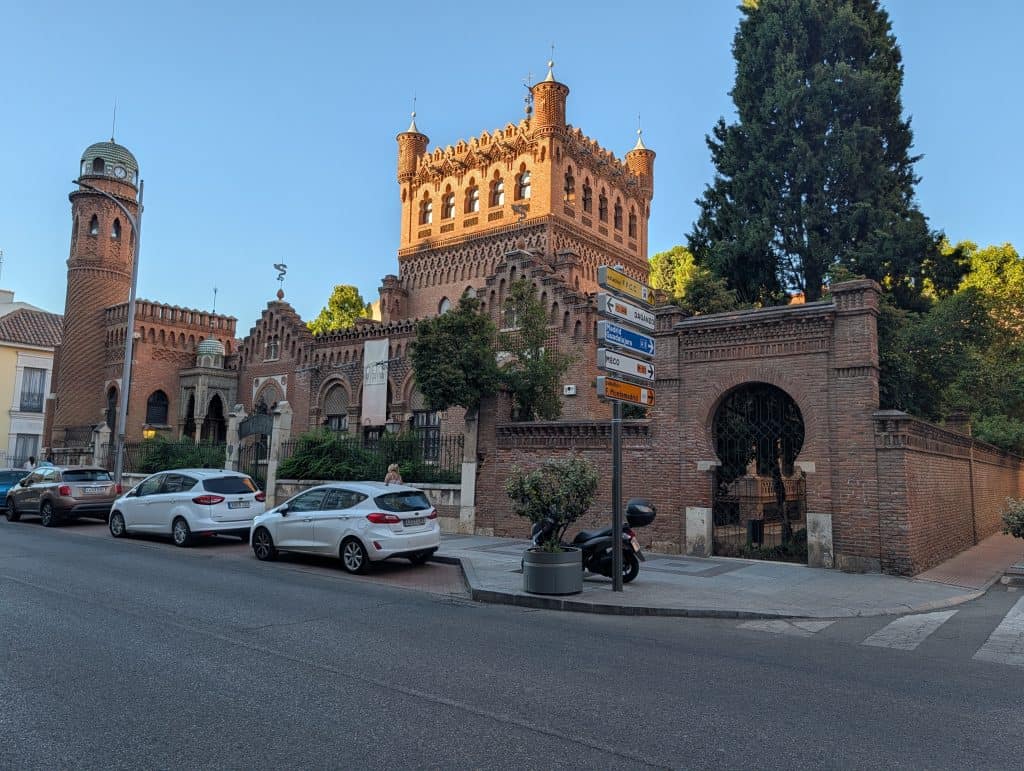
Almost immediately, on Paseo de la Estación itself, look out for the Palacio de Laredo, a striking neo-Mudéjar mansion built in the 1880s by Manuel José de Laredo, its minaret-like clock tower topped with a green-and-white ceramic dome. It’s currently closed, but worth a look from the street.
The University’s Own Visit: Hours, Tickets, Booking
Your visit to the University of Alcalá starts at the Tienda del Rectorado, Plaza de San Diego s/n, 28801 Alcalá de Henares, both where you pick up tickets and where the guided tour itself actually begins.
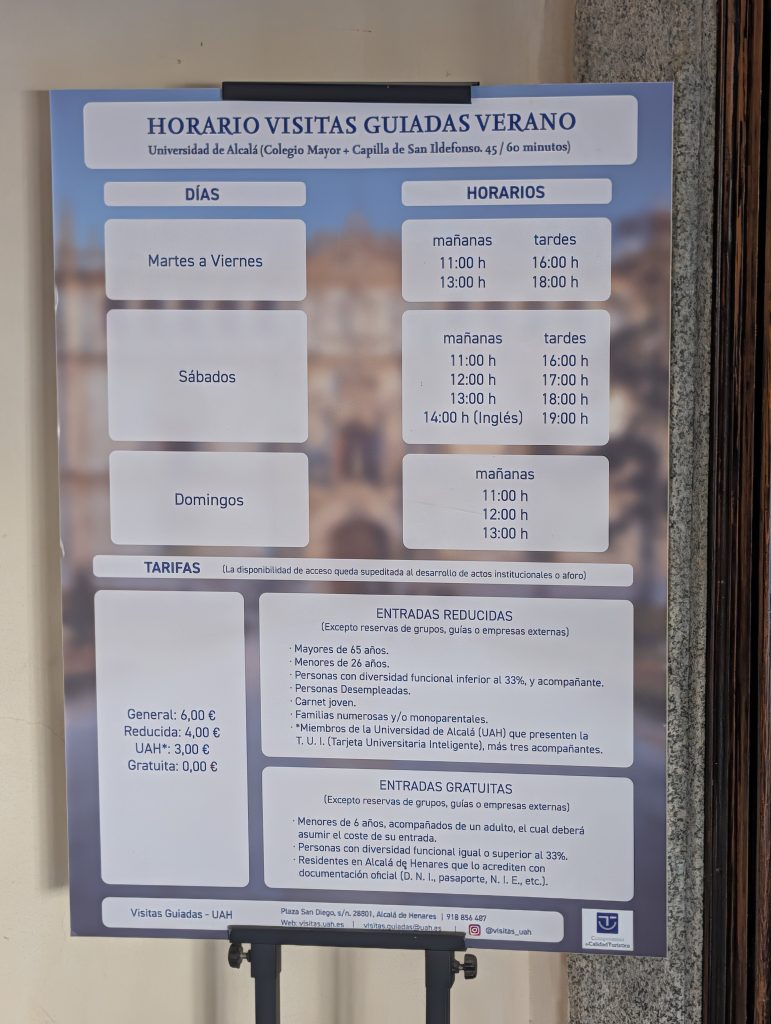
- Days: Guided visits run Tuesday to Sunday, closed Mondays. The Tienda del Rectorado, where tickets are actually sold, keeps its own separate hours and stays open on Mondays too (see Tienda del Rectorado hours below), even though there’s no tour to take that day.
- Length: 45–60 minutes.
- Tour times:
- Regular season: Tue–Fri 11:00, 13:00, 15:00, 17:00 · Sat 11:00, 12:00, 13:00, 14:00 (English), 15:00, 16:00, 17:00, 18:00 · Sun 11:00, 12:00, 13:00
- Summer: Tue–Fri 11:00, 13:00, 16:00, 18:00 · Sat 11:00, 12:00, 13:00, 14:00 (English), 16:00, 17:00, 18:00, 19:00 · Sun 11:00, 12:00, 13:00
- What’s included: the university chapel, the Paraninfo, the Patio de Filósofos, and the Patio de Santo Tomás de Villanueva. You’ll also pass through a small fourth courtyard, the Patio de las Lenguas, on the way between the chapel and Santo Tomás, not one of the three the visit is actually built around but still part of what you’ll see. The Patio Trilingüe isn’t entered; it’s seen through a gate connecting to the Patio de Filósofos.
- Prices:
- €6 general
- €4 reduced: over 65, under 26, registered unemployed, or part of an officially certified large or single-parent family (a formal Spanish status, not just family size)
- €3 UAH members, plus up to 3 guests
- Free: an official disability rating of 33% or higher (government-certified, not self-reported), under 6, or Alcalá de Henares residents with proof of address
- Booking: Book online through tiendauah.es, the recommended way to guarantee a spot. It’s also possible to buy a ticket in person at the Tienda del Rectorado on the day of your visit, capacity allowing (the whole visit is capped at 60 people).
- Arrival: Arrive at least 15 minutes before the tour starts, whether you booked online or bought in person. Show up late, and the tour won’t wait, you’ll forfeit the visit.
- Tienda del Rectorado hours: Mon–Sat 10:00–13:30 & 15:30–18:30 · Sun 10:00–13:00. The office notes the shop can occasionally close if two guided visits overlap.
Hours and prices are exactly the kind of thing that changes without warning, so book directly, or at least double-check before you go, on the university’s own visitor site.
Guided tours through the university’s own booking site run mostly in Spanish, but not entirely: per the university’s own cultural events page, one specific slot each week is run in English, Saturdays at 2pm. Every other time, weekdays and the rest of the weekend alike, is Spanish by default. Treat that day and time as provisional, though, not fixed forever; scheduling like this can shift, so it’s worth confirming the current English slot directly with the university before you plan a visit around it.
Got a specific question that isn’t covered here? The university’s own Guided Visits Service will answer directly: visitas.guiadas@uah.es. I’ve used this address myself, and got a reply within 24 hours, on a weekday; a weekend email will likely sit until the next business day.
Why I’d Book David Instead
Descubre con David, run by David Alba, a Tourism graduate of the University of Alcalá itself and a certified local guide, is the guide I’d actually recommend for this visit, university’s own tour included. University tours tend to run larger groups (I’ve seen them take twenty people or so), and that’s no fault of theirs; a group that size just naturally makes for something a little more scripted, with less room for real back-and-forth or a question that sends things somewhere unplanned.
The university’s own tour is also, understandably, scoped to the complex itself. David’s covers more ground: he walked us through the string of minor colleges that once lined the surrounding streets, giving real context for the neighborhood the university actually grew out of, before we ever set foot inside. Time budget alone explains some of that extra depth: our tour ran a full two hours, roughly double the standard 45-to-60-minute university visit. His knowledge runs deep, and it’s obvious this is a labor of love for him, not just a job.
We booked this tour through GetYourGuide, and the process itself was genuinely hassle-free, no confusion, no surprises, a confirmation that actually matched what happened on the day. That tracks with the platform’s own reputation: of the third-party booking sites out there, GetYourGuide is consistently rated among the more reliable ones for this kind of tour, particularly in Europe.
The tour starts from an off-campus meeting point rather than the Tienda del Rectorado itself. David checks everyone in there, and things actually get underway on the spot, with the building right in front of the meeting point, before the group ever walks toward the main complex.
David also runs several other tours around Alcalá itself, beyond the University of Alcalá one, along with tours in villages around Guadalajara and, soon, in Madrid itself. I’d take his tour again myself, just to pick up more of what I missed the first time.
On language: English isn’t guaranteed on every departure. Rather than a fixed public schedule, the way Saturdays at the university are, it’s arranged directly with David, so reach out to him well in advance of your visit if you want it, not the day of. Reviews from his English-language tours have been consistently strong, so there’s no reason to hesitate booking one.
Plaza de San Diego
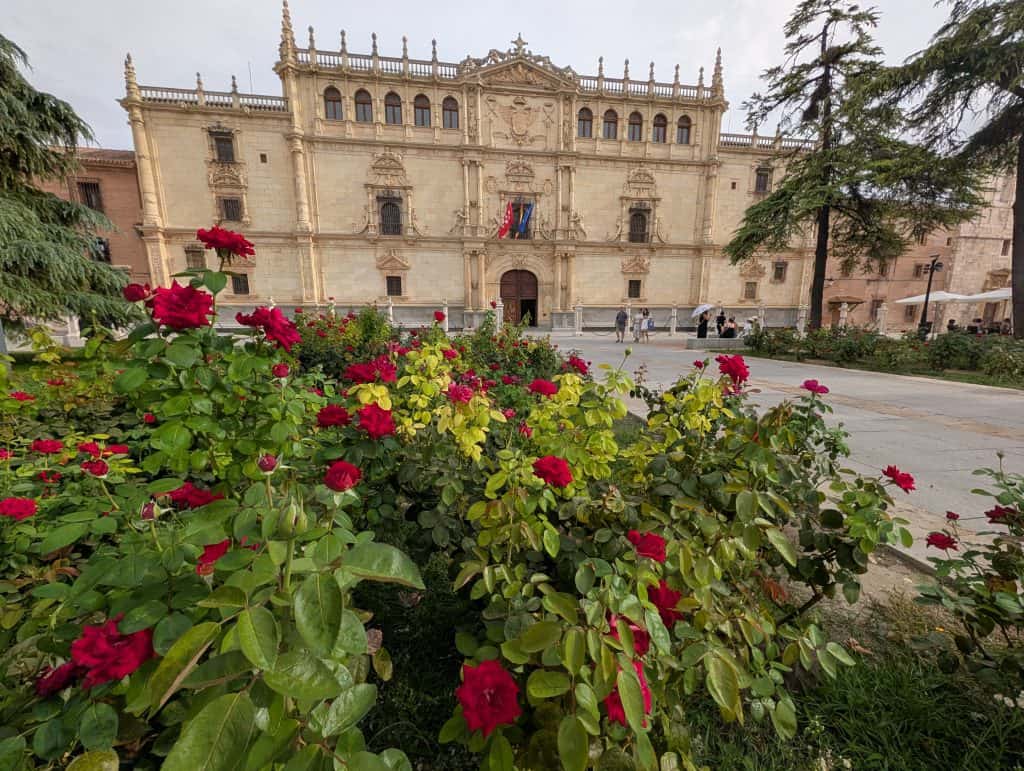
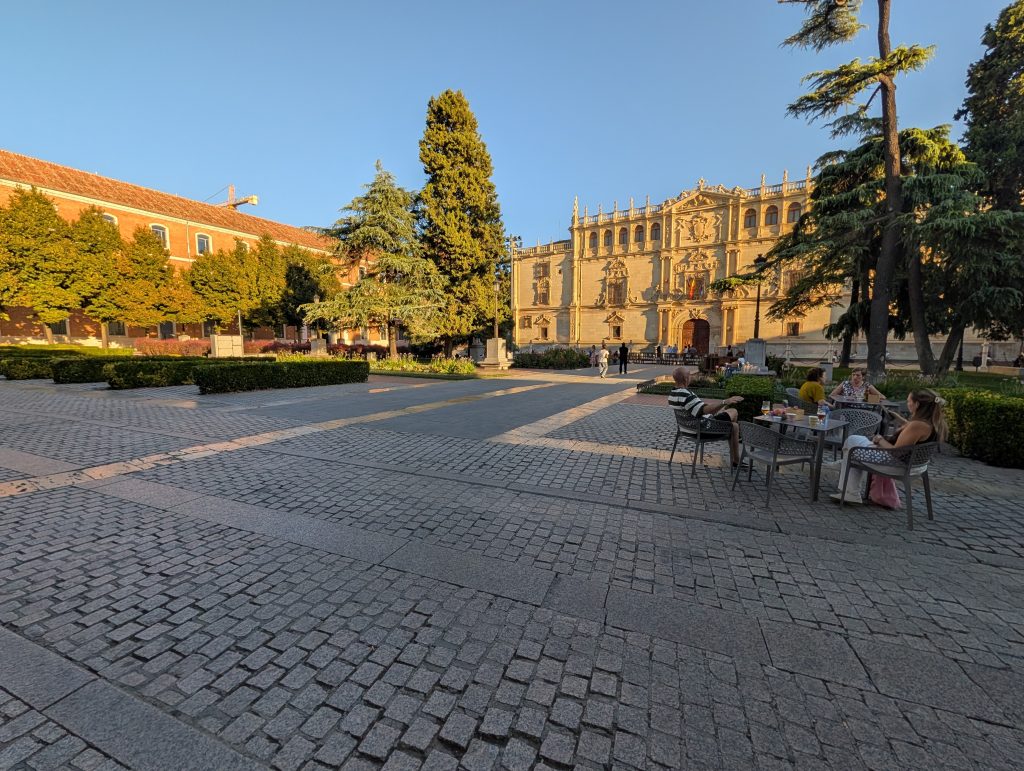
It’s worth resisting the urge to walk straight through the plaza and into the building. Plaza de San Diego is genuinely worth a few minutes on its own: a long, narrow fountain along the left side as you face the façade, spouts running its length and stone blocks set across it to cross on foot, restaurant terraces lining the perimeter, mature trees that fill with birdsong in season, and enough open grass that sitting down for a while before or after your visit doesn’t feel out of place.
The square only exists because of the building in front of you. In 1588, the city tore down half a city block purely to open up a sightline to the façade, since up until then there’d been nowhere far enough back to actually see it. The full visual read of that façade, tier by tier, along with everything else Cisneros didn’t live to see finished, is its own piece, “The University He Never Saw.”
The name is its own story, and a stranger one than the demolition. In 1562, Prince Carlos, Felipe II’s son and a student here himself, fell on the stairs of the nearby Archbishop’s Palace and cracked his head badly enough that his recovery looked doubtful. Felipe II had the body of a local Franciscan friar named Diego, dead for nearly a century yet still uncorrupted, brought to the prince’s bedside; the prince recovered. That “miracle” became one of six the Church required to canonize Diego as San Diego de Alcalá in 1588, the first canonization carried out under the Church’s newly created Congregation of Rites. The plaza carries his name because of it, and so does the convent just off it (see below).
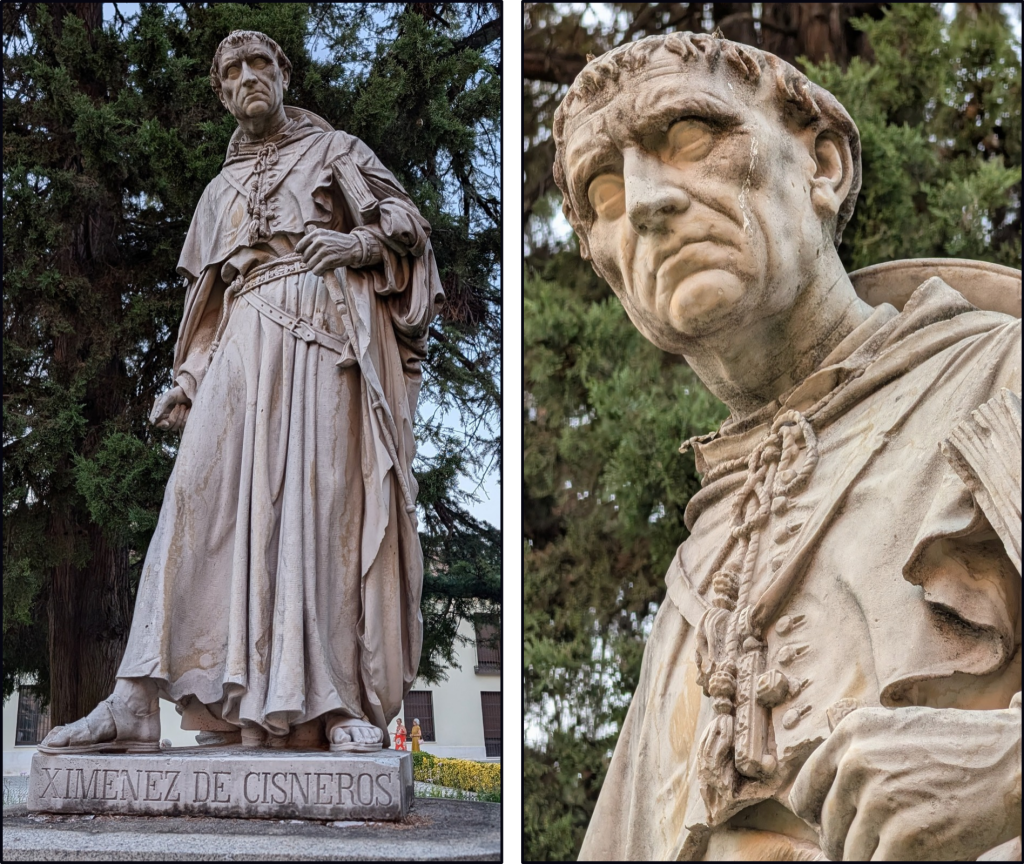
One statue stands right in the plaza: Cisneros, identified by the plain inscription XIMENEZ DE CISNEROS at the base. He’s shown in his Franciscan habit, a rosary and cross at his chest, a book against his shoulder. What you’re actually looking at is a faithful reproduction installed in 2007; the original moved permanently to the Patio de Filósofos, one of the courtyards on the guided tour, in 2018, after a small odyssey of its own, one with its own dedicated telling in “The University He Never Saw.”
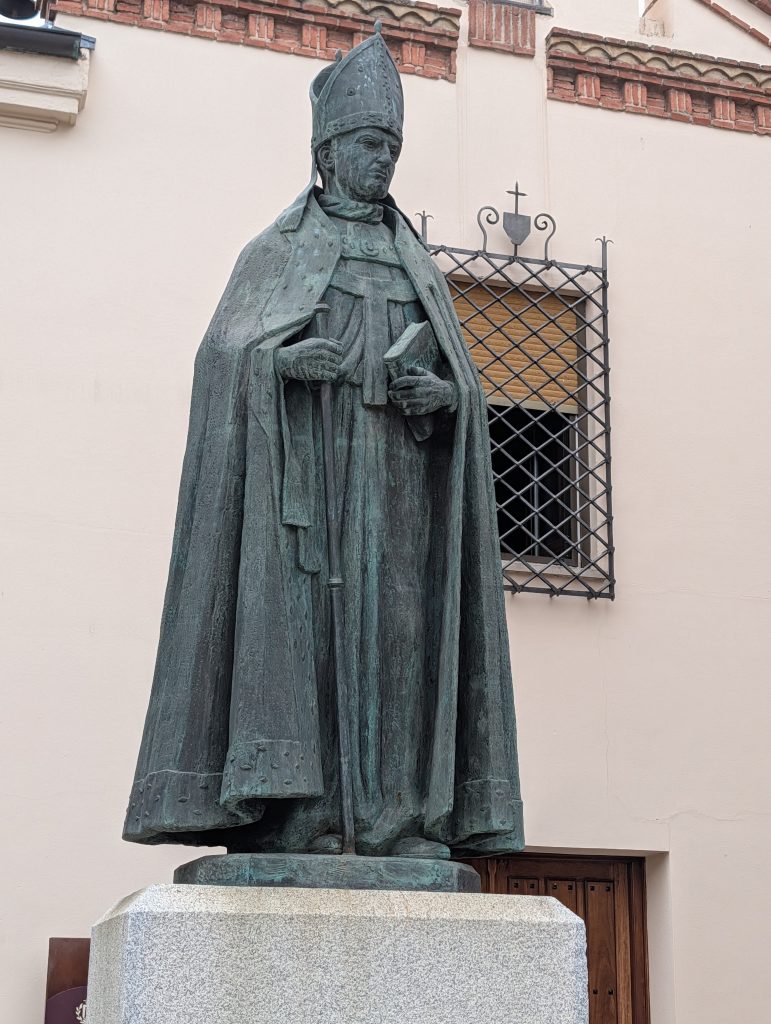
A second statue, worth the short walk over, sits in a small square in front of the Convento de las Clarisas de San Diego, a convent just off the main plaza: a bronze figure of Alonso Carrillo, another Archbishop of Toledo. He’s also the man who once had Cisneros thrown in prison for six years over a contested church post, a story worth its own read, told in a later post on the university’s own five-century history. No signage at either site acknowledges the connection between the two men.
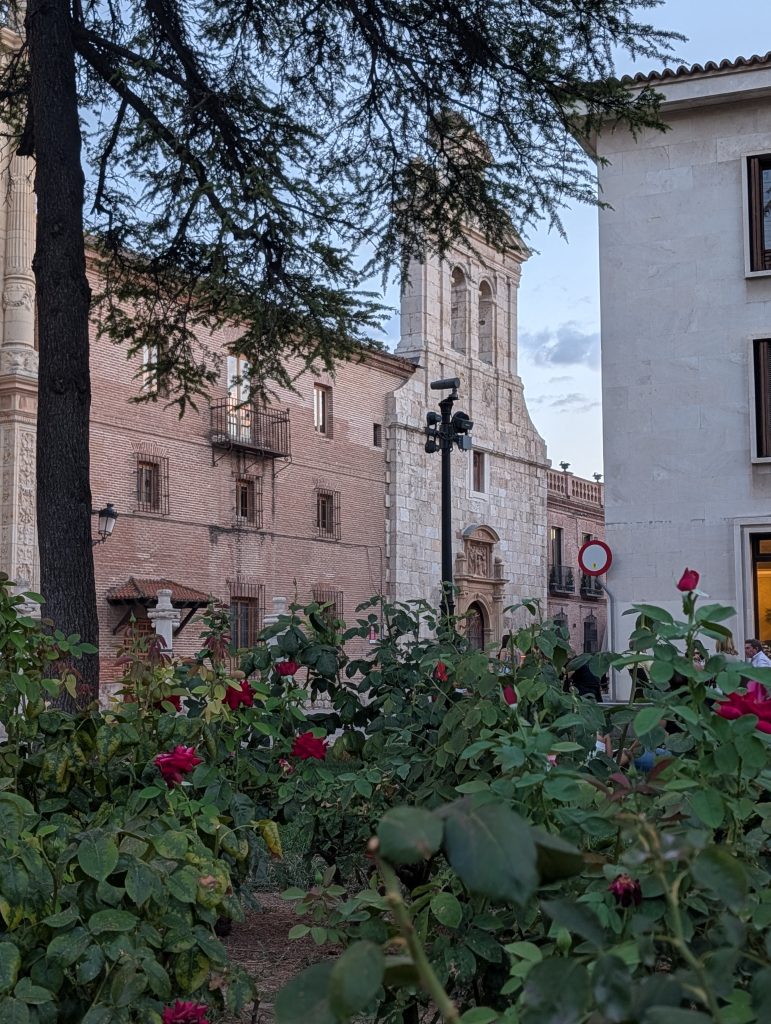
One more thing worth seeing before heading toward the university’s main entrance: off to the right rises the Capilla de San Ildefonso, the university’s own chapel, clearly visible from where you’re standing even though it’s technically on Calle Pedro Gumiel rather than the plaza itself. Its stepped stone façade, carved door, and the relief above it all reward a closer look, told in full in “The University He Never Saw.”
What You’ll Actually See Inside
Here’s what a guided tour actually includes, in brief; the full visual and historical deep dive on all of it, the Paraninfo, the façade, the tomb, and the courtyards, lives in its own post, “The University He Never Saw.”
- The Paraninfo: the university’s ceremonial hall (the name comes from Greek, originally the word for a wedding’s best man), and the room where Spain’s most prestigious literary honor, the Cervantes Prize, is still awarded every April 23rd.
- The Capilla de San Ildefonso: holds Cisneros’s tomb, though not his actual remains, an empty cenotaph.
- The courtyards (patios): the guided tour takes you fully into two, the Patio de Filósofos and the Patio de Santo Tomás de Villanueva, views a third, the Patio Trilingüe, from outside only, and passes through a small fourth, the Patio de las Lenguas, on the way between the chapel and Santo Tomás, easy to walk past without noticing.
A Quieter, Unplanned Bonus
Although the chapel and the Paraninfo can only ever be seen as part of a guided tour, the courtyards are a different story. There’s a small possibility worth knowing about, though not one you can plan around. On one visit in the evening, and again on a subsequent day, the university’s main door stood wide open onto the Patio de Santo Tomás de Villanueva, no ticket or guide in sight, and it was possible to walk straight through, on through an arched walkway into the Patio de Filósofos beyond it, and sit quietly in both, entirely unaccompanied. Neither occasion showed any visible sign of a specific event, no concert setup, no filming crew, and why the door happened to be open stays genuinely unclear.
The university does have legitimate reasons these courtyards sometimes open outside the tour system: an annual concert series takes over the Patio de Santo Tomás de Villanueva for several nights every July, and there are standing rules for outside groups booking the space for events and filming. Neither explanation matched what I actually saw, though. There’s no way to seek this out on purpose; if you happen to find a door open, it’s worth stepping in for a few contemplative, unhurried minutes the guided tour doesn’t really offer, but it’s pure chance, not something to build a visit around.
The Patio Trilingüe is the one exception even to this small opportunity. It stayed closed on both occasions, visible only through a metal gate, matching what the university’s own official tour offers there too. Independent guides can sometimes do better; David got our small group inside through a back door on his own tour, worth asking about, though not something to count on.
Even if you catch a door open, though, a good guide still adds something a quiet, unaccompanied moment can’t: someone actually explaining what you’re looking at, room by room. Worth remembering before skipping a guide altogether just because a door happened to be unlocked.
If You Want the Deeper History
Everything above gets you through a visit. If any of it made you want the fuller story, I’m publishing that separately, one post a week over the next month or so, so this post doesn’t have to carry it all itself.
The façade, the tomb, and the three courtyards, tier by tier, all reward a much closer look than a practical guide has room for, and there’s a genuinely surprising thread running through all three: how much of what you’re looking at, Cisneros never actually saw. That’s “The University He Never Saw.”
The university’s own five-century history, from Cisneros’s original design through near-collapse and a neighborhood that literally bought the buildings back to save them, gets its own post too.
Cisneros wasn’t inventing the idea of a university from nothing. Europe had been arguing about what a university should even be for three hundred years before he broke ground, and the Iberian kingdoms had their own head start too. That older, stranger story, “The Idea Nobody Invented,” has since been told as well.
The university’s first major piece of scholarly work, a six-volume printed Bible, carries a design choice in its own layout that Cisneros explained himself, and it’s more uncomfortable than it looks at first glance. That one’s called “The Argument Built Into a Page.”
While the university was being built, Cisneros was also pressing two campaigns, in Granada and then in North Africa, using very different tools than the ones he used here. That story, “Two Wars, One Argument,” closes out the series.
Before You Go
Time budgeting depends on which tour you take, and what you build around it. The university’s own tour runs 45 to 60 minutes: chapel, Paraninfo, and courtyards, nothing more. David’s tour ran a full two hours, since it opens with a walk through the surrounding streets and minor colleges before ever heading inside the complex itself. On top of either one, it’s worth setting aside whatever time you want in Plaza de San Diego, before or after the tour, no need to rush that part. And if you pair the visit with a meal or a round of drinks, covered below, plan on adding roughly another hour to the day, or more. It also sits close enough to the Catedral-Magistral and the Calle Mayor colonnades that both pair naturally with the visit on foot, no separate trip required.
Starting early genuinely pays off: the earlier the visit, the fewer people, since most tourists in Spain, in David’s experience, aren’t early risers. He’s seen the same 11:30am slot swing between nearly empty and genuinely crowded depending on the day, so an early start narrows the odds of a crowd without fully guaranteeing you’ll dodge one.
Alcalá doesn’t lack for good places to eat or drink. The historic center is dense with them, and you don’t have to go looking. Plaza de San Diego itself, and the streets running off it, hold a high concentration of solid options for a city this size, more than the university alone would suggest.
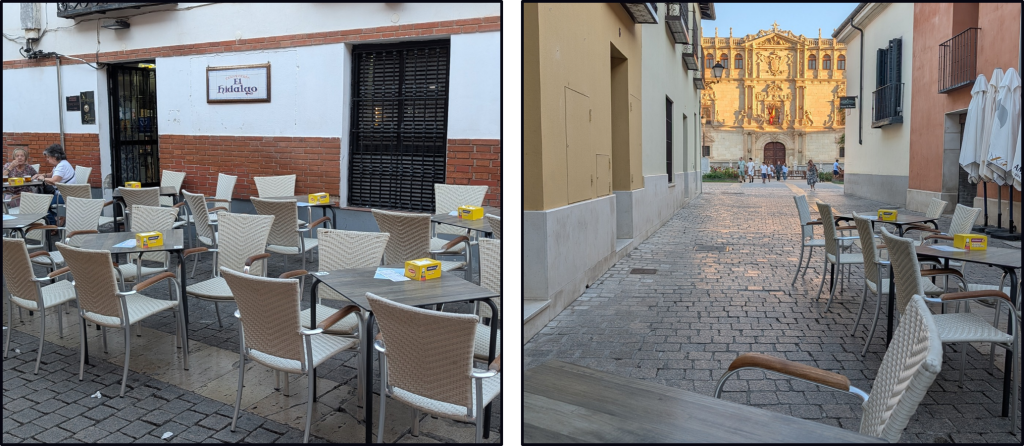
My own favorite, specifically as a way to close out a visit to the university, is a short walk from the entrance: Cervecería El Hidalgo, on Calle Bedel, just off the plaza. It isn’t a restaurant in any formal sense, no sit-down menu of hot entrees or courses, but there is a real list you can order from directly: cured meats, conservas, cheese and ham montaditos, patatas fritas.
On top of that, whatever tapa (a small savory snack) shows up with your drink, and one almost always does. Order a caña (a small draft beer) or a tinto de verano (red wine and lemon soda, Spain’s more casual answer to sangria) and a tapa comes with it automatically, unasked for, generous: chorizo, jamón, torreznos (fried pork belly), whatever’s behind the bar that day. Ordering from the list is for when you want something specific in addition, not instead.
What it’s actually good for, though, is a few drinks on the terraza. The terraza isn’t the only reason it’s the pick; the food, the drinks, and the service are all genuinely good on their own. Combined with the view, though, it’s what makes this the specific pick for closing out a visit to the university. Calle Bedel runs off Plaza de San Diego rather than facing directly into it, but the terraza still looks straight down the street to the façade in the distance, and if you time it for golden hour, that stone catching the late light while you’re sitting there with a drink in hand is genuinely one of the best, easiest pleasures Alcalá offers. One caveat worth planning around: it’s a popular spot, especially in season, and golden hour is exactly when everyone else has the same idea. Don’t assume you can simply walk up and get a table; go a little early, or be ready to wait.
We’ve gone back several times since arriving, once for a full round of cured meats and rabo de toro that turned into most of dinner, once as the opening stop on a longer tapas crawl, and every time it’s delivered the same thing: real quality, real quantity, for very little money. It’s the kind of place where two rounds turn into a meal without either of you deciding that’s what was happening.
Go for Cisneros. Stay for the tapas. By the end of the evening, you won’t be entirely sure which one you actually came for.