In 1078, in a monastery in Normandy called Bec, already one of Europe’s most important centers for theological training, a monk named Anselm sat down and wrote a short book called the Proslogion. In it, he tried to prove God’s existence using nothing but pure logic, reasoning from the idea of a being than which nothing greater can be conceived. Not through vision, not through miracle. Through a disciplined mind working out an argument from first principles, alone, and arriving somewhere true. It’s a strange place to start the story of an institution, but that’s exactly the point. The university, as an idea, didn’t spring from nowhere. It grew out of centuries of argument over whether human reason could be trusted at all, and Anselm’s small, stubborn act of pure thought is one of the first places that argument actually shifts.
An Institution Nobody Planned
For roughly six hundred years before that moment at Bec, Europe had run on a fairly simple assumption: order and dignity came from the supernatural, full stop. Liturgy was orderly. Ritual was orderly. The natural world, left to its own devices, was not, and nobody expected much from human reason applied to it, because nobody had much confidence it was worth reasoning about in the first place. The Proslogion is one of the first cracks in that assumption. The historian R.W. Southern, in Medieval Humanism, treats it as close to a hinge point. Something like real confidence in human reason, dormant since antiquity, was waking back up.
Southern’s case, and it’s genuinely persuasive, is that the two centuries after Anselm produced something worth calling humanism, long before Petrarch, the fourteenth-century poet usually credited with starting the humanist movement. It rested on three convictions that would have sounded strange to an eighth-century monk: that man, fallen or not, remains the noblest of God’s creatures; that nature itself carries a dignity and order worth studying on its own terms; and that the universe is, in principle, intelligible to a reasoning mind. None of that sounds radical to a reader today. In 1100, it was close to revolutionary.
That confidence needed somewhere to live, and by the end of the twelfth century it found one, in an institution nobody had actually planned. The historian Alan Cobban argues, in The Medieval Universities, that this wasn’t purely an intellectual awakening. It was an economic one too: European cities were growing, trade was expanding, and an increasingly urban, commercial society suddenly needed people who could read a contract, keep accounts, and argue a case in front of a judge. Add Aristotelian logic flooding back into the West through Arabic and Byzantine sources, and you get, more or less by accident, the university. It wasn’t a building, or even really a place, but a universitas: a sworn guild of scholars banding together for protection, the same way merchants and stonemasons were forming guilds in the same cities at the same time.
The University of Paris, in France, organized around its masters. The University of Bologna, in what’s now northern Italy, organized around its students, mostly older, wealthy law students who effectively employed their own professors and fined them for showing up late or failing to draw a crowd. Paris and Bologna were arguably the two most important universities to come out of this period, though hardly the only ones, and none of Europe’s early universities had a peaceful history.
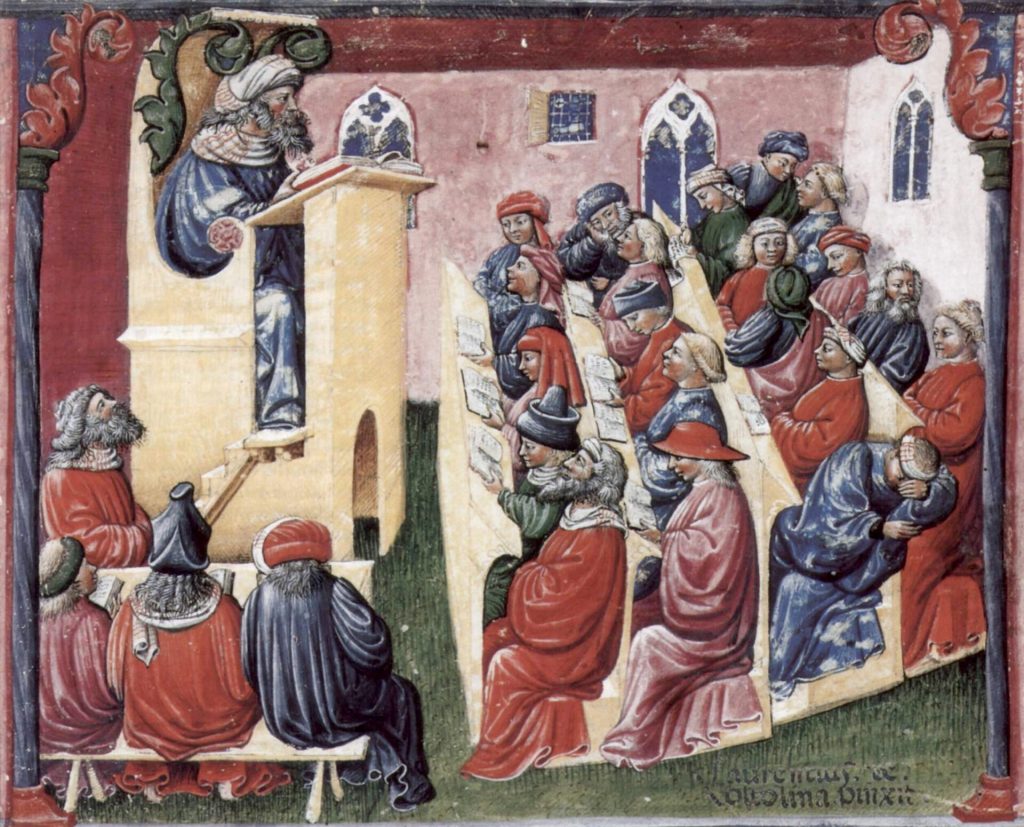
Paris’s turn came on Shrove Tuesday, 1229, the last blowout before Lent. A group of drunken students picked a fight with a tavern keeper over the price of wine, got beaten for it, then came back the next day with clubs and wrecked the place. The city guard, acting for the queen regent Blanche of Castile, retaliated against the wrong students entirely, men who’d had nothing to do with the brawl, and killed at least two of them. The university’s masters didn’t just protest. They suspended every lecture, and the entire school scattered across Europe in what historians call the Great Dispersion. It didn’t come back for two years. Pope Gregory IX, who had studied at Paris himself, finally intervened with a 1231 bull still known as the Magna Carta of the University of Paris, granting it real independence from local authority.
Bologna’s version went further: it kept happening. Its students, mostly foreigners with no local legal protection, kept walking out over disputes with the city: rents, prices, harsh treatment in local courts. A group founded a rival university at Vicenza in 1204, another at Arezzo in 1215. In 1217 they walked out en masse once more, with Pope Honorius III taking their side, and stayed away until a settlement around 1220. It didn’t hold. Two years later, roughly a thousand students left at once and founded the University of Padua, chasing what they called libertas scholastica, the freedom to run their own education without a city’s interference. Padua wasn’t safe from the same pattern either. In 1228, a group of its own students seceded again, founding yet another university at Vercelli.
In 1209, a clerk at the University of Oxford, in England, killed a woman by accident and fled before the town could catch him. Her name isn’t recorded anywhere, and neither is his. What survives in detail is what happened next. Unable to find him, the town seized the housemates he’d left behind, men with no connection to the killing, and a few days later, on King John’s order, two or three of them were hanged. Furious, most of Oxford’s masters and students walked out of the city entirely. Some went to Reading. Others settled in a market town called Cambridge and started a university there. Between them, Oxford and Cambridge would become England’s two most renowned universities.
It took five years to resolve. In June 1214, a papal legate ruled in the university’s favor, and the penalties were specific. The townsmen behind the hanging had to carry the bodies to an honorable burial. The town had to pay fifty-two shillings a year to support poor scholars, and feed a hundred of them every December 6th, Saint Nicholas’s Day. Nobody in power planned any of this. Scholars simply gathered in one place until self-organization became necessary, then useful, then powerful enough that kings and popes started competing to charter what already existed.
Spain, Chartered Not Grown
The Iberian kingdoms took a different path from everything just described, at least in how a university could begin. There, a king could simply decide to found one instead of waiting for scholars to gather and organize themselves. Two of those kingdoms, Castile and León, did exactly that. What neither did yet was design the whole institution in advance. A royal charter got each one started; its internal organization still grew as it went.
Sometime between 1208 and 1212, Alfonso VIII of Castile raised the cathedral schools of Palencia into a university, by most accounts at the urging of the city’s bishop, Tello Téllez de Meneses. In 1212 the same king would lead a coalition of Christian kingdoms to a decisive victory over the Almohad Caliphate at Las Navas de Tolosa. Palencia was modeled on the University of Paris, and it may be the first university in Europe to owe its status to a deliberate royal act rather than a scholars’ guild.
Palencia’s schools had already trained a young Dominic de Guzmán, who studied there in the 1180s and 1190s and would go on to found the Dominican order. Writing in the 1230s, the chronicler Lucas de Tuy praised Palencia as a place where learning and soldiering had always flourished side by side. The idea survives in the Castilian saying en Palencia, armas y ciencia, in Palencia, arms and knowledge, still the motto on the province’s coat of arms. None of that saved the university. Alfonso VIII died on October 5, 1214, and Palencia’s fortunes died with him, its studies suspended for several years amid the chaos of a child king’s regency.
The University of Salamanca followed in 1218, chartered by Alfonso IX, king of León, reportedly so his own subjects wouldn’t have to cross into rival Castile to get an education. It served other purposes too, better documented ones: training the canon lawyers and administrators his court needed, and turning Salamanca itself into an economic and civic anchor for a kingdom perpetually jostling for standing against its larger neighbor.
Whether Salamanca was a new foundation or effectively inherited Palencia’s collapsing faculty and students is an old, unresolved argument. Some accounts describe Alfonso IX simply transferring what was left of Palencia’s university to his own kingdom. Others, including the most detailed modern account of Palencia’s own history, call that a documented misconception, insisting the two were always separate institutions that happened to trade scholars as one declined and the other rose. Either way, Palencia didn’t last as an independent university, which is almost certainly why standard histories credit Salamanca, not Palencia, as Spain’s oldest university. Spain’s own government makes the same case in the formal application it submitted to UNESCO seeking World Heritage status for Alcalá’s historic university precinct. Founded first isn’t the same as survived first.
Alcalá itself joined the pattern later that same century. On May 20, 1293, Sancho IV of Castile granted the town a royal privilege for a center of higher learning, at the request of the archbishop of Toledo, Gonzalo García Gudiel, though little survives of it beyond the charter itself.
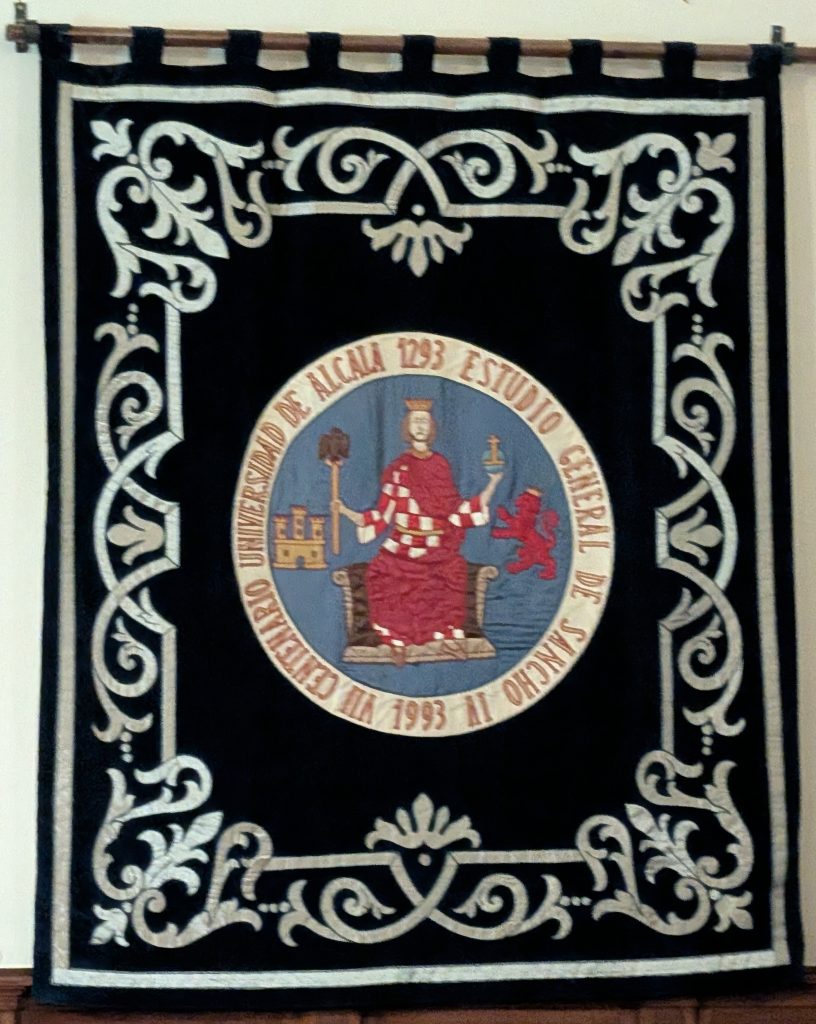
So by the time Francisco Jiménez de Cisneros, Archbishop of Toledo and later a cardinal, founded the University of Alcalá de Henares in 1499, the idea wasn’t new. It wasn’t even new to the Iberian kingdoms. It was already some three hundred years old, and Castile and León had been chartering their own versions of it for almost as long. It’s easy to read his university as a Renaissance curiosity springing up fresh. In some ways it is exactly that. But it’s also a late, unusually deliberate entry in an argument Europe had been having with itself since a monk in Normandy decided reason alone might be enough.
Cisneros didn’t invent the university. He inherited an institution that had spent three centuries developing piecemeal, out of guild self-protection and urban necessity, one negotiation and one upheaval at a time. What he did was design one whole, in advance, skipping every messy compromise the model had accumulated along the way. He built it in a town that had lost its Jewish community to the 1492 expulsion only seven years earlier, a community of several hundred people that had run much of the town’s trade. What Cisneros built there, and what made it different, is its own story.
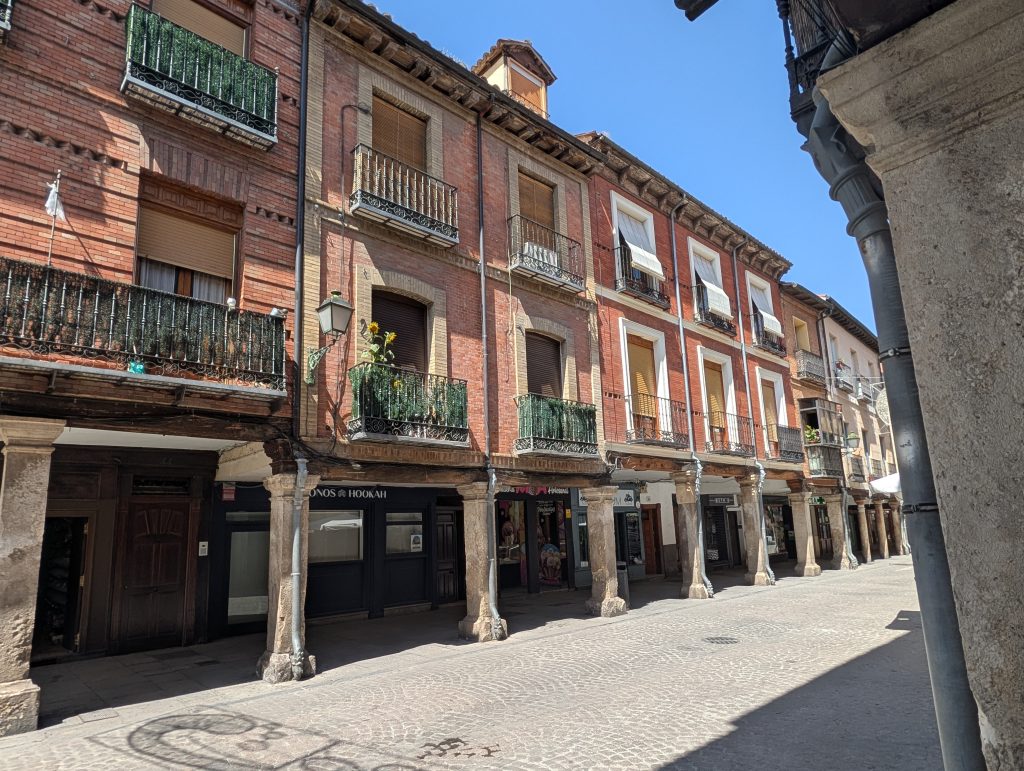
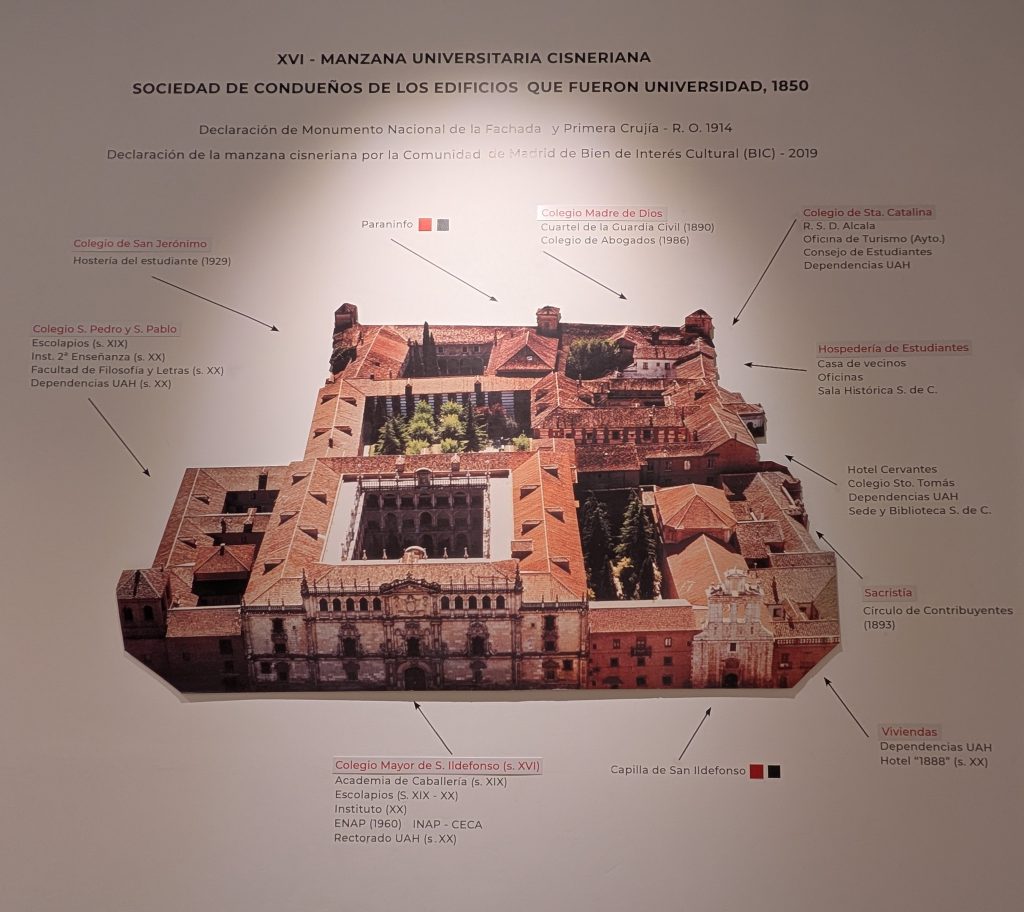
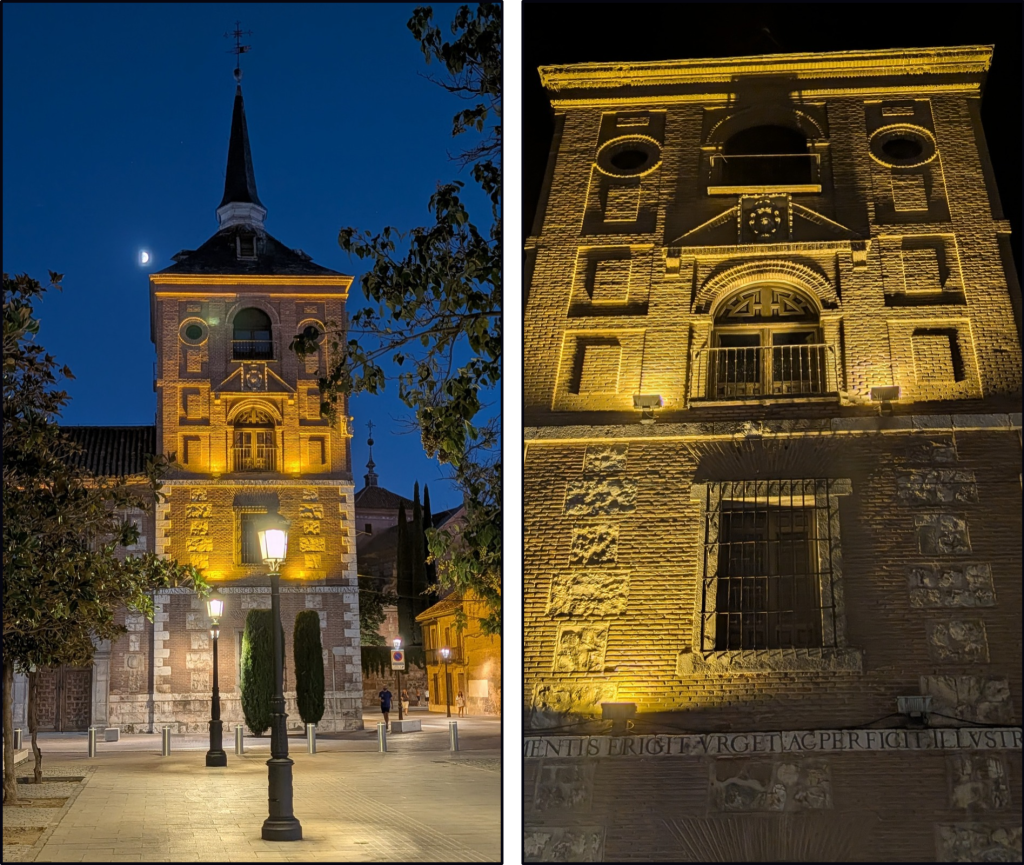
That design wasn’t only institutional. It was physical too. Every earlier university in this story had grown into its city, its halls and colleges added one at a time across neighborhoods never laid out with a university in mind. Cisneros instead carved out an entire district for his, eighteen city blocks laid out on a deliberate grid of straight streets, the Colegio Mayor itself occupying block one, the literal center of the plan. Historians of the city call Alcalá the first planned university city of the early modern period, and the description holds up specifically because of that grid: this wasn’t a university that grew into its surroundings. It was a surrounding built for the university.
Whether that makes Alcalá the end of an old argument or the start of a new one probably depends on which century you’re standing in when you ask. Either way, it’s not where the story of the university starts. It’s where, for the first time, someone sat down and drew one.