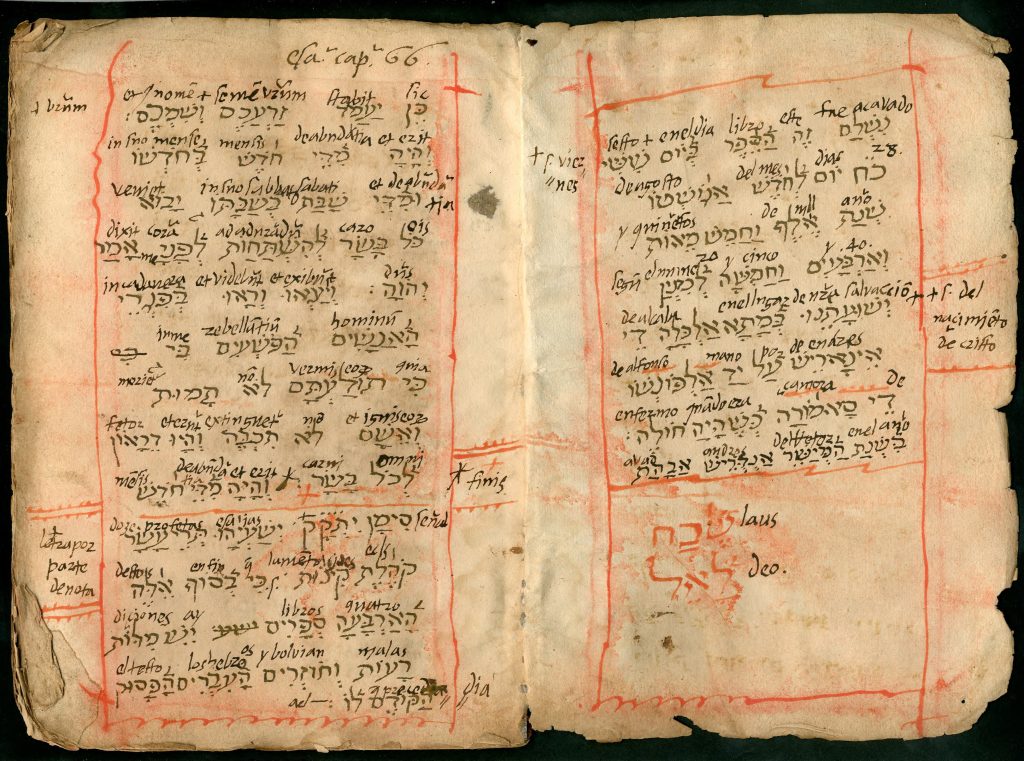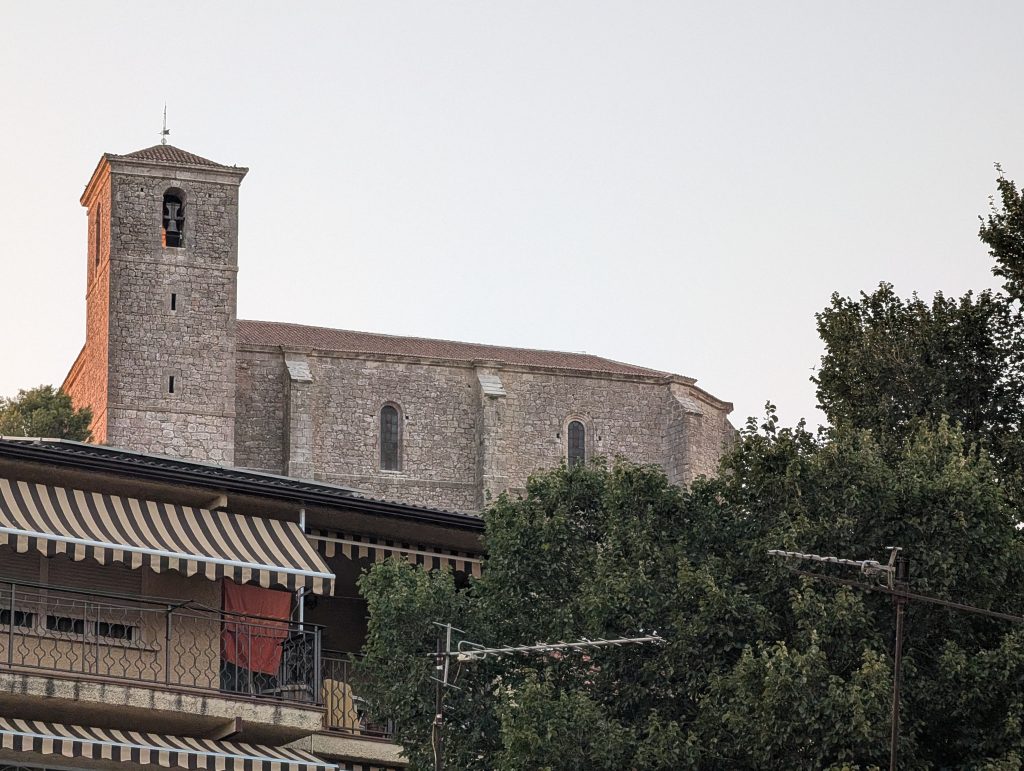
Francisco Jiménez de Cisneros, Archbishop of Toledo and later a cardinal, founded a university at Alcalá de Henares in 1499. Its first real piece of scholarly work was a six-volume printed Bible, the Complutensian Polyglot, assembled inside the university between 1502 and 1517, at enormous cost, by scholars he installed there for that purpose. In the prologue that opens it, he explained what he meant by the way he laid it out, and what he wrote there is harsher than anything a critic has needed to accuse him of.
What the Page Actually Says
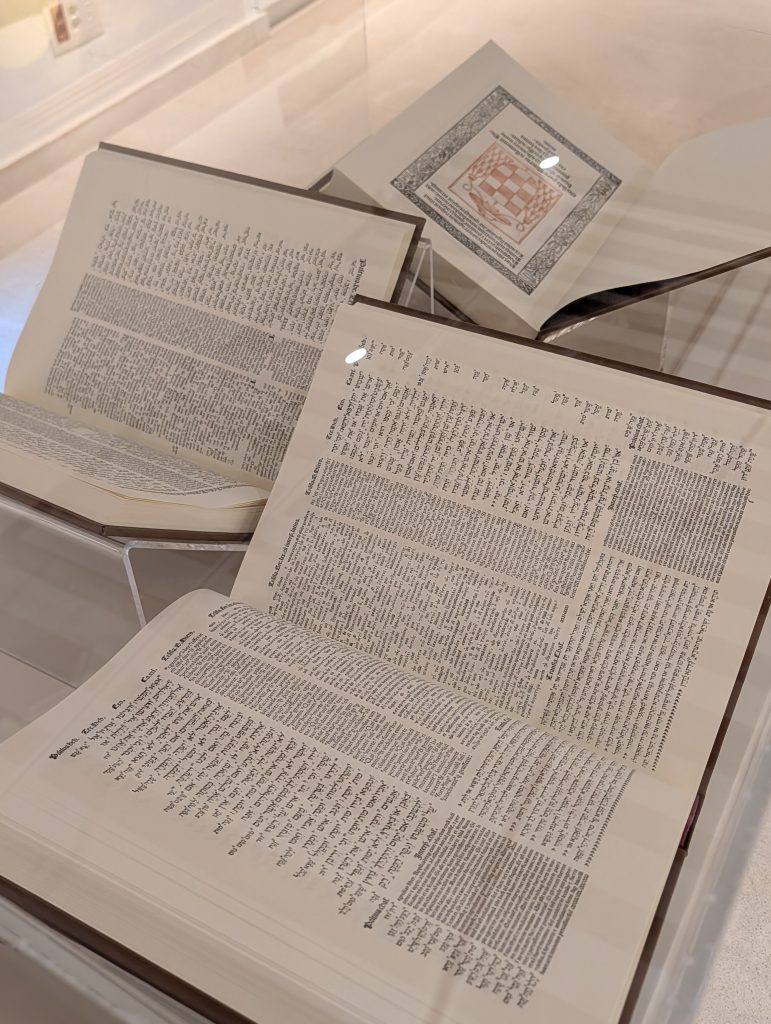
Under glass in the historical room of the Sociedad de Condueños, the society of Alcalá residents that has owned the university’s old buildings since 1850, three facsimile volumes of the Bible lie open. Start with the page itself. Each Old Testament page ran three parallel columns. On the outside sat the Hebrew. Down the middle ran the Latin Vulgate, Jerome’s translation and the Church’s officially sanctioned text. On the inside sat the Greek Septuagint, the ancient translation of the Hebrew Bible begun in the third century BCE. For the first five books, an Aramaic translation ran along the foot of the page.
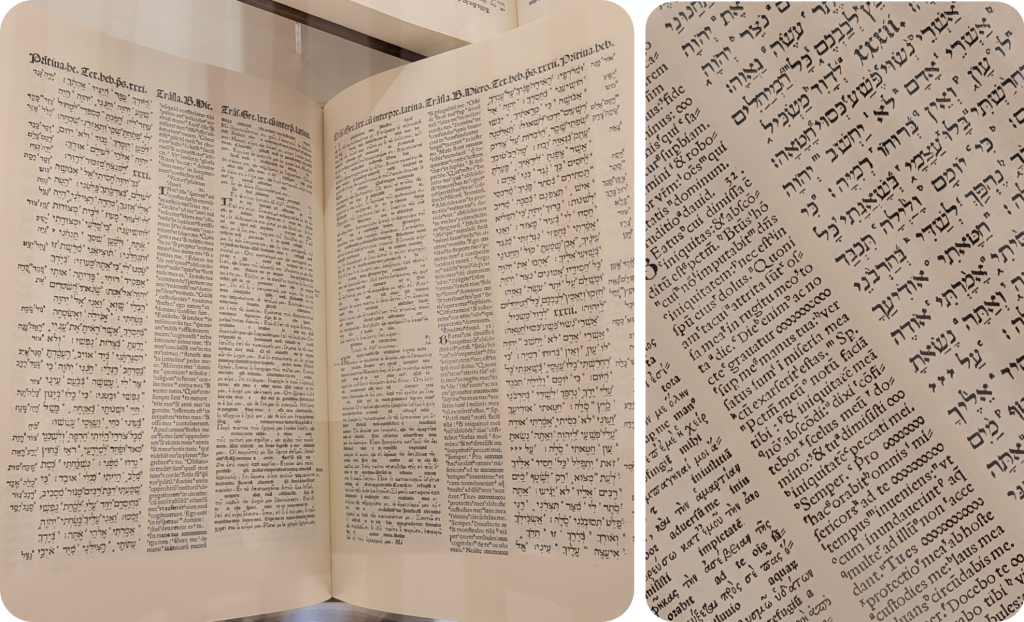
In his prologue, Cisneros explained why the Latin sat between the Hebrew and the Greek. He had placed Jerome’s Latin between the Synagogue and the Eastern Church, he wrote, “like the two thieves, one on each side,” with Jesus, the Roman Church, in the middle. The two men crucified alongside Christ in the Gospel accounts were condemned criminals, one of them repentant and one of them not, and for centuries painters and preachers had used them to frame the cross with guilt on either side of innocence.
Cisneros chose that comparison himself, in print, for his own life’s work. No later critic had to read it into the layout. He put it there, with the most loaded image a Christian reader of his day would have recognized.
The two thieves weren’t interchangeable, either. The prologue assigns them: the Hebrew column stood for the Synagogue, the Greek for the Eastern Church. That second assignment carried its own long history. The Eastern Church had been Rome’s estranged sibling since the two split in 1054, over the pope’s claim to authority across all of Christendom and a disputed clause about the nature of the Trinity. Both quarrels were old, but they were different quarrels. The Synagogue’s role was permanent by design, preserved to remain visibly subordinate. The Eastern Church’s was different in kind: a rival claiming its own legitimate inheritance, considered wrong rather than deliberately preserved, and one Rome still hoped to reconcile with. On Cisneros’s page, they end up as the same kind of thief.
The fourth language on the page sits lower still. For the first five books, the Polyglot adds the Targum Onkelos, an ancient Aramaic paraphrase of the Hebrew text, in the language Jewish communities had actually spoken for centuries while Hebrew lived on mainly in prayer and study. Instead of a fourth column, it runs along the bottom of the page, beneath the other three, with its own Latin translation. There was a practical reason, since the Targum Onkelos covers only those five books. Still, what the page shows is a Jewish text placed beneath the scripture Jews had kept for centuries.
Generosity, and What It Cost
Reading the Polyglot as an act of scholarly generosity, three ancient languages given what looks like equal room so the texts could be compared directly, is the natural first impression. That reading leaves things out, but it holds. Whatever else Cisneros believed about the hierarchy his layout displayed, the Bible gave scholars something useful: primary-language texts side by side, printed for circulation at a scale no earlier comparative Bible had approached. The third-century Christian scholar Origen had attempted something similar. His Hexapla ran six parallel columns of Hebrew and Greek versions rather than three, but it existed as a single, massive manuscript in the library at Caesarea. A handful of scholars could consult it there, Jerome among them, and within a few centuries it was fragmentary and largely lost.
Cisneros’s version was built to circulate. It was printed in six hundred sets by Arnao Guillén de Brocar, a printer probably born in Béarn, on the French side of the Pyrenees, whom Cisneros brought to Alcalá from Logroño specifically for the job, on Nebrija’s recommendation.
Most of it never reached a reader. Cisneros died in November 1517, only months after the last volume was finished and before a single finished copy left the building. Of the six hundred sets, a later letter from King Philip II records that some four hundred and fifty went down with a ship bound for Italy around 1521, leaving perhaps a hundred and fifty in circulation. Library records today put the surviving complete sets at roughly a hundred and twenty, depending on which count you trust.
For Cisneros, the theology and the scholarship were one project, and his prologue leaves no doubt which came first.
An Argument Eleven Hundred Years Old
The Synagogue’s side of that hierarchy has the deepest history behind it, and Cisneros didn’t invent any of it. The idea that Judaism should be preserved rather than destroyed goes back to Augustine of Hippo, one of the most influential theologians in the history of Christianity. He laid out its core around the year 400 in Contra Faustum, his long reply to Faustus, a Manichaean bishop who had attacked the Hebrew scriptures. Augustine, a former Manichaean himself, argued that Jews carrying and observing the same scriptures Christians read as prophecy served a purpose: their continued existence was involuntary proof that Christianity hadn’t rewritten history to suit itself. Scholars call it the doctrine of Jewish witness. Jews were to be kept alive and left to practice their faith, and their subordinate survival was what made them useful to Christianity’s case.
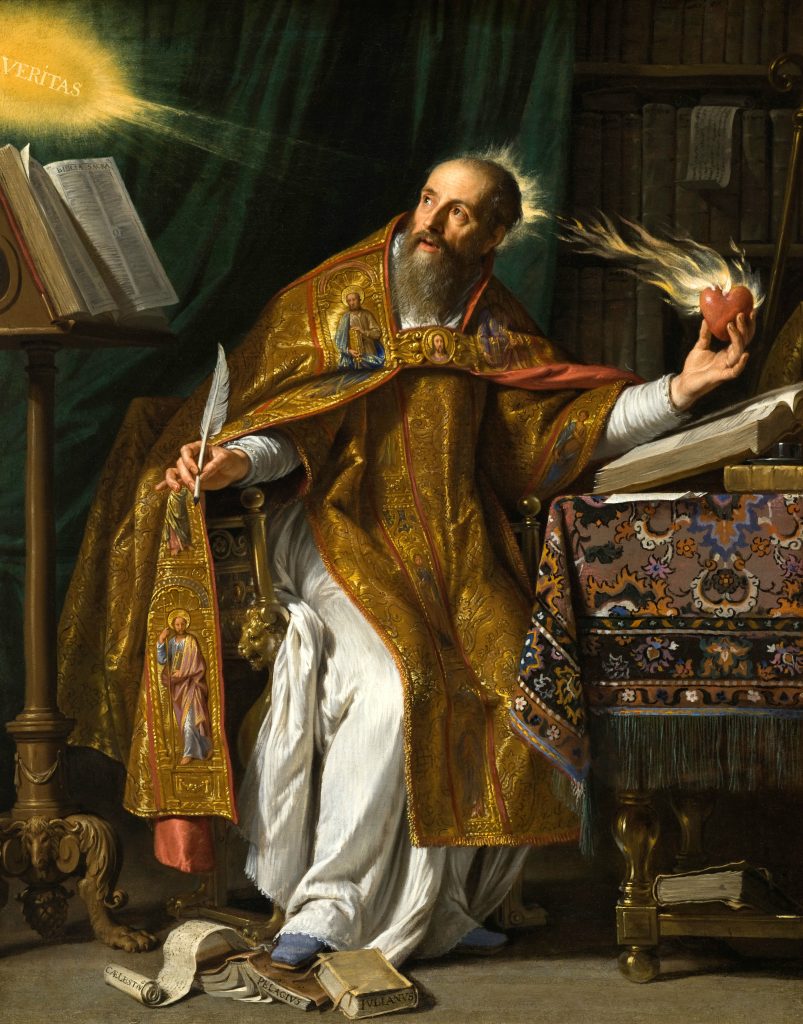
Years later, in The City of God, Augustine found the verse that gave the doctrine its enduring phrase. Quoting a psalm, he put it bluntly: slay them not. In this framework, the Jews’ tradition didn’t need standing on its own terms. Their defeat needed a living witness, because visible weakness was the proof. A subordinated, scattered people, still carrying the books that foretold Christ, was better evidence of God’s favor toward Christianity than any argument a theologian could construct from scratch.
The historian Jeremy Cohen, in Living Letters of the Law, has written the essential modern account of this doctrine and its long medieval afterlife.
Not every modern scholar reads Augustine’s motives the same way. Paula Fredriksen, a historian of ancient Christianity, argues in Augustine and the Jews that whatever the doctrine’s uncomfortable logic, Augustine’s purpose was protective, an attempt to steer Christians of his own time away from real violence against real Jewish communities. Both readings can be true at once.
That doctrine, whatever Augustine hoped it would prevent, is the one Cisneros was working from more than a thousand years later, though Castile had already broken half of it. Ten years before work on the Polyglot began, the Catholic Monarchs, Isabella of Castile and Ferdinand of Aragon, expelled every Jew in their kingdoms who refused baptism. That abandoned the doctrine’s oldest promise, that Jews were to be preserved. The Polyglot kept the other half: the Jews’ scripture as witness, set on the page with no Jewish community left in Castile to carry it. None of this theology was Cisneros’s invention. What he added in 1502 was the clearest picture of it anyone had made: a page you can’t read without seeing the hierarchy.
What was Castilian about it was the execution. Legal historians trace the same Augustinian reasoning into the Siete Partidas, the law code compiled around 1265 under Alfonso X of Castile. Its section on the Jews explains that Christian rulers allowed them to live among Christians as if in captivity, a standing reminder of the crucifixion. The code gained force of law in 1348 through the Ordenamiento de Alcalá, issued by Alfonso XI in this same town. By the time Cisneros designed his Bible, Castile had lived under that hierarchy, in writing, for a century and a half, on top of centuries of governing a religiously mixed peninsula where Arabic, Hebrew, and Latin all had practical uses.
Few places in Christian Europe had as many Christians who could read Hebrew as natives do, because so many of them were converts or the children of converts. Those families now supplied the scholars who could build the Polyglot. The theology was old. The skills to build it were local, the product of centuries of living with the religious mix Cisneros now arranged into a hierarchy.
The Scholars Who Built It
Antonio de Nebrija, Spain’s most respected humanist and the author of the first grammar of the Castilian language, took on the revision of the Latin. He wanted to correct Jerome’s text wherever it conflicted with the Hebrew or Greek originals, treating centuries of accumulated scribal error as fixable rather than sacred. Cisneros and the rest of the editorial team disagreed, and the finished Bible went to print with Nebrija’s corrections largely set aside.
This wasn’t the first time the question had put Nebrija in danger, and the earlier time nearly ended his career. In the first years of the century, while he was still teaching at Salamanca, the Inquisitor General, Diego de Deza, seized his notes on correcting the Vulgate against its original languages. Nebrija rewrote them from memory and published them. Deza opened proceedings against him, and the case went nowhere only because Cisneros succeeded Deza as Inquisitor General in 1507 and came to his defense.
Nebrija answered with a published defense of his right to correct the text, his Apologia. Cisneros had protected him from the Inquisition over the same question on which he later overruled him. Nebrija stayed on the Polyglot project regardless.
Nebrija is buried in the university’s own chapel, the Capilla de San Ildefonso. It opens only to guided visits, and how to book one is covered in “A Practical Guide to Visiting the University of Alcalá.”
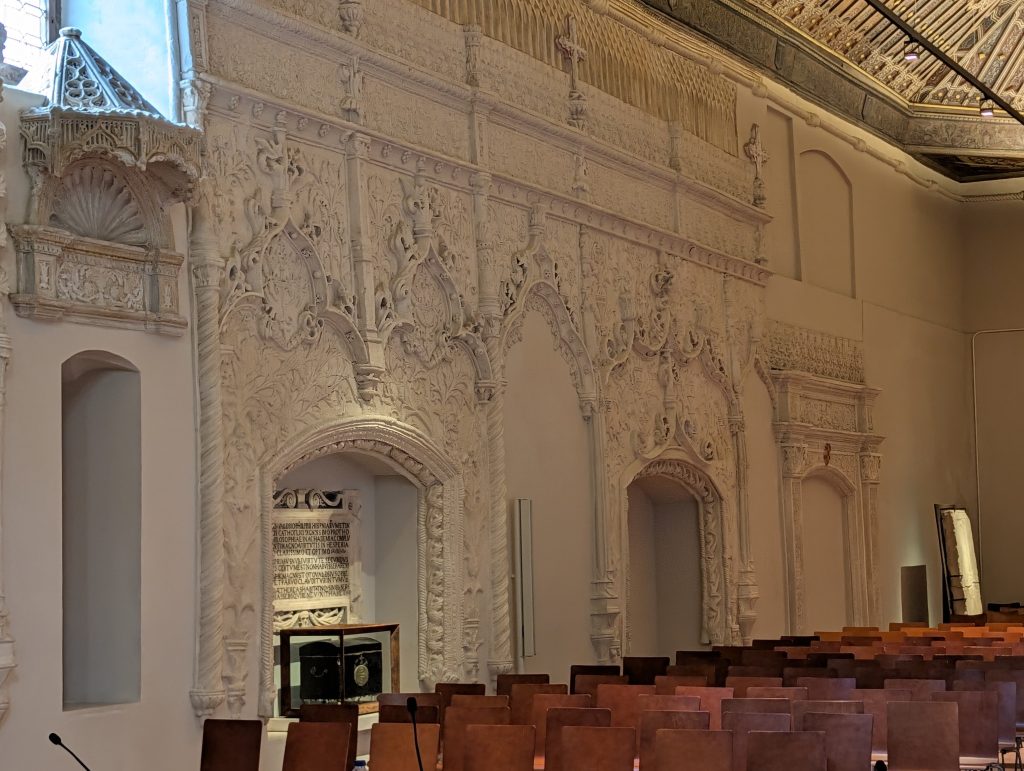
The Greek fell to a team that included Diego López de Zúñiga, Hernán Núñez de Toledo, known as the Comendador Griego, the Cretan scholar Demetrius Ducas, and Juan de Vergara. Vergara came from a converso family, and his brother Francisco later held the university’s chair of Greek. Juan himself served as Cisneros’s personal secretary, composed the epitaph on the cardinal’s tomb, and later supplied the notes Álvar Gómez de Castro drew on for his 1569 life of Cisneros.
That epitaph, and the boast it makes on Cisneros’s behalf, gets a closer reading in “The University He Never Saw.”
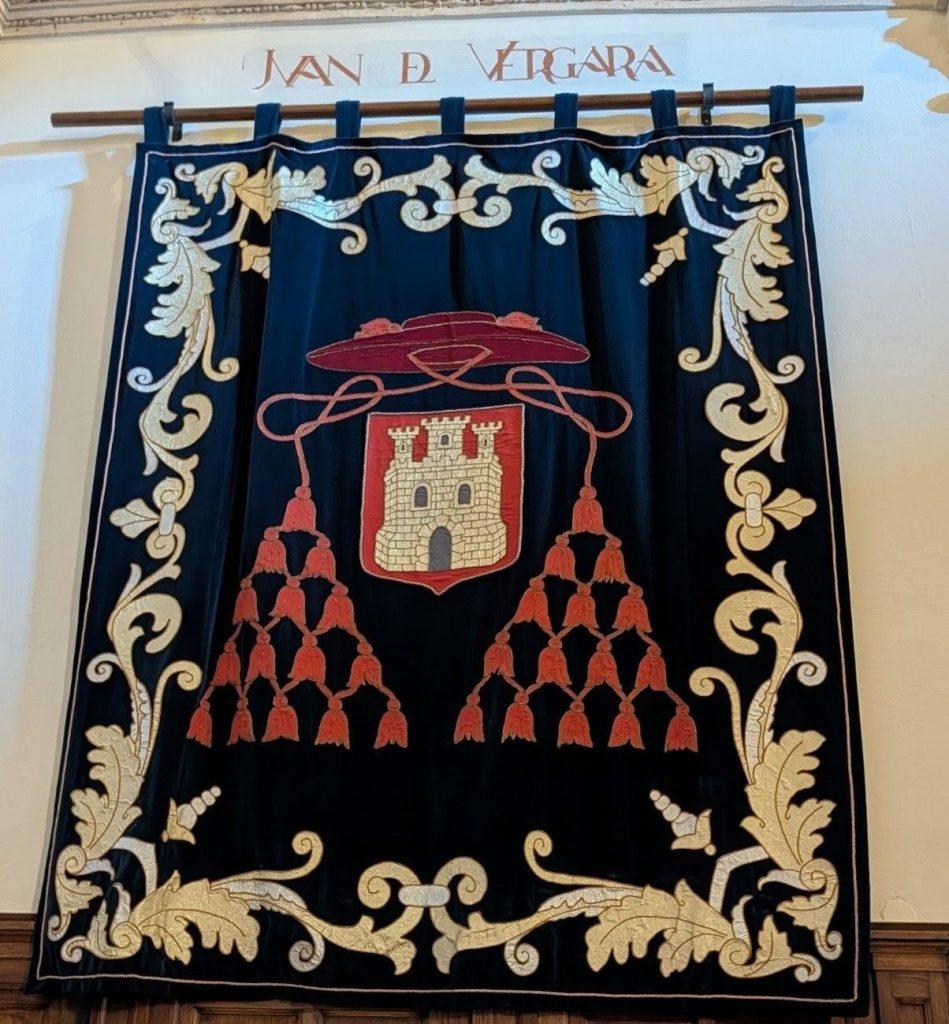
None of that protected Vergara. Spain’s Inquisition had grown suspicious of anyone who admired Erasmus of Rotterdam. Erasmus had criticized certain Church rituals and argued that inner faith mattered more than outward religious performance, and Spanish authorities heard that as dangerously close to what Luther was saying in Germany. They lumped Erasmus’s admirers together with the Alumbrados, a Spanish mystical movement, and with outright Lutheranism: three different things treated as a single threat. A phrase circulating across Europe captured the anxiety: Erasmus laid the egg that Luther hatched. Vergara was caught in it.
Sources disagree on when he was first detained, as early as 1530 or as late as 1533, but the end of the story is on record. He was made to recant publicly in an auto-da-fé at Toledo on December 21, 1535, fined fifteen hundred ducats, and confined the following January to the monastery of San Agustín. He wasn’t released until February 27, 1537.
The Hebrew and Aramaic work, the hardest and most specialized part of the undertaking, fell to three converso scholars: Alfonso de Zamora, Pablo Coronel, and Alfonso de Alcalá. Zamora, the son of a rabbi and a Hebrew speaker from birth, carried the main responsibility for the Hebrew column. Salamanca had let him teach Semitic languages but, by several accounts, would not give him a permanent chair because he was a convert. In 1512, with the Polyglot still years from finished, Alcalá made him its first professor of Hebrew, a post he held for more than thirty years. The university that gave him that post has its own history, from Cisneros’s founding to the neighbors who bought its empty buildings in 1850.
Building the Proof of Their Own Defeat
The doctrine of Jewish witness puts Zamora and his colleagues in a strange position. They weren’t hired despite the ideology behind the project. They were hired because the ideology needed their expertise to make its case convincingly: you cannot stage the Synagogue’s subordination in three parallel columns without someone who can render the Hebrew column correctly. Within a decade of the expulsion, converso scholars were using their fluency in the language of the faith they, or their parents, had left behind to help build the printed proof of that faith’s defeat. No one stumbled into that irony. The project could not have been finished without the people it was built to put in their place.
I don’t think that fact resolves into anything as tidy as a moral. It sits there. A cardinal who believed, sincerely and consistently, in a hierarchy more than a thousand years old built its clearest physical proof using the people his own theology placed furthest beneath him.