In December 1850, the people of Alcalá de Henares pooled their money and bought the empty buildings of the university their town had lost fourteen years earlier.
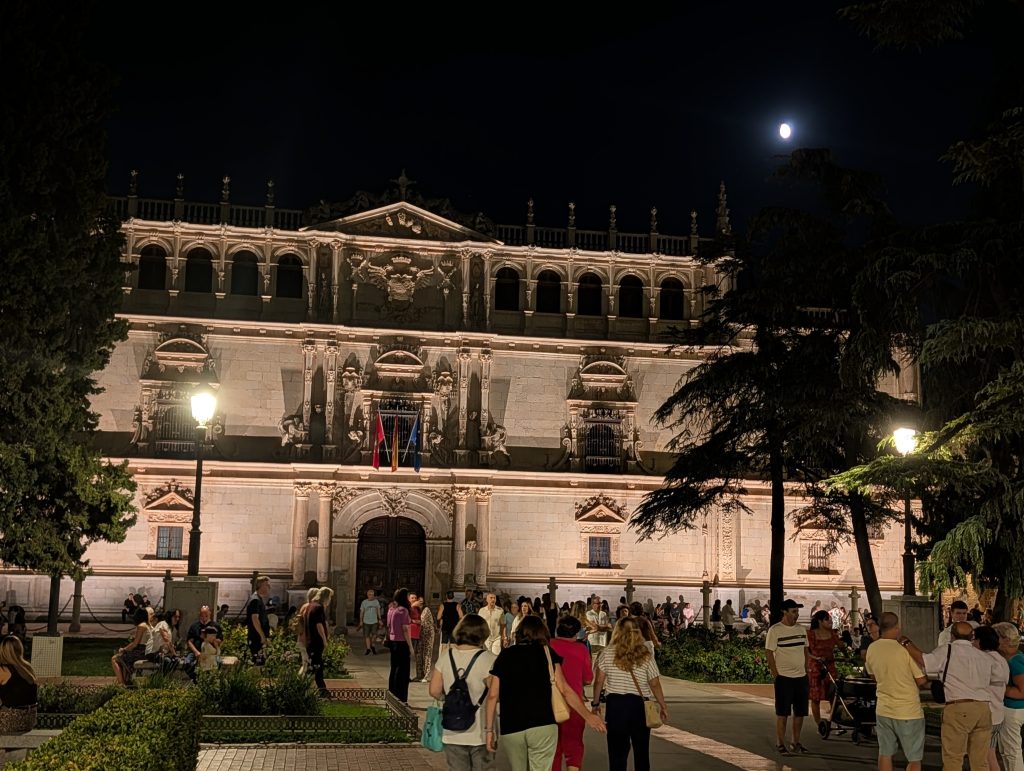
That university had been founded in 1499 by Francisco Jiménez de Cisneros, then Archbishop of Toledo and later a cardinal, and for more than three centuries the town had organized itself around it. A royal order took it to Madrid in 1836. The buildings stayed behind, and so, as it turned out, did the town’s attachment to them.
Cisneros built it in a medieval town still reeling from the 1492 expulsion of its Jewish community. The Catholic Monarchs, Isabella of Castile and Ferdinand of Aragon, had ordered that expulsion seven years before the founding, and it had removed the community that ran much of the town’s trade. The town’s historic center still orbits what he built there.
The Man Who Built It
Cisneros was not born with that name, and he was not born important. He was born Gonzalo in 1436, in Torrelaguna, a small Castilian town. His father was a hidalgo, from the lowest rung of the nobility, who made his living collecting taxes. Gonzalo trained in law at Salamanca, then spent years in Rome as a lawyer at the papal court, arguing cases before the pope and his cardinals sitting together in formal session. He came home with a papal letter of expectancy, a formal document reserving for him the next paid church post to fall vacant in his home region. It looked like routine paperwork. It would cost him six years of his life.
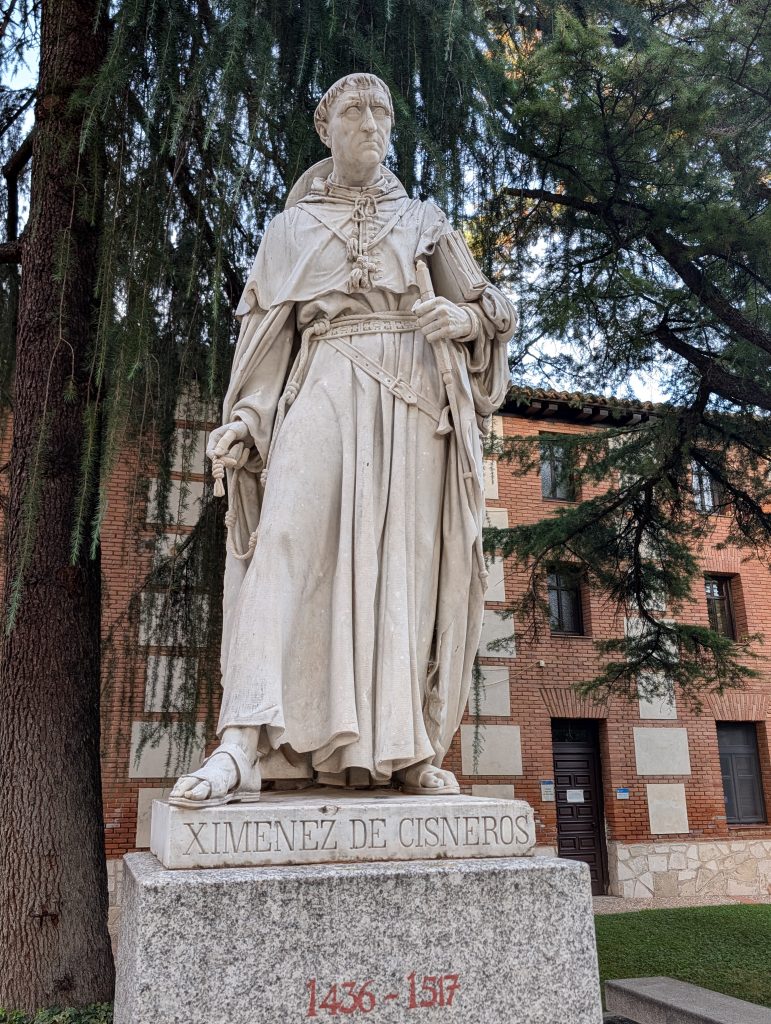
That letter turned out to be a weapon. When the archpriest’s post at Uceda became contestable, Cisneros used his standing claim to sue the man holding it, Pedro García de Guaza, over canonical irregularities. He won, backed by a papal ruling confirming him in the post. Alonso Carrillo, Archbishop of Toledo and the most powerful prelate in Castile, had wanted Uceda for his own favorite, and he had Cisneros thrown in prison for the maneuver: two years locked up in Uceda itself, then four more at Santorcaz, a prison reserved specifically for clergy who’d committed crimes. He came out in 1480, freed by the intervention of the Countess of Buendía.
He never renounced his claim, not once in six years. That single fact, more than any of his later titles, tells you what kind of man would go on to govern Castile twice as regent, while its kings were absent or dead: someone who would rather sit in a fortress than concede a point he believed was his.
Out of prison, he rose quickly, and under the right man: Pedro González de Mendoza, then Bishop of Sigüenza. Mendoza would later become Cardinal Archbishop of Toledo, and was known in his own time as “the third king of Spain,” one of the most powerful men in the country whatever his title said.
Then, in 1484, Cisneros walked away from all of it. Entering religious life was a normal, respected path for a man of his standing. The order he chose was not the comfortable one. The Franciscans had two branches. The Conventuals held property corporately, lived in substantial urban houses, and moved easily among wealthy patrons and political power. The Observants still enforced the poverty and manual labor the original 1223 Rule of Saint Francis had demanded. Cisneros chose the Observants, and changed his name to Francisco. For a while it looked like the story was over: a talented lawyer in his late forties disappears into a monastery to fast and pray.
It wasn’t a phase. In 1492, the same year she backed Columbus’s first voyage, Isabella made him her confessor, and he accepted on conditions he set himself: he’d walk everywhere with a single companion, take no palace rations beyond what his convent provided, and come to court only when specifically summoned.
Three years later the archbishopric of Toledo came open, the wealthiest and most powerful church post in Castile, and Isabella handed Cisneros the papal letter naming him to it with her own hands. He handed it straight back. This had to be a mistake, he told her, and left court altogether, making for Ocaña ahead of Holy Week. She sent men after him and had him brought back. He still refused, for six months, the queen of Castile waiting on one man too stubborn to take the second most powerful title in her kingdom. He gave in only on a condition of his own: the Crown had to drop its plan to split the archbishopric in two, a move that would have cut its territory and revenue roughly in half.
He took the title. He never took the life that came with it. He kept traveling on foot or on a donkey he called Benitillo. He wore a rough hair-shirt under his ceremonial robes and mended it himself. He ate bread and water at tables set for feasts, unfolded a camp bed each night instead of using the one his rank entitled him to, and slept less than four hours a night. Pope Alexander VI eventually had to write to him directly, reprimanding him for not living in the style his rank required. All of this, along with the countess who freed him, his rise under Mendoza, and the fine print of the Uceda lawsuit, comes down through his early biographers, not through anything the university’s own surviving records confirm.
By 1495 he was Archbishop of Toledo. By 1506 he was regent of Castile for the first time. By 1507 he was both a cardinal and Grand Inquisitor of Castile and León. Then, after Ferdinand died in January 1516, he was regent again, and this time, in practice, alone, holding Castile together for roughly twenty months while the Flemish court of the absent heir tried more than once to rein him in. Only in September 1517 did Ferdinand’s grandson and heir, a seventeen-year-old named Charles who had been raised in Flanders and had never yet set foot in Spain, arrive to take the throne as Charles I, the future Emperor Charles V.
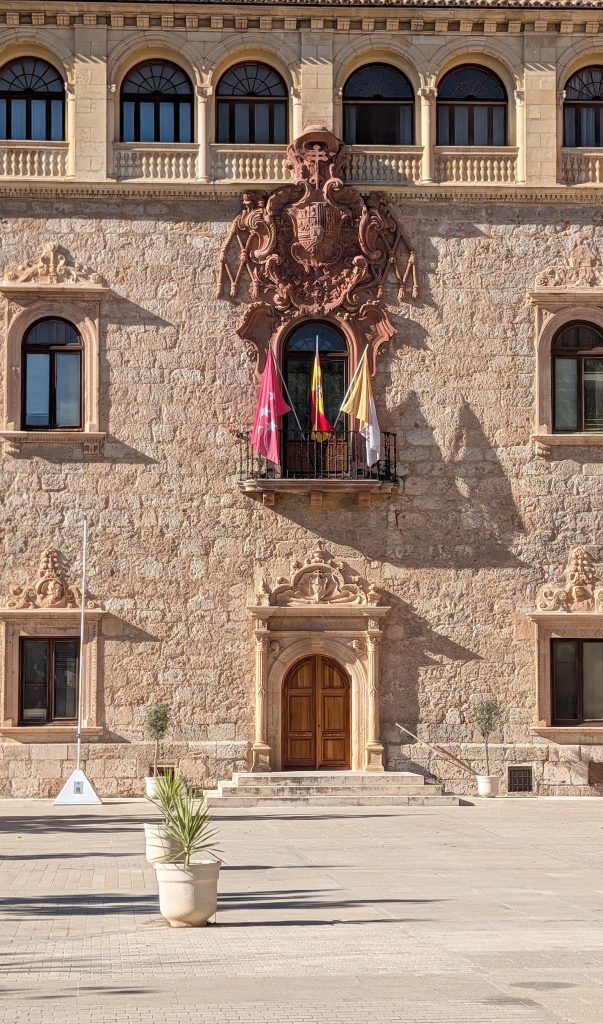
For the whole life in one book, Erika Rummel’s 1999 biography, Jiménez de Cisneros: On the Threshold of Spain’s Golden Age, remains the standard modern English-language account, covering his reform program, the Bible, and his political career in full.
Long before either regency, though, the archbishopric alone had given him more institutional power than almost anyone in the kingdom, and within four years he was using it to found a university on his own terms. Why not simply expand an existing one? Because Cisneros had opinions about what had gone wrong at the University of Salamanca, where he had studied law decades earlier. A loose federation of independently governed colleges left, in his view, too much room for the kind of self-governing chaos he wanted no part of. He also had opinions about what Salamanca taught: he forbade civil law at Alcalá entirely, permitting only enough canon law to support theology, steering the whole institution away from the legal careerism Salamanca was known for.
His university in Alcalá would answer to a single college instead, San Ildefonso: thirty-three members governing the entire institution, with several affiliated colleges beneath it, each assigned its own students and its own task. Every student had a place in the plan, down to the head count. Eighty students of Latin grammar, split between San Eugenio and San Isidoro. Forty-eight beginners in logic and philosophy at Santa Catalina and Santa Balbina. Eighteen theologians and six medical students at the Colegio de la Madre de Dios. Thirteen Franciscan friars studying theology at San Pedro y San Pablo. A rector, elected annually, ran the whole thing, one tightly controlled structure rather than a scattered collection of colleges each managing its own affairs.
He wanted more than a well-run college, though. He wanted the whole town rewritten around education and scholarship, streets and colleges laid out as a single plan, and that’s exactly what he got. UNESCO’s inscription describes Alcalá as the first city designed and built solely as the seat of a university, and as the model for the Civitas Dei, the ideal City of God that Spanish missionaries later carried to the Americas. This was a campus designed as a campus from the start, built to give scholarship room to happen undisturbed.
The buildings themselves, the façade, the tomb, and the courtyards, reward a slower look, and I read them one by one in “The University He Never Saw.”
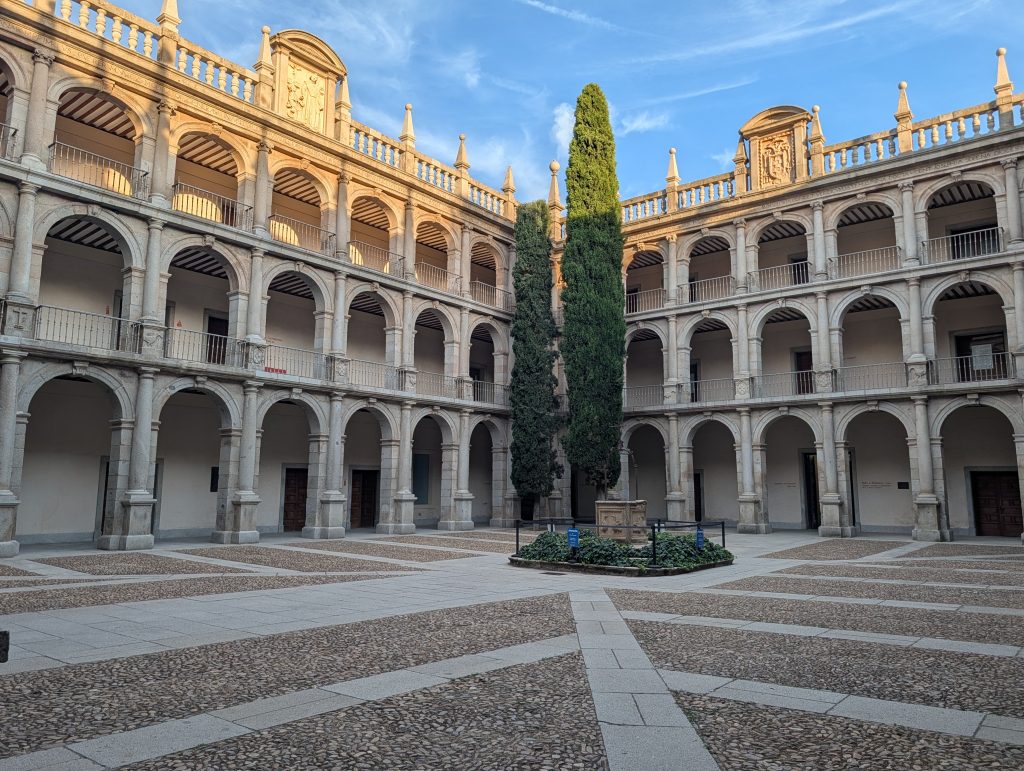
He wasn’t inventing the idea of a university. Europe had been arguing about what a university should be for three hundred years by the time Cisneros broke ground, and the Iberian kingdoms had a head start of their own, through the universities of Palencia and Salamanca. Alcalá itself had held a royal charter for a center of higher learning since 1293, though little survives of it beyond the charter itself. What made Alcalá different wasn’t the concept. It was designing one from scratch, on purpose, all at once, instead of letting it grow the way the older universities had grown, riot by riot, negotiation by negotiation, over centuries. That older, messier story is the subject of a later piece of its own, “The Idea Nobody Invented.”
While the university took shape, Cisneros was also busy elsewhere, using a completely different set of tools. Granada, the last Muslim kingdom on the Iberian Peninsula, had fallen to Castile seven years earlier. The same year Pope Alexander VI’s bull authorized the University of Alcalá, Cisneros traveled to Granada and overrode the city’s archbishop, replacing years of patient, gradual persuasion with forced conversions and burned manuscripts. In 1509 he went further: he organized a military campaign into North Africa, financed largely from the Toledo archbishopric’s revenues, and accompanied it as its Captain General into the conquered city of Oran. Coercion in Granada, then coercion again in Oran ten years later, the same faith targeted twice. An upcoming post, “Two Wars, One Argument,” tells that story in full.
Older biographers tended to read him as fundamentally split: a Renaissance humanist genuinely curious about Hebrew and Greek scholarship on one side, an Inquisitor who forced Granada’s Muslims to convert and burned their libraries on the other, two men sharing one body. Modern biographers have largely dropped that framing, and I’ve come to reject it entirely. He wasn’t torn. He was remarkably consistent, and the different pieces of his life, the university, the Bible, Granada, Oran, all point in the same direction once you stop expecting them to contradict each other.
What Made the University Radical
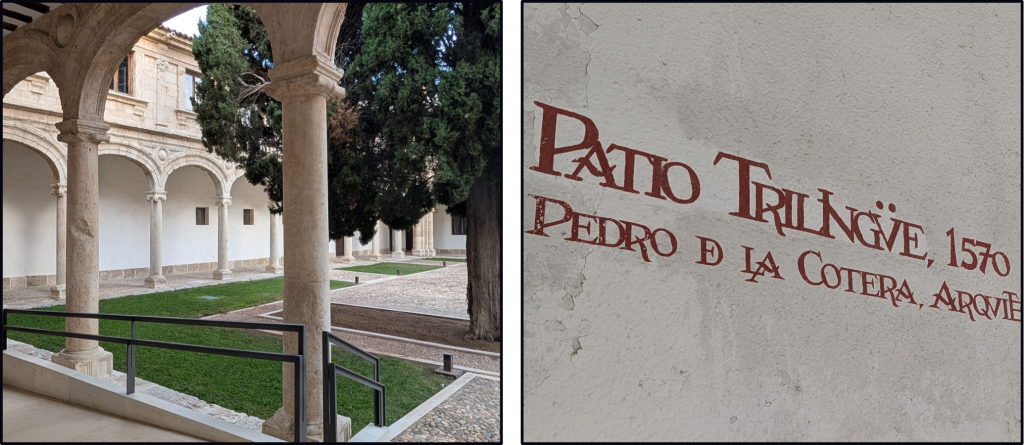
Eighteen years after the Catholic Monarchs expelled every Jew in their kingdoms who refused baptism, Cisneros wrote Hebrew into his university’s founding law. No single decision tells you more about what he believed. The 1510 constitution mandated a Trilingual College by name: a formal course of study in Latin, Greek, and Hebrew together. He had been buying books for it since 1496, three years before the papal bull that founded the university. It wasn’t a quick success. The college struggled for years to find teachers qualified to staff it, and didn’t reach its full working form until 1528, over a decade after Cisneros died. He conceived it, funded it, and wrote it into the university’s founding law. His successors made it real.
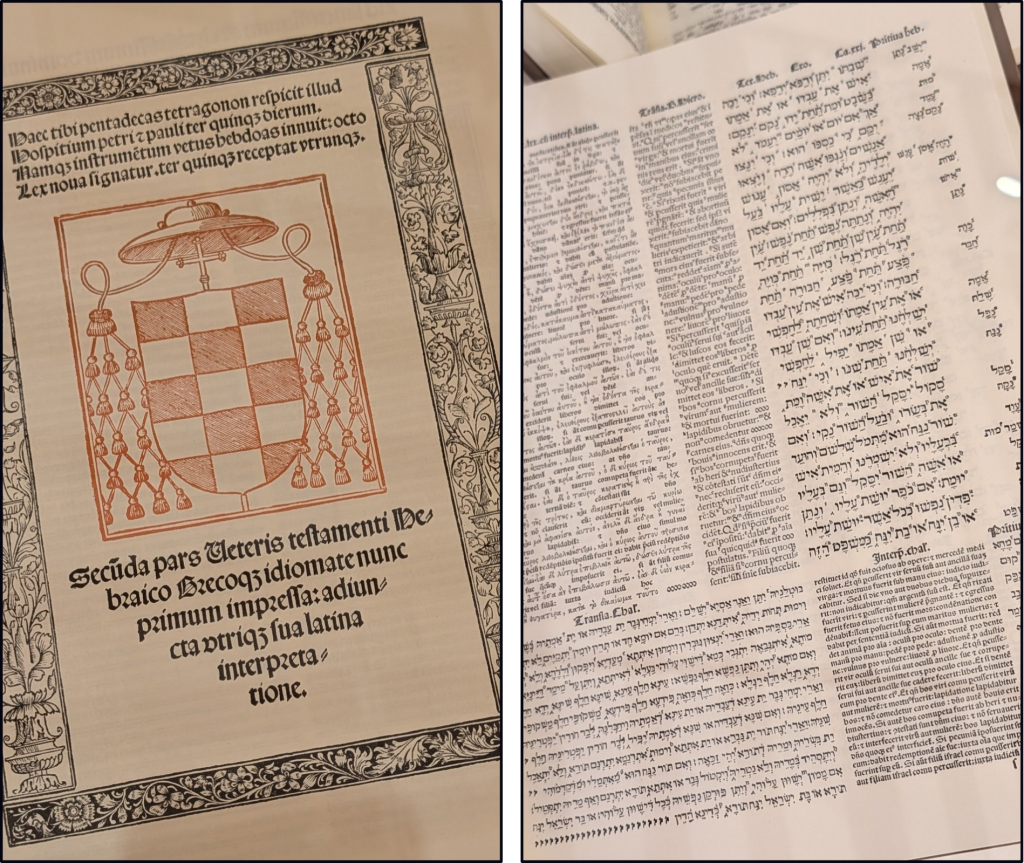
The university’s first major achievement wasn’t a graduate or a discovery. It was a Bible, the Complutensian Polyglot, assembled inside the university by scholars Cisneros installed there for exactly that purpose, and it grew out of the same commitment to the three languages. Six volumes: four of Old Testament, printed in parallel columns of Hebrew, Latin, and Greek, with an Aramaic translation along the foot of the Pentateuch; one of New Testament, in Greek and Latin; and a last volume of dictionaries and scholarly apparatus.
In his prologue, Cisneros explained the layout plainly: the Latin sat between the Hebrew and the Greek because it stood for the Roman Church between the Synagogue and the Eastern Church, the same as Christ hung between two thieves on Calvary. Why he thought that arrangement mattered, and what it costs to take him at his word, needs a post of its own, and a later one, “The Argument Built Into a Page,” gives it the room.
The Bible took fifteen years to finish, and Cisneros died only months after seeing it completed. He was spared what came next. According to a later letter from King Philip II, roughly four hundred and fifty of the six hundred sets printed went down with a ship bound for Italy around 1521, before they ever reached their intended readers. Roughly a hundred and twenty complete sets survive today.
Antonio de Nebrija, Spain’s most respected humanist, wanted to correct the Latin against the original languages, and Cisneros overruled him. The finished Bible went to print with Nebrija’s corrections mostly set aside, and Nebrija stayed on the project anyway. The Hebrew and Aramaic side was effectively run by Alfonso de Zamora, a converso scholar and Hebrew speaker from birth. In a kingdom that had expelled its Jews, the Hebrew of its most ambitious Bible lay, in practice, in a converso’s hands. In 1512 Zamora became the university’s first salaried Professor of Hebrew.
The university’s formal Latin name, Complutensis Universitas, comes from Complutum, the Roman city that once stood in this same stretch of the Henares valley, fifteen hundred years before Cisneros ever broke ground. His brand-new, deliberately planned institution took its name from a Roman settlement that had been laying out ordered, permanent streets nearby long before he arrived. Complutum itself, and what’s left of it to see, is a story for another post.
The city’s name carries a second layer entirely. Alcalá isn’t Latin or Spanish at all; it’s Arabic, from Al-Qal’at, “the castle,” a fortress built in the ninth century on the opposite bank of the river from where the university now stands. Its ruins are still there, a marked walking trail through what’s left of the walls and a single surviving tower, and they deserve a post of their own. Say the university’s full name out loud and you’re layering a Roman ghost over an Arabic one before Cisneros even enters the sentence.
The Golden Age and What Followed
For roughly two centuries the university held its own against Salamanca as one of Spain’s two great intellectual centers, in a town whose entire reason for existing was educating the people who filled it. Ignatius of Loyola arrived in 1526 to study theology and philosophy. He left within a year, investigated and briefly imprisoned on suspicion of being an Alumbrado, a Spanish mystic movement the Inquisition watched closely. This was more than a decade before he founded the Jesuits, and only a few years before Cisneros’s former secretary, the humanist Juan de Vergara, was detained by the Inquisition on strikingly similar suspicions.
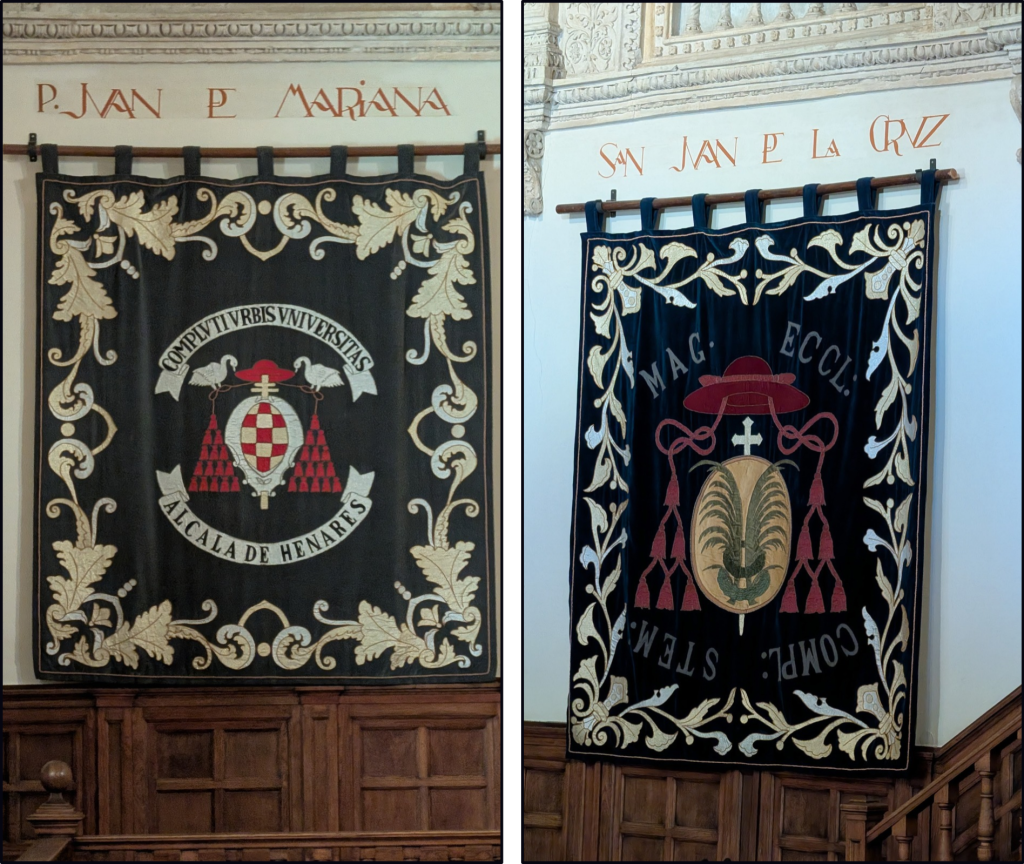
Nebrija was only the most famous name on a roster that kept growing through the century that followed: the theologian Domingo de Soto, the historian and political theorist Juan de Mariana, the mystic poet Saint John of the Cross, and the satirist Francisco de Quevedo all studied or taught within these same walls. Lope de Vega passed through in 1577 on his way to becoming Spain’s most prolific playwright.
That prestige didn’t last untouched. By the 1660s, San Ildefonso had fallen into corruption and disorder. In 1665 Philip IV, the reigning Habsburg king, sent a royal investigator to restructure it: the jurist García de Medrano, a judge on Castile’s Royal Council. Every other Spanish university facing similar decay in that century resisted reform; Alcalá was the only one the Crown forced into it. Medrano’s reform document runs to more than eighty separate titles governing everything from faculty appointments to chapel funds, and it is still held in Spain’s national historical archive.
By the eighteenth century, the university was choosing its rectors by lottery: four candidates’ names sealed in wax balls, drawn from a jar by the college chaplain with a long pin, without looking. The single-college structure had turned inward on itself again. Cisneros had designed it to keep control centralized. Instead it ran for the benefit of the people already inside it, not the university as a whole. Faculty chairs became close to hereditary through seniority and college connections. Pay grew lopsided enough to look absurd on paper: Alcalá’s senior theology professor earned under two thousand reales a year, against roughly nineteen thousand for the equivalent post at Salamanca.
The medical faculty came closest to collapse: its chairs in anatomy and surgery sat vacant for years at a stretch, and by mid-century nobody on the faculty could recall when an actual dissection had last taken place. Reform pressure did build, starting under Charles III in 1759, the Enlightenment-minded king who spent much of his reign modernizing Spain’s institutions, but three centuries of accumulated institutional habit weren’t undone in a decade.
Then, on October 29, 1836, a royal order from Queen Regent María Cristina shut the university down and moved everything to Madrid: faculty, library, legal existence. The order belonged to the broader ecclesiastical confiscations driven by the Liberal politician Juan Álvarez Mendizábal, a nationwide push that same year to strip property and power from church-linked institutions and centralize authority in Madrid. That program would have caught Alcalá regardless of its condition. What over a century of decline did was make it an easy target. By 1836 there was little institutional strength left to make the closure a genuine fight.
In Madrid it became the Literary University, then the Central University. The Complutense name went unused for well over a century, until 1970, when Madrid’s university took it back in reference to its Alcalá origins. That’s why one of Spain’s largest universities today is called Complutense even though it hasn’t been anywhere near Alcalá in almost two hundred years: same bloodline, different city. If that sounds confusing, it’s because it is, and nobody in Alcalá seems especially bothered by explaining it to you twice.
The library alone took over a decade to fully relocate, twenty thousand volumes eventually making the move to a new building on Madrid’s Calle San Bernardo in 1849. The buildings left behind fared worse before they fared better. At a public auction in November 1845, a buyer named Joaquín Alcober won most of the old complex, planning to turn San Ildefonso into a silk-spinning mill, plant mulberry trees for the silkworms, and demolish one of the colleges outright. The mill never happened. Alcober ceded his claim to a second buyer, Joaquín Cortés, who held the buildings for three years before selling them in April 1850 to Javier de Quinto, the Conde de Quinto, a politician close to the court.
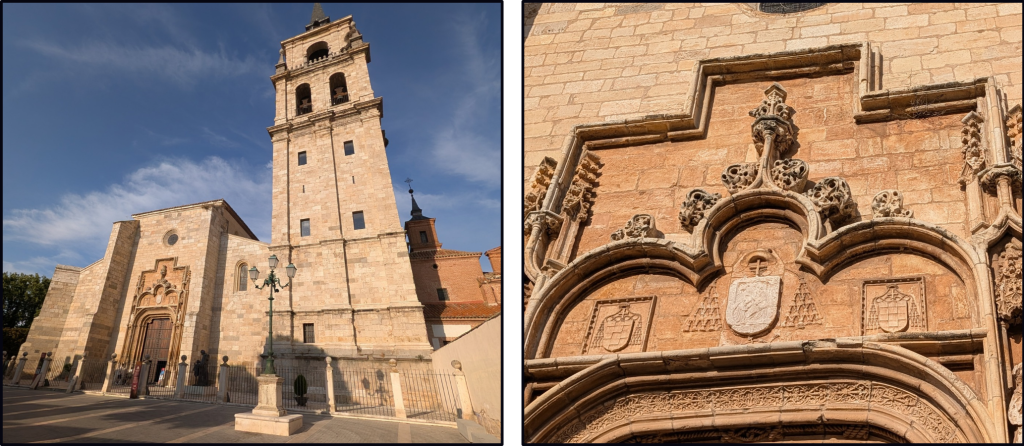
That October, the town moved Cisneros’s tomb and remains out of the chapel and into Alcalá’s principal church. Then Quinto set about taking the complex apart for what he could get from it: the chapel’s bells, cast from bronze cannons captured at Oran; the Trilingual College’s balustrade; the brick arch that carried a passage over the street to the house where Nebrija had lived; and paintings, altarpieces, and iron grilles. He had spent the previous three years directing the royal picture gallery that would become the Prado. Rumor had it he meant to take down the façade itself and rebuild it somewhere else.
It took ordinary residents of a town of barely seven thousand people to stop the bleeding. They raised ninety thousand reales, bought the buildings from Quinto on December 12, 1850, and on January 12, 1851, formally incorporated themselves as the Sociedad de Condueños, the Co-owners’ Society, before a notary in Alcalá itself. If you’re looking for the single most Alcalá detail in this whole story, that’s it: not a cardinal, not a king, but a neighborhood that decided the buildings belonged to everyone and paid, out of their own pockets, to make that true.
The Society’s founding members included former university professors and lawyers standing alongside bricklayers and carpenters, ordinary tradespeople next to professionals, some of whom couldn’t even sign their own names on the incorporation papers. Roughly nine hundred shares were issued at the start; something like three hundred are still held today.
Buying the buildings back didn’t mean they were safe yet. Spain’s Cavalry Academy moved into the complex not long after the Society formed, and an inspection with engineers found the place in genuine ruin: doors lying on the floor, windows with no glass left in them, the structure itself on the edge of collapse. The rescue had kept the buildings from being lost outright. It hadn’t yet made them whole.
What happened over the century that followed is the part I like telling people, because it complicates the sad-decline story you’d expect. The buildings didn’t simply sit empty, rotting, for nearly a century and a half. Some were deliberately kept vacant, held in trust for a university that might one day return. Others went to practical use entirely: one former convent church became a women’s prison in 1883, then a men’s prison, before the University of Alcalá finally reopened it as a theater in 1978. UNESCO’s assessment of the site notes that many of the old colleges were pressed into continuous use as barracks, prisons, and administrative offices, and that this constant attention, whether occupied or deliberately watched over, is precisely why so much survived intact. Neglected buildings decay. Buildings someone is actively looking after, occupied or not, tend to get a roof repaired when it leaks.
None of that meant the danger was over for good, though. Spain’s nomination dossier to UNESCO admits that the worst damage came later, in the 1960s and 70s, when municipal ordinances let developers raise and realign buildings for extra height. The pressure behind it was real: industrial immigration multiplied Alcalá’s population sixfold across those two decades, and the city needed somewhere to put everyone.
The historic center won formal protection in 1968, but that didn’t end things immediately. The specific ordinances allowing the height increases were approved that same September, and stayed in force for seven more years, until 1975, because the city couldn’t agree on a general plan to replace them. Even winning protection on paper took years to mean anything on the ground. Looting and ruin hadn’t finished off the university’s buildings; zoning came close to finishing off the streets around them.
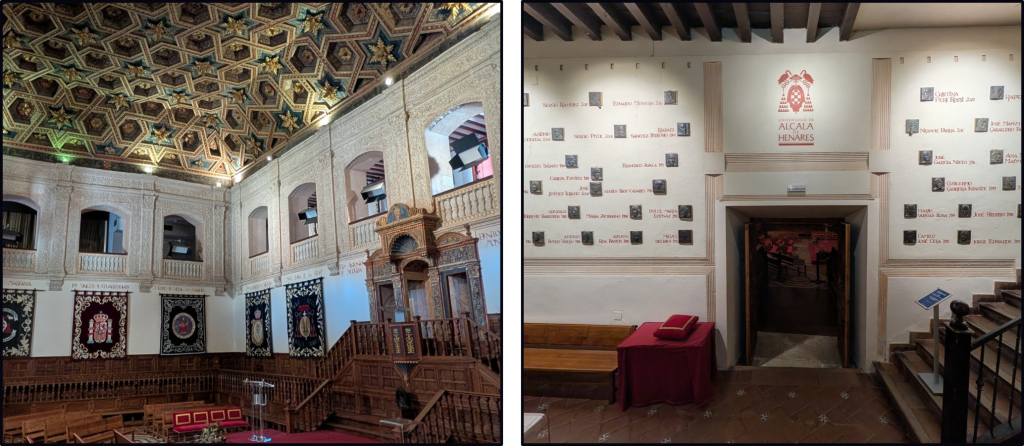
The modern University of Alcalá opened in 1977, a new institution in very old buildings. Only in January 1985 did the Convenio Multidepartamental bring the national ministries of education, culture, and public works, the regional, provincial, and city governments, and the university itself into a single agreement. It consolidated the scattered buildings under university control and began their restoration. UNESCO named the historic university precinct a World Heritage Site in 1998. You can walk into much of it today, though the Paraninfo, the university’s ceremonial hall, and the university’s chapel open only to guided visits; if you’re planning to see it for yourself, the practical side, from booking a tour to choosing a guide, has its own dedicated post.
Whatever else Cisneros was, the hall he commissioned for the university’s public ceremonies, finished only after his death, is still used for exactly that. Every April 23rd, the Paraninfo hosts the Cervantes Prize, Spanish letters’ highest honor, under the same coffered ceiling, five centuries on.